
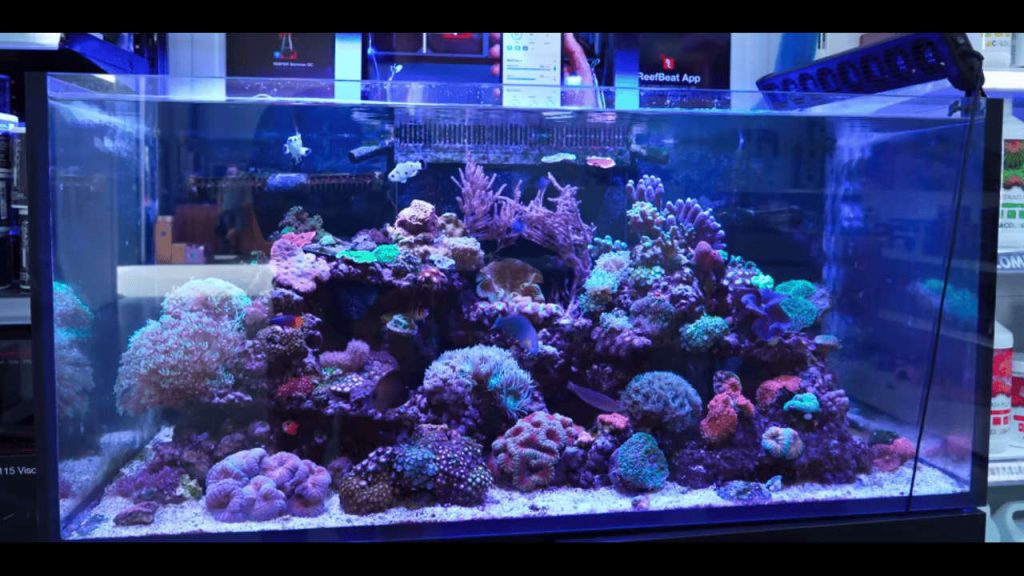
I recommend a fish-only-with-rock or basic reef setup to all first-timers rather than jumping into complicated reef aquariums right away. The general size range for a beginner’s aquarium is 20-40 gallons since it assures a better overall stability than smaller tanks and does not lead to unnecessary complications of caring for it. Small tanks work well, but the salinity and water chemistry change very quickly.
In case you are just searching for beginner saltwater aquarium setup information, I want to share my guide on the decisions that I would make in this order: choose the tank type, pay for required equipment only, create an aquascaping design, mix water correctly, cycle the tank without fish, and be patient with adding fish and controlling water parameters.
Start With the Type of Saltwater Aquarium
Prior to choosing a tank, light, filter, or fish, I try to decide what type of aquarium I want. That single decision influences everything else that comes after that.
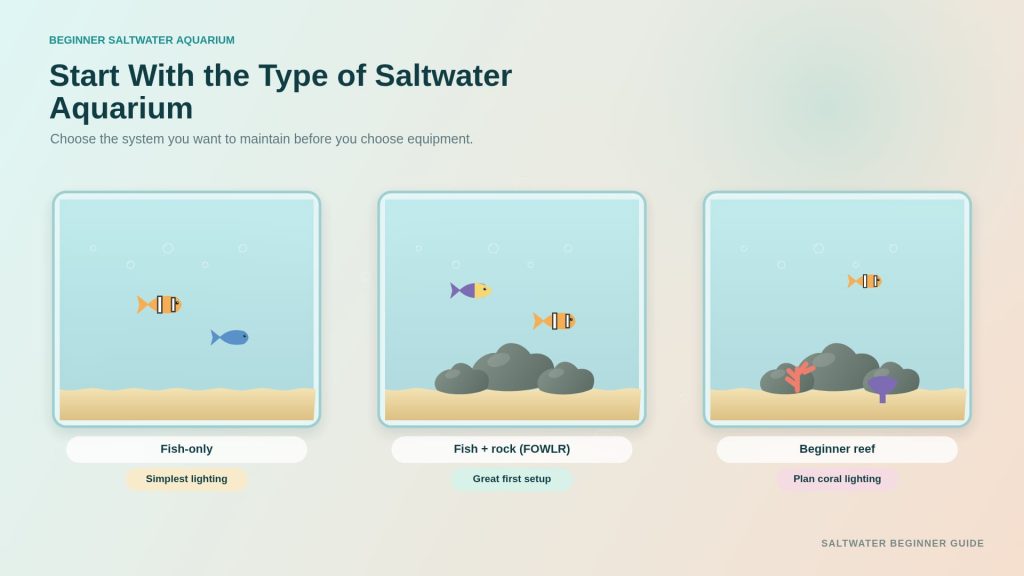
A fish-only saltwater aquarium contains marine fish but no corals. This simplest option to consider is appropriate if the focus is solely on the fish. Simple lighting is possible, but biological filtration, water movement, temperature control, and water quality must still be taken into account.
A fish-only-with-rock setup (FOWLR for short) is the next step in adding porous rock to provide a habitat and surface area for helpful bacteria. Many novice aquarists find this option very suitable for saltwater fish tanks, as it provides both hiding places for fish and natural-looking aquascapes.
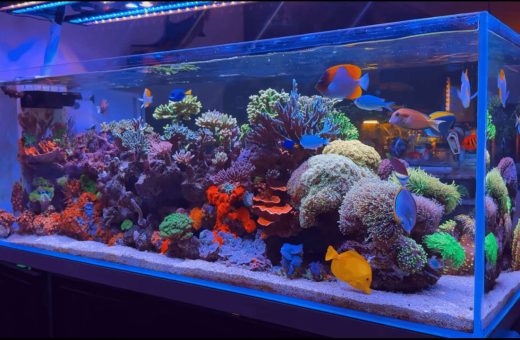
A reef aquarium is one that contains corals. Reef systems can be created by beginners, as they require special reef light and some additional chemistry, given that corals have their own requirements. Fish-only ones and reef systems differ in terms of equipment and chemistry requirements, particularly with regard to lighting and trace elements.
My typical advice is to plan for the aquarium you will need six months into the future. If you know that you want corals, investing in a tank that comes with a good lighting system that is right for corals and designing the tank layout accordingly will save you time and money later.
Choose a Beginner-Friendly Tank Size
A small tank seems easier because it occupies less space and consumes less water; however, in reality, small aquariums leave less margin for errors. Even a minor amount of evaporation can increase the salinity significantly. Even missing a single feeding results in rapid levels of ammonia rising. A heater malfunction will also change the water temperature faster.
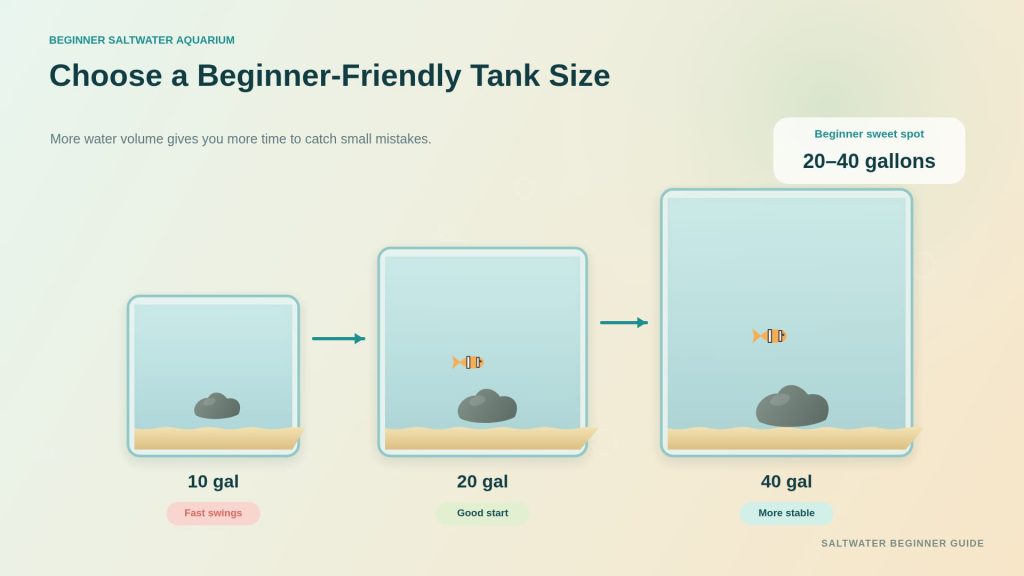
For a first marine aquarium for beginners, I believe that the tank should be big enough to allow for diluting errors while still being accessible. A tank with a capacity between 40 gallons is a reasonable choice for a beginner, as it makes marine tank maintenance easier.
The configuration matters. I prefer a tank that is deep enough from front to back rather than tall from bottom to top. More depth means more possibilities in terms of the construction of the tank together with the provision of enough space for fish to swim and corals to be put at different levels of illumination.
The stand needs to be fabricated in such a way that it could hold the regular aquarium. I will install it in such a way as to ensure stability and minimize the influence of any external factors; for instance, direct sunlight and heating vents are to be avoided.
Essential Equipment for a Beginner Saltwater Tank
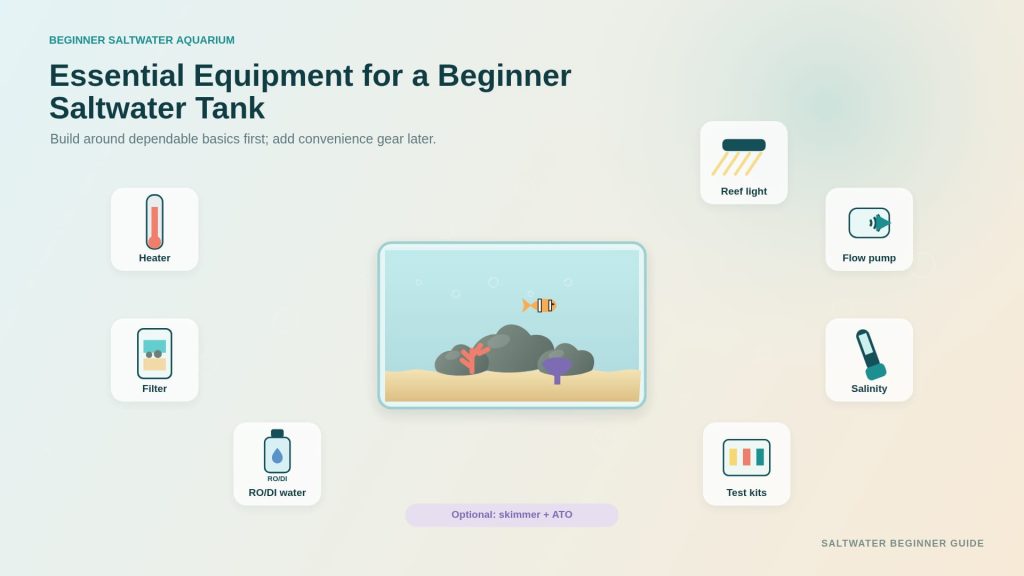
I divide equipment into two categories based on whether the items are needed for the survival of the fish or for easier aquarium management.
Tank, Stand, and Filtration
An aquarium and stand form a basis of a good system. It is good to have a starter aquarium kit from a well-known company that provides for all the plumbing and filtration, not a must.
As for filtration, you can use any type of filtration system, be it a simple hang-on-back filter, an all-in-one rear compartment, or a sump that is the correct size. The idea is not to get the most complicated one. I hope for reliable mechanical filtration and enough space for active filtration if needed.
The porous rocks are essential components of natural biological filtering. When they are properly able to seed and cycle, the dry rocks are just as good as the live rocks, which add to the filter beneficial bacteria or organisms that can be used in processing.
Heater and Thermometer
The marine fish and corals demand the required temperature range in the tropics. For that reason, the heater is duly matched with the fish tank size, and the temperatures are measured by another thermometer.
Thus, most tropical marines require a stable temperature around 78°F. Consistency is better than constantly adjusting the heater trying to reach the perfect amount.
Water Movement
The saltwater aquarium alteration needs more moving water than many filters can provide. It can be done by the powerhead or circulation pump, which sends the oxygenated water through the rocks and helps to reduce dead zones and take the waste.
The guidelines for beginner fishkeeping are consistent in stating that water movement can be added to the list of essential equipment rather than left as an option.
Reef Lighting
Fish are not so reliant on reef lights, but the corals are.
If I had to create a reef tank, I would buy an LED light dedicated to coral instead of decorative aquarium lighting. With the inverter, I would also think about the size of the tank and the type of fish to put in it.
RO/DI Water and Marine Salt Mix
Source water is one of the simplest places to avoid dealing with problems.
Using distilled or reverse osmosis water is a good way to control the amount and composition of water in the aquarium. It gets rid of some minerals, nutrients, and pollutants that are available in water from the sink. Source water is recommended in many starting reef tank guides because the constant composition of water also makes solving problems easier.
I mix marine salt with freshwater in a container but keep the water separate until it has been circulated and its salinity has been measured.
I make sure to not refill lost volumes of water using saltwater because water tends to evaporate while salt stays where it is.
Refractometer or Salinity Meter
Salinity is a very significant reading to keep track of in any marine tank, particularly if it is your first one.
The natural seawater contains a salinity of about 35 parts of salt per thousand, which translates into approximately 1.026 specific gravity if measured in a typical way in aquariums.
The device I choose for the salinity measurement is a reliable salinity meter or a calibrated refractometer. In any case, I perform a proper calibration before taking measurements, and I measure in the same way every time I do it.
Test Kits
During cycling, my critical measurements include ammonia, nitrite, and nitrate as well. Besides these tests, I pay attention to salinity, temperature, and pH.
When corals are introduced into the tank, the need for measuring alkalinity increases. As coral start demanding more, calcium, magnesium, nitrate, and phosphate also become more meaningful.
I would rather have a small collection of test kits that I can use with confidence than have a huge amount of testers.
Useful Upgrades
A protein skimmer is a helpful tool to remove organic substances from the water of the saltwater tank. However, I don’t think it is a necessity to have in a beginner’s aquarium system.
An automatic top-off is another useful additional piece of equipment because it provides the evaporation of freshwater from the aquarium and allows maintenance of the stable salinity levels of the tank.
Protein skimmers and automatic top-off systems have become commonplace to hear about when referring to the necessary equipment for beginner aquarists.
Build the Tank in the Right Order
When setting up a beginner aquarium system, it is important to follow a sequence. Doing so eliminates the risk of having to redo everything as well as the temptation to set up the aquarium and add fish before it is finished.
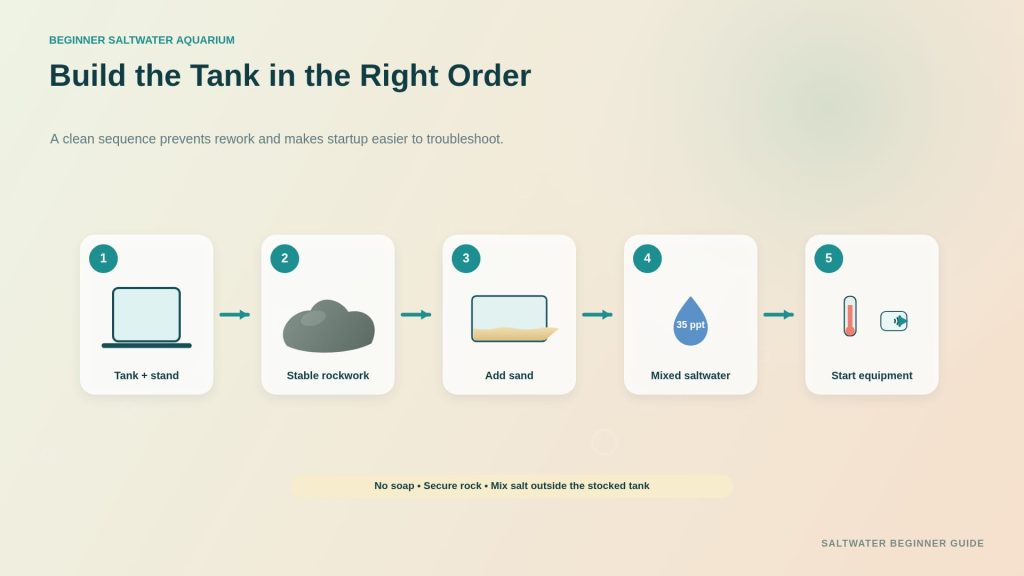
Prepare the Tank and Rockwork
I only clean new aquariums with water and never use any cleaning detergents in the process. Then I move on to planning the aquascape before it would be impossible to work in the aquarium.
I make rock structures considering the factors of stability. The fishes will use the caves, opaque places, and obstacles in their way now, but I will also leave room for swimming and cleaning.
I prohibit myself from setting heavy stones haphazardly onto a bed of unstable sand. The construction must be strong enough to withstand slight disturbances caused by the aquarium inhabitants, including a snail or burrowing fish as well as my hand. Many marine aquarists encourage building stones on solid foundations.
Add Sand Without Creating a Detritus Trap
Aragonite sand is popular amongst aquarists. I use enough of it to provide the scenery I need and the environment I want to create before I am forced to keep a deep bed I did not ask for.
Fine sand looks very natural, but its strong currents have a tendency to shift it. Because of that, it is easier to deal with coarser sands.
Live sand will bring the beneficial bacteria, whereas dry sand is good enough for a well-seeded and cycled setup. The main thing is to make sure that biological filtration works, not to check whether all the surfaces are alive.
Mix and Add Saltwater
To begin with, I have purified freshwater. After adding marine salt according to the instruction from the manufacturer, I will circulate the freshwater until it is mixed well and measure the salinity.
Instead of pouring dry salt directly in an aquarium with animals, I prefer to slowly adjust the salinity.
For the average reef-style aquarium, my target salinity is about 35 ppt or 1.026 specific gravity.
Once I have filled the tank with the water, I then start the heater. Along with that, I start the filter or the return pump and the water circulation pumps. I check that there are no leaks, surface movements are ok, and the temperature is stable.
Cycle the Aquarium Before Adding Fish
The cycling phase is actually one of the most important phases in the setup of the saltwater fish aquarium.
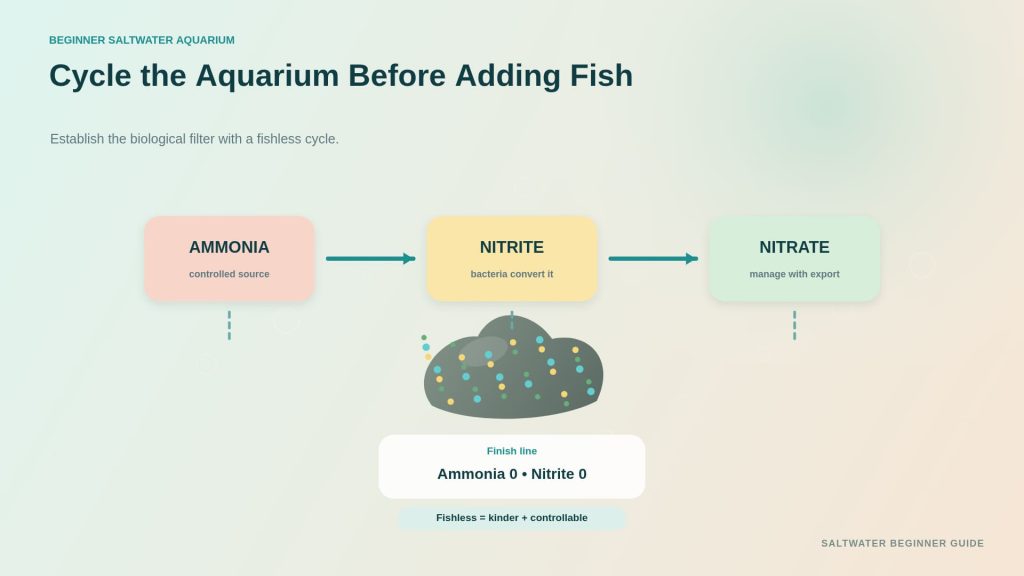
The biological filter needs to host quite a lot of microorganisms that can process ammonia due to the animal’s waste and decomposed organic matter.
I use the fishless cycle method. There is no point in exposing a live fish to ammonia in order to establish a biological filtration process. A Manitoba ammonia source in combination with suitable nitrifying bacteria provides a much more conscientious approach.
During cycling, I keep an eye on the ammonia and nitrite levels in my tank and observe how efficiently the system deals with its nitrogen source.
Although cycling can last a few weeks, I never call a tank ready just because the weeks have elapsed. Some beginner sources state that cycling lasts 2-4 weeks but point out that the duration may be influenced by the types and numbers of bacteria and biological filtration.
My definition of the end of the cycling process is when the aquarium has the capability to process the ammonia added to the system without leaving ammonia or nitrite in measurable quantities behind.
Once my ammonia levels are under control, I will pay attention to nitrates using water changes and multiple nutrient export techniques afterward.
After the cycling process is complete, I will perform a water change, check for the salinity and the temperature again, and slowly start stocking the new aquarium.
Keep the First Water Parameters Simple
Many beginners with saltwater tanks make their lives more difficult than necessary by testing everything and responding to all small changes.
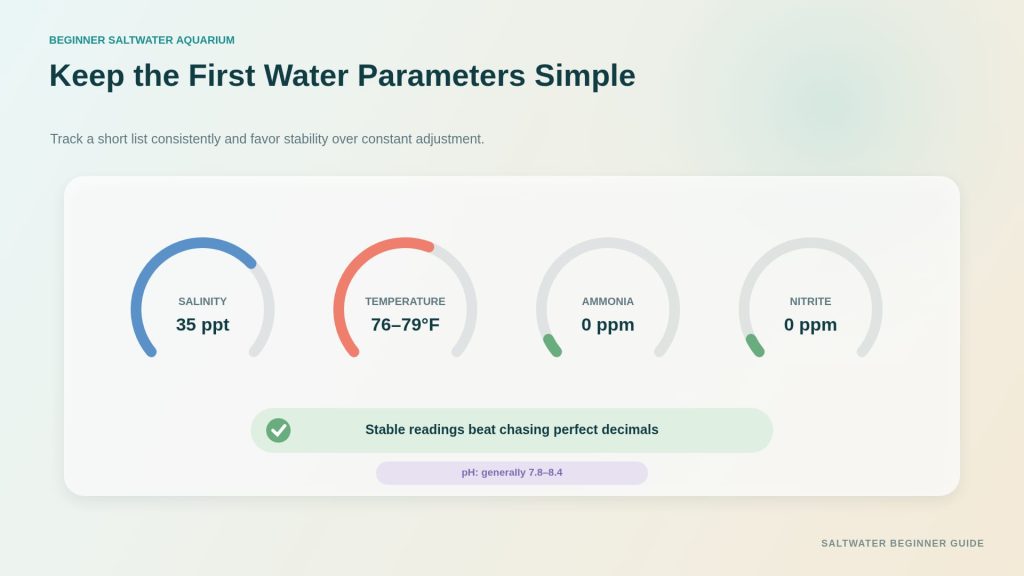
In my case, I choose to test just a few things and achieve some level of understanding of the ongoing processes.
| Parameter | Practical Beginner Target |
| Salinity | About 35 ppt / 1.025–1.026 SG |
| Temperature | Roughly 76–79°F for many tropical marine tanks |
| Ammonia | 0 ppm after cycling |
| Nitrite | 0 ppm after cycling |
| Nitrate | Low and controlled; avoid large upward trends |
| pH | Generally around 7.8–8.4, with stability favored |
| Alkalinity in reef tanks | Keep stable within the chosen salt mix and coral-care range |
I won’t try to “adjust” any figure unless I understand the origins, trust the measurement, and genuinely need to make an adjustment.
Sometimes rapid changes can cause greater stress to marine species than a stable yet incorrect reading. Therefore, I pay a lot of attention to uniformity rather than looking for an ideal reading each time.
Add Beginner Saltwater Fish Slowly
The top beginner fish aren’t merely those species that manage to live through dangerous conditions.
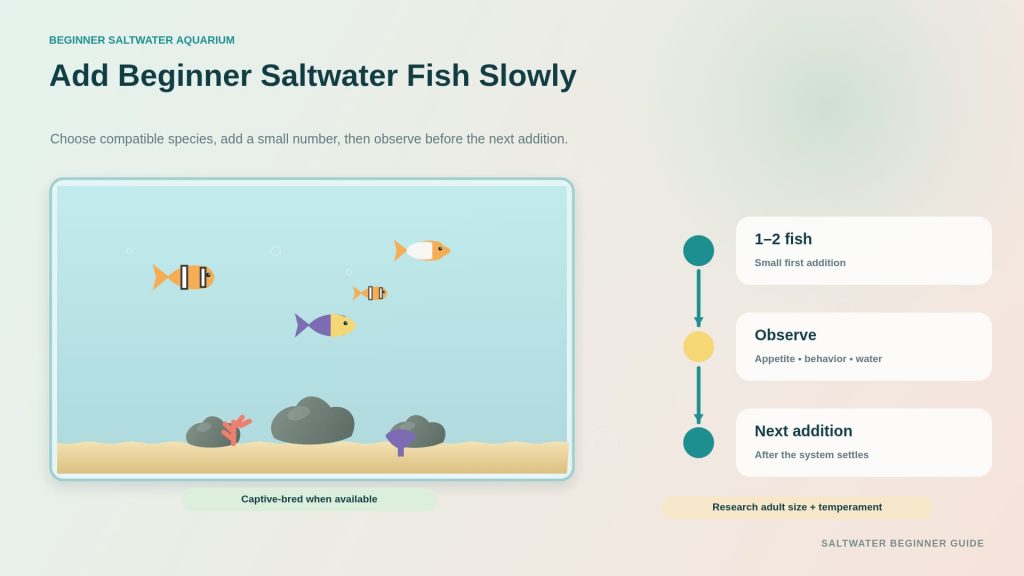
I’m looking for fish that are suitable for their future adult size, easily accept food available in captivity, are able to live in the standard conditions of captivity, and are compatible with the temperament of the mixed community.
The good fish to start keeping a marine aquarium include the following varieties:
- Ocellaris or percula clownfish—a hardy fish that is usually bred in captivity and can hardly be fed properly.
- Royal gramma—a bright fish that can fit in the peaceful community if a good shelter is provided.
- Firefish—an undemanding fish that I keep under the lid since it is a good jumper.
- Neon gobies and some other suitable small gobies—small fish suitable for modest aquaria.
- Pajama cardinalfish—a calm and easy-to-feed fish.
It is the advantage of captive-bred fish that makes them appealing for someone just starting in the hobby because they are already adapted to live in captivity. The present-day recommendation for beginners also includes captive-bred fish wherever possible.
I never stock the aquarium with all the fish at once.
What I do is to add a few fish at a time and see how the aquarium is doing after that and how the biological filter is coping with the task before adding more fish. It is recommended to leave about a fortnight between the batches of fish.
Compatibility is as important as the hardiness.
Some damselfish may be quite resilient, but they can sometimes become aggressive. Some wrasses can show aggression and require a significantly larger aquarium than expected, judging by their current size.
I make sure to check the adult size of the fish, its feeding habits, its behavior in the aquarium, and whether it can live with other fish before purchasing any marine fish.
Use Quarantine as Insurance
Finding out that a new fish brought a parasite into your beautiful display aquarium is a nightmare.
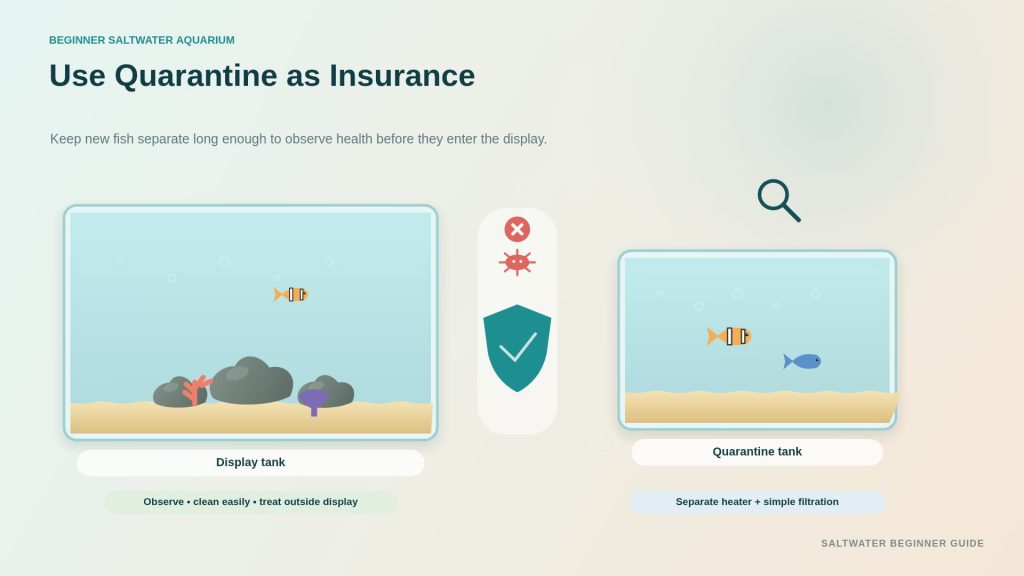
For this reason, I always make sure to quarantine all new fish before placing them into the main tank.
This quarantine tank does not have to be fancy: just a regular good-sized bare aquarium, heater and cover, a basic filter, and some non-reactive hiding places where I can keep an eye on the ammonia level in the water.
The aim is not to replicate the display aquarium, as we are trying to make it easy to monitor the situation, clean, and treat the fish if required.
Quarantining fish can greatly reduce the chances of sending parasites and diseases into the display aquarium, where it becomes much more difficult to treat the fish later.
I also tend to avoid using medicines in the main aquarium casually, as some medications can be ok for fish but can be extremely dangerous for other live creatures in the tank.
Add Beginner Corals Only After Stability
Using coral in the setup of a saltwater aquarium is not mandatory because you can still have a successful aquarium without it. However, if you plan to make a reef tank, the addition of corals can take place only when the aquarium is cycled. Additionally, the livestock must be healthy and the parameters must remain stable.
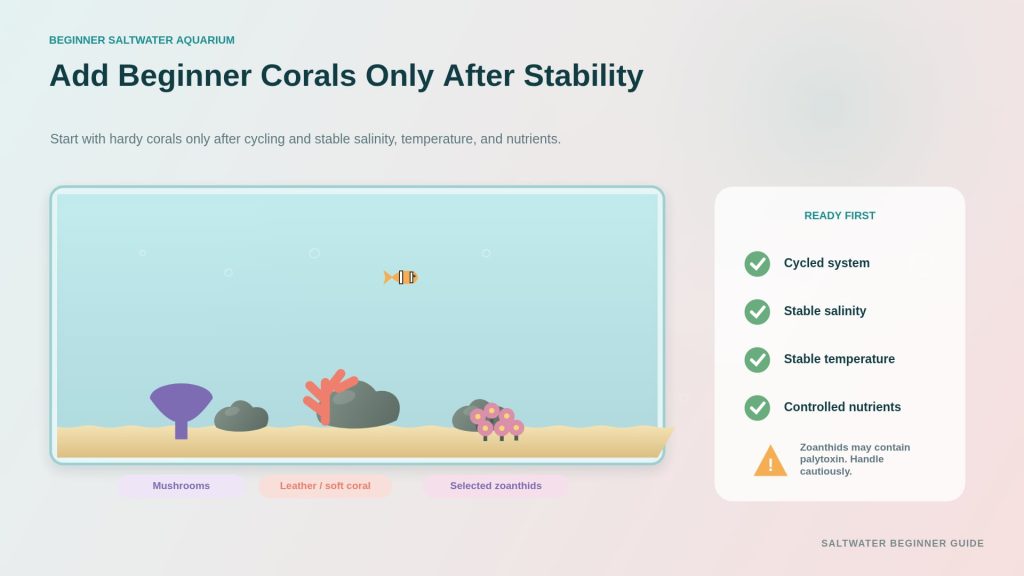
While reviewing beginner corals that can fit into a saltwater aquarium, I tend to begin with mushrooms and leather corals along with some species of zoanthids and other resilient soft corals.
In addition to that, it is possible to work with some large stony corals when proper knowledge of alkalinity and lighting is acquired.
I never think of beginner corals as corals that can be neglected. Each species of coral needs appropriate lighting, water chemistry, and water movement.
I always have extreme caution while working with zoanthids and Palythoa-like colonies because some may contain palytoxin. Depending on how you interact with them, you may be exposed to the poison through skin contact, eyes, or inhaled aerosols.
Fast-growing corals require planning as well.
For instance, green star polyps can rapidly grow across all parts of the aquarium décor, so to enjoy their movement and colors without turning them loose in the whole aquarium, it would be necessary to use a separate rock.
Feed for Health Without Feeding the Filter
Overfeeding is among the quickest methods to make a new saltwater aquarium difficult to maintain.
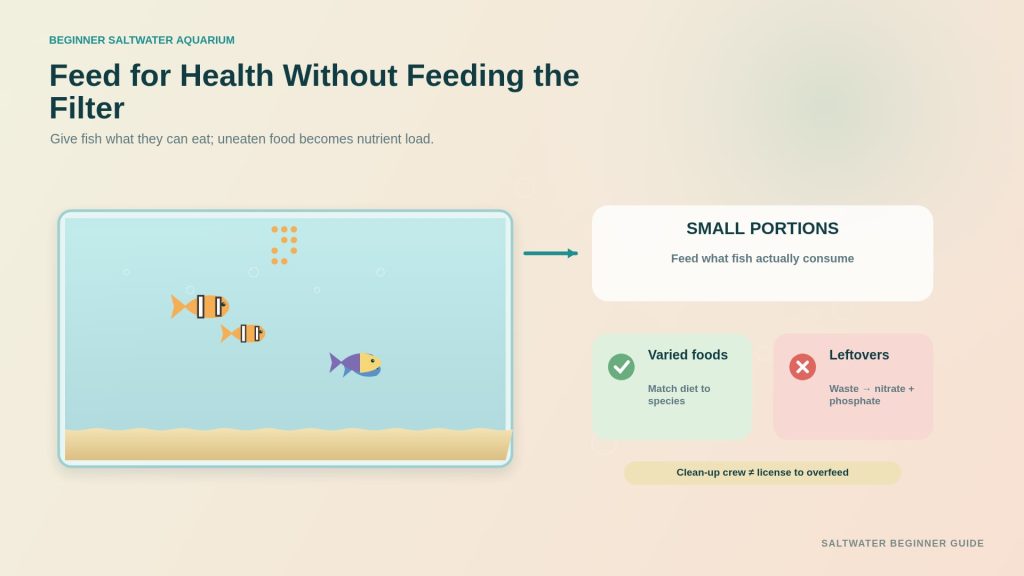
Uneaten food does not just vanish; it becomes part of the nutritive load and contributes to detritus, nitrate, phosphate, and algae growth.
I am giving specific portions to the fish and adjusting them according to their physical condition and feeding response in order to be sure that every portion is consumed.
In terms of food, I prefer giving various types of food rather than relying on one type of food forever. The way the menu looks depends on the fish, as herbivorous, omnivorous, and planktivorous fish have different requirements in terms of nutrition.
When there are shy fish present, I ensure they get the food directly without whiting out the whole aquarium until some portion of food gets to them.
A suitable clean-up team may assist with algae grazing and leftover handling, but there is no replacement for regulated feedings and routine maintenance.
Follow a Repeatable Maintenance Routine
A novice saltwater tank becomes much more manageable once the maintenance has become more monotonous rather than unpredictable.
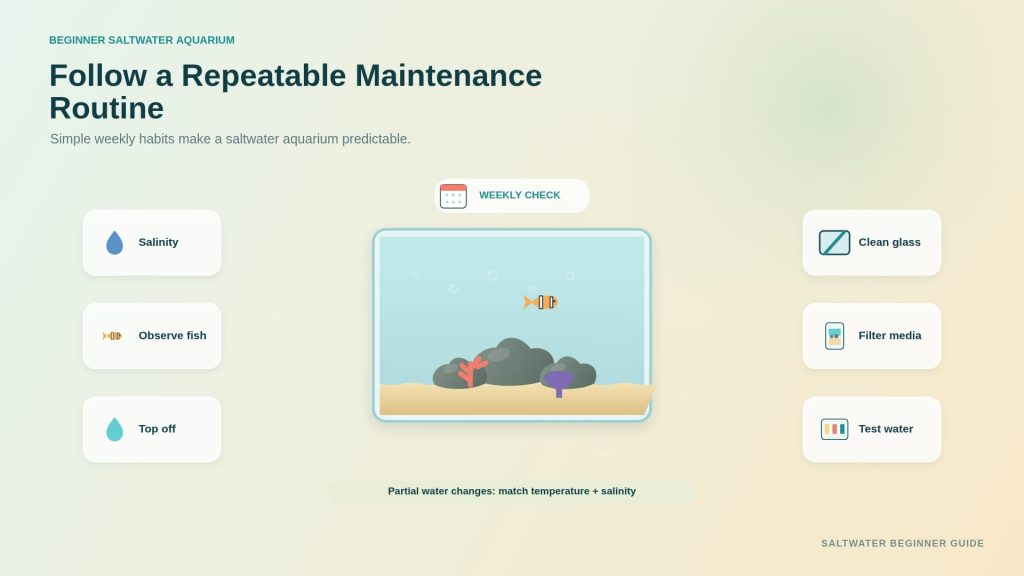
My weekly tasks are easy:
- Check for the temperature and salinity.
- Observe the condition of the fish and their appetite, breathing, coloring, and behavior.
- Clean the glass; the frequency of the process is determined by the cleanliness of the panes.
- Perform maintenance on the filters to prevent accumulation of decomposing waste.
- Test the parameters, depending on age and livestock species.
- Remove every visible bit of detritus and other undesirable algae.
- Replenish the evaporated water with fresh.
- Check all appliances for their performance.
For many aquariums regular water changes are essential.
Water changes in saltwater aquariums help to get rid of the old nutrients while introducing new ones through adding the salt mix. Before making the replacement water, I try to match both the temperature and salinity of the water closely enough to keep variations at bay.
As the aquarium ages, I adjust the frequency of testing to the correct stability level of the aquarium.
New systems are appropriately monitored. Aquariums that have been used for some time have their parameters under control, and trend behavior can be focused on instead of taking individual readings all the time. This trend approach is used these days by all novice aquarists.
Avoid the Mistakes That Make Saltwater Feel Difficult
Most common first tank problems are not any kind of mystery. Usually, they happen because of unnecessary speed or instability.
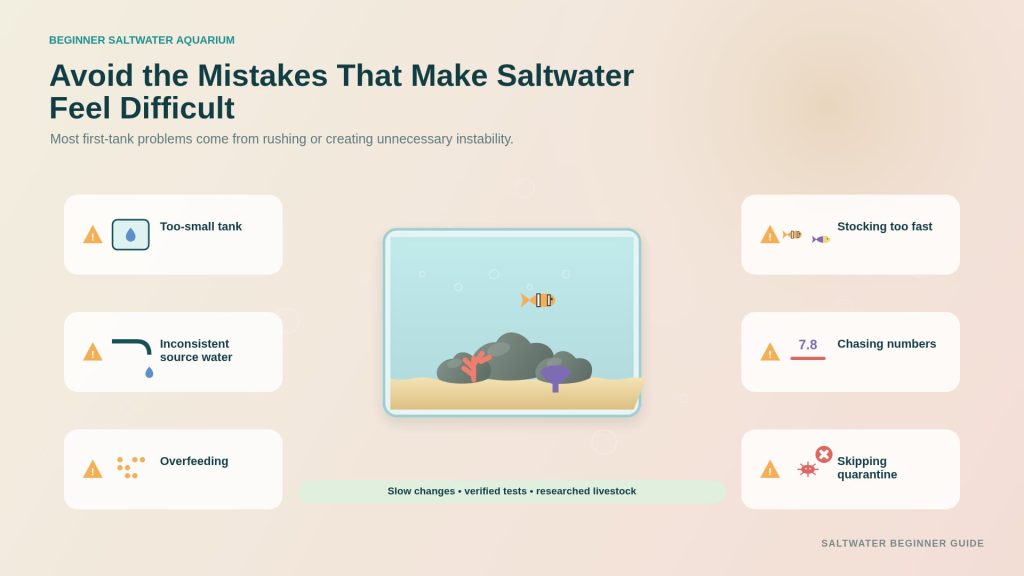
Starting with a small aquarium. Nano aquariums are nice, but their chemical makeup can change too fast. A larger volume of water will give the aquarist more options.
Using various sources of water. Purified source water eliminates many variables before they get to the tank, where every parameter is examined.
Cycling the tank with live fish. I cycle my tank without fish, allowing the biological filter to develop without putting live fish at risk.
Putting too many fish in the tank at once. Fish population increases biological load and affects the social structure of the tank, thus taking more time for stocking.
Overfeeding. Too much food turned into waste eventually.
Leaving the reef lights running for extended periods or at full power. Recently manufactured rock does not need high reef illumination throughout the day. I gradually increase the levels of light available to the coral and adjust the photoperiod accordingly.
Paying too much attention to numbers. I confirm the reading, analyze the reasons for it, and take necessary steps. Throwing chemicals doesn’t help.
Neglecting evaporation. Evaporation results in loss of water and doesn’t let any salts go. If top-off is not being done regularly, the salinity will rise.
Not performing the quarantine process. Preventing the disease from entering the tank is much easier than removing all fish from the mature reef for treatment.
Buying livestock without getting to know their adult habits. The small fish found in the store can become too large, aggressive, and incompatible with corals.
A Simple Beginner Marine Tank Blueprint
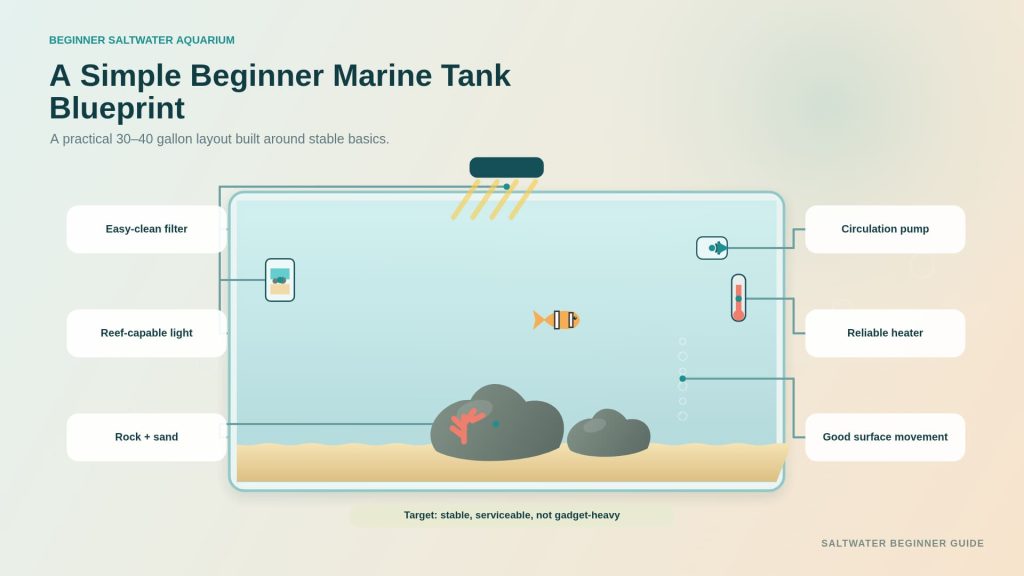
When I am asked to design an easy saltwater tank for beginners, I like to keep the design simple:
- A 30- to 40-gallon aquarium or similar all-in-one system
- An aquarium-approved level stand
- Seashells, rock, caves, and swimming space
- An appropriate sand bed
- A reliable heater and thermometer
- A filter or a back chamber that is easily serviced
- A circulation pump or two depending on the layout
- RO/DI water and a good quality marine salt mix
- A calibrated refractometer or salinity meter
- Setting up ammonia, nitrites, nitrates, and pH testing during the start-up
- Reef-capable LED lights only if corals are in the plan
- Optional protein skimmer depending on the biological load
- Optional automatic top-off device for more control over salinity
It is preferable that a novice aquarist invest in tried-and-tested principles, proper measurements, healthy aquatic animals, and adequate maintenance, rather than spend money on devices that are meant to solve problems that do not exist.
The ultimate beginner’s guide to saltwater aquariums teaches the values of patience.
Make the proper setup once only and let nature do its job. Be slow with your stocking in order to monitor your fish properly. Keep both the salinity and the temperature within acceptable limits, as well as make necessary changes in small amounts so that you know what you have done.
Saltwater aquariums become less scary if you stop treating them as something that requires chemical treatment and start seeing them as a developing ecosystem.
Quick answers
Frequently asked questions
Is a saltwater fish tank appropriate for a beginner?
Definitely. A saltwater fish tank can be easy for beginners if they establish their aquariums with stable water, proper equipment, fishless cycling, slow stocking, and reasonable maintenance. New all-in-one systems and the breeding of marine fish in captive conditions made things much easier.
What is the best saltwater tank size for a beginner?
A beginner should ideally buy a tank of 20 to 40 gallons because it is manageable. I would recommend that beginners go for a tank from the higher end of this range.
What do you need first when setting up a saltwater aquarium for the first time?
The first thing you need when setting up a saltwater aquarium is a tank with a stand, filtration, heater, thermometer, circulation pump, water, marine salt mix, salinity measuring instrument, rocks, and necessary test kits as well. If you plan on adding corals, you may need the special reef lighting.
How long should one wait to cycle a saltwater aquarium?
The cycling process can take anywhere in the range of a few weeks, and while there are numerous sources specifying a time frame of two to four weeks, I gauge the process based on water quality test results rather than time passed. Indeed, the biological filter must process all ammonia without any ammonia or nitrite left in the water after processing.
What is the recommended level of salinity to use in an aquarium by a novice hobbyist?
For a standard reef-style aquarium, I strive to achieve about 35 ppt salinity, which is roughly equal to 1.026 specific gravity. However, I would say that tuning the instruments properly to achieve the required measurement is as important as the optimal salinity.
Is it ok to use tap water for the saltwater aquarium?
The chemical composition of tap water varies from place to place and can change with time. I personally prefer RO/DI water for my novice saltwater aquarium since it gives me a cleaner basis for mixing saltwater and compensating for the loss of water due to evaporation.
Is it essential for a beginner's saltwater aquarium to use a protein skimmer?
Not necessarily. Protein skimmers are useful, but many fish tanks can function normally even if one is not employed. In deciding whether to use one, take into consideration tank volume, type of filtration, number and types of fish, frequency of feeding, and maintenance performed on the aquarium.
Are live rocks required for first-time saltwater fish tanks?
Live rocks are not obligatory, but the fish tank must have a biological filtration operation, whether or not it is caused by live rocks. While live rocks contain organisms and bacteria, dry rocks can work also if they receive proper treatment.
What is the best fish species to start with in a saltwater tank?
I think it is possible to start with captive-bred clownfish, royal grammas, firefish, some gobies, and pajama cardinal fish, provided the fish sizes and species are compatible with the size of the tank. I also make sure I carry out research on each species of fish prior to putting it in the aquarium.
How many fish can be added at once?
I usually add a small batch and see how the system reacts before adding more. Taking a break of around two weeks between small additions allows the biological filtration system to process the additional organic waste as well as provide me with time to figure out potential compatibility and health issues.
When can a beginner add corals into the saltwater aquarium?
I usually wait for the aquarium to be completely cycled and on its way to demonstrating a stable level of salinity, temperature, and other basic checks before adding corals. When adding corals, I go for the hardy types of coral species that are good in the current light and flow conditions rather than just the visually attractive ones.
How often should water be changed in beginner saltwater tanks?
Following a proper routine of partial water changes is more important than sticking to one universal percentage of water changes. Many beginners opt for the changes every week or every two weeks but learn to adjust their water change frequency to the established levels of nutrients, fish population, feeding habits, coral requirements, and overall stability.
Are marine aquariums more complex than freshwater aquariums for a beginner?
Marine aquariums have some different requirements from freshwater aquariums, particularly when it comes to salinity. Marine fish also are much less forgiving in terms of chemical fluctuations within the aquarium. However, once one learns about mixing saltwater, checking salinity, topping off the tank, feeding the fish, and maintaining the aquarium, running the aquarium becomes fairly easy.
What do most beginners do wrong with a saltwater aquarium?
The biggest mistake of beginners with saltwater aquariums is that they are rushing. They introduce fish before the filtration system is ready, they put too many fish too soon in the aquarium, they do everything too quickly regarding chemicals, and they switch equipment all the time. What I believe is that it is better to achieve stability first and only then let the system run and mature.
Can I create a saltwater tank now and add corals later?
Definitely! Starting as a fish-only-with-rock aquarium and later adding corals is a good choice for a beginner aquarist. If creating a coral reef is the aim, I always buy reef-friendly fish and have financial possibilities for putting in proper lights and carrying out appropriate tests.

About the author
Ethan Cole
My name is Ethan Cole, and I have been a writer on saltwater aquariums and reef tanks for over eleven years. My work essentially deals with practical aspects of reef-keeping, such as keeping marine fish and corals; the use of live rocks, protein skimmers, and understanding filtration; analyzing water quality; and performing routine maintenance of an aquarium. I write for aquarists looking for easy-to-understand answers as well as those looking for practical advice.
Reader Fishkeeping Feedback
Comments, questions, and aquarium reviews
Share your aquarium experience, ask a fish care question, or write a helpful note about tank setup, water quality, filters, algae control, or maintenance for other readers.
No aquarium reviews yet. Be the first to share a helpful review on content or fishkeeping question, setup tip, or care experience.