
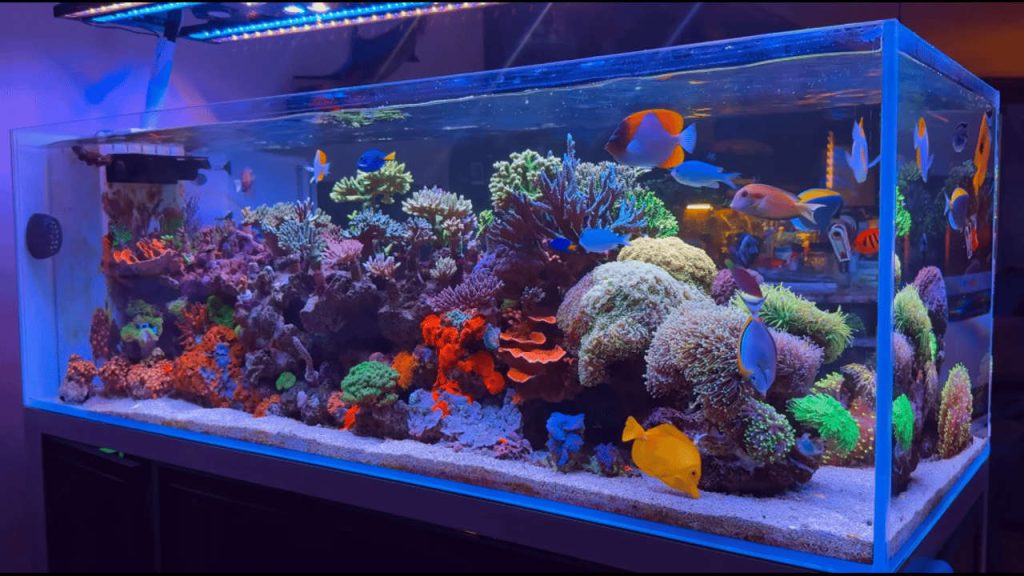
The best corals for beginners have species that allow for making some mistakes during your learning process. They do not require perfect conditions all the time and adapt well to moderate reef lighting and natural water flow. Mushroom corals, zoanthids, green star polyps, leathery toadstool corals, Sinularia, Kenya tree coral, and some species of LPS corals fit into this category.
However, the fact that it is beginner-friendly does not mean that you do not have to care about them at all. When getting different hardy corals for a saltwater aquarium, it is necessary to have a previously cycled aquarium, a steady salinity, proper lighting, good water flow, and enough space for growing coral.
You do not have to look for a coral key to survive under any conditions. Instead of focusing on the strength of the species, try to make a good selection of corals that will provide a lot of benefits.
Best Beginner Corals at a Glance
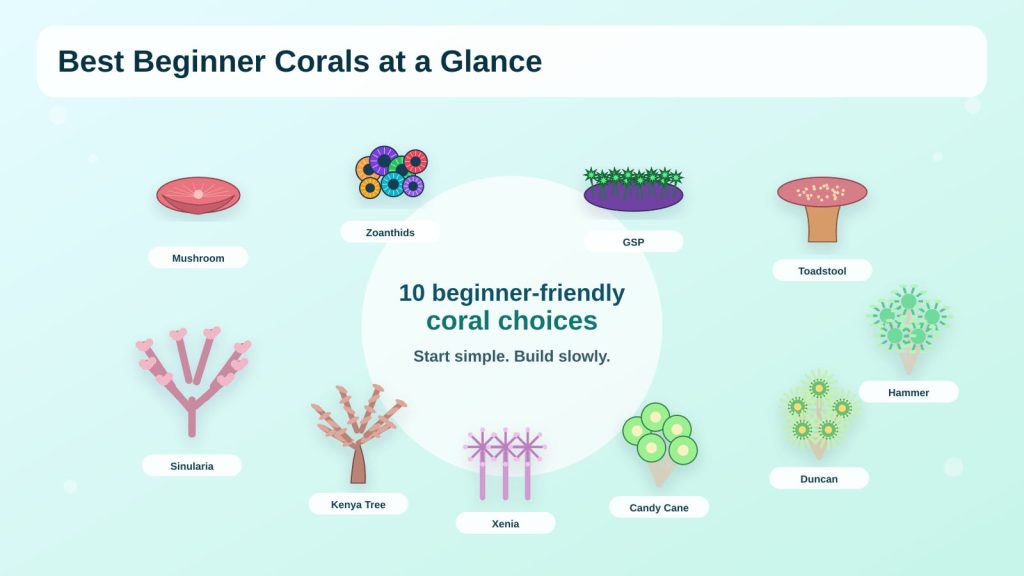
| Coral | Type | Light | Flow | Growth | Beginner Level |
| Mushroom Coral | Soft | Low–Moderate | Low–Moderate | Moderate–Fast | Very Easy |
| Zoanthids | Soft/Colonial Polyp | Low–Moderate | Moderate | Moderate–Fast | Easy |
| Green Star Polyps | Soft | Moderate | Moderate | Very Fast | Very Easy |
| Toadstool Leather | Soft | Moderate | Moderate | Moderate | Easy |
| Sinularia Leather | Soft | Moderate | Moderate | Moderate–Fast | Easy |
| Kenya Tree Coral | Soft | Moderate | Moderate | Fast | Very Easy |
| Pulsing Xenia | Soft | Low–Moderate | Low–Moderate | Very Fast | Easy |
| Candy Cane Coral | LPS | Low–Moderate | Low–Moderate | Moderate | Easy |
| Duncan Coral | LPS | Moderate | Moderate | Moderate | Easy |
| Hammer Coral | LPS | Moderate | Moderate | Moderate | Easy–Intermediate |
When it comes to beginners in reefkeeping, the wisest way is to start with 2-3 soft corals instead of covering the tank with dozens of different species. Due to the behavior of corals, one can learn a lot about the aquarium. You will get to know that different corals have a different reaction to light, flow, nutrients, position, and water stability.
What Makes a Coral Beginner-Friendly
Hardiness plays a huge role, it is not the only characteristic that makes it possible to use this species in aquarium keeping.
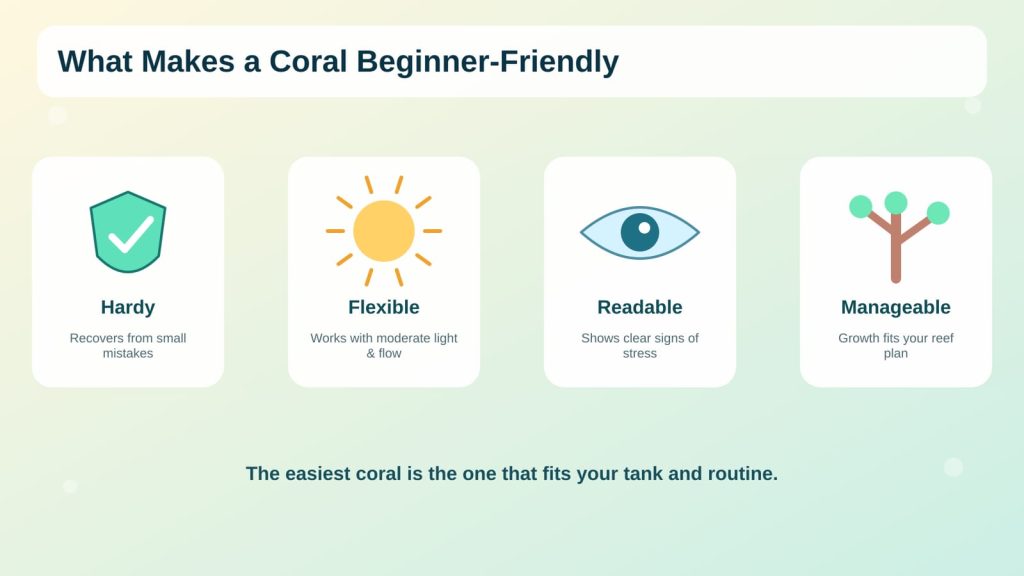
The ideal type of coral must be strong because it can survive any kind of flow and light; it can cope with the negative influence; and it can live in normal aquarium conditions. Moreover, it will be better if the coral shows some little signs revealing the fact it is going to be ill before it actually becomes sick.
This is one of the reasons why soft corals are highly favored by novice aquarists. They do not form crystalline structures like stony corals do, meaning their requirements for calcium and alkalinity are not too demanding when compared to fast-growing SPS coral species, but they are still vulnerable to unpleasant changes in the water’s chemistry.
Good beginner coral species need not only be easy to care for but also keep in mind the long-term concept of the aquarium. Many of the easy species grow very rapidly and can become troublesome in terms of overgrowing space in lamps or hidden caves, like green star polyps, Xenia, and Kenya tree coral.
Thus, the fastest-growing coral is not automatically the most suitable for every aquarium. The size of the aquarium, aquascaping, lighting, maintenance practices, and the plans for stocking the aquarium all have to be taken into consideration when choosing corals for beginner reef aquariums.
Preparing a Saltwater Tank for Beginner Corals
The nitrogen cycle being complete means that the cycle is ready to begin; it is not the end of the journey. A new reef needs to have the kind of stability that will prevent radical changes in conditions from one day to the next.
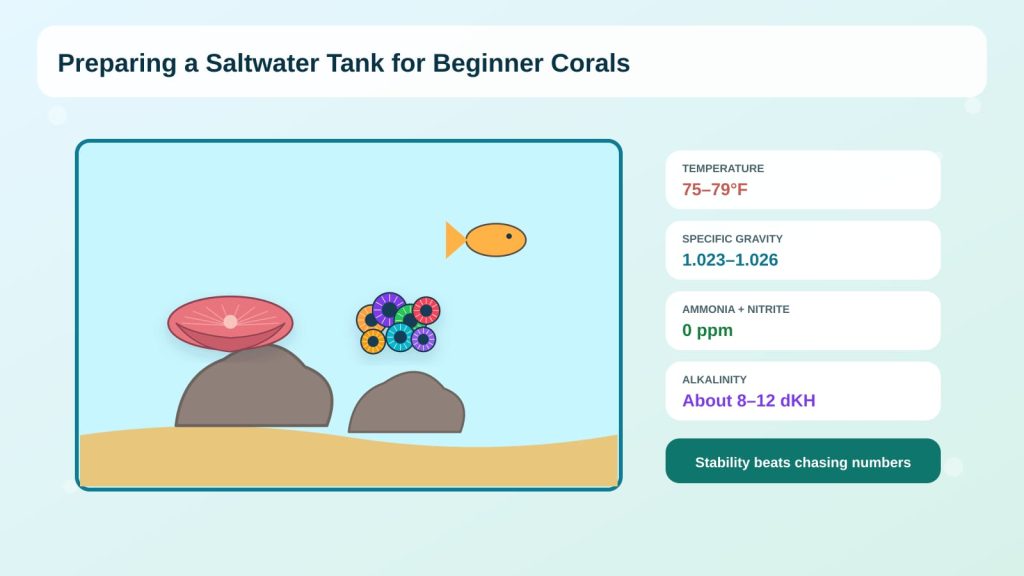
The ammonia and nitrite levels have to be zero before any coral is added to the tank. The salinity and temperature should be stable, and the setup must have the required lighting and water circulation equipment for the reef.
Suggested water conditions for a new reef aquarium are:
| Parameter | Practical Beginner Target |
| Temperature | About 75–79°F |
| Specific Gravity | About 1.023–1.026 |
| pH | Roughly 7.9–8.3 |
| Ammonia | 0 ppm |
| Nitrite | 0 ppm |
| Alkalinity | About 8–12 dKH |
| Calcium | About 380–450 ppm |
| Magnesium | About 1,250–1,350 ppm |
| Nitrate | Present but controlled |
| Phosphate | Low but measurable/controlled |
Those conditions can be taken as a guideline, and there is no necessity to achieve them on a daily basis. It is much more important for the parameters of the reef tank to be stable than for those of the aquarium to be adjusted all of the time.
Corals will tolerate minor fluctuations in water conditions. It’s not a problem to maintain different alkalinity or nutrient levels; the deadly swinging back and forth between values is what causes the biggest harm.
Whenever it is possible, keep records of your experiments, as simple or as elaborate as you wish. A notebook or a simple program such as a spreadsheet or an aquarium app will help you to make gradual adjustments easy to notice long before actual problems occur.
1. Mushroom Corals
Coral mushrooms are one of the simplest corals to start with, but they are far from boring!
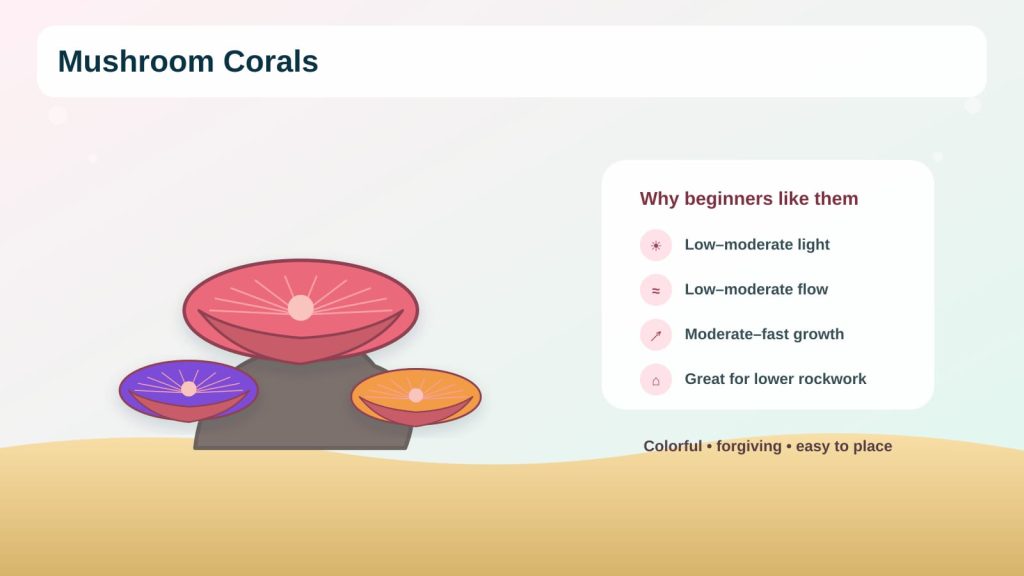
The most popular types of mushrooms that can be kept in aquariums include Discosoma and Rhodactis mushrooms, which come in many colors, including, but not limited to, bright reds, greens, fluorescent oranges, blues with stripes, and highly textured types. A small rock with mushrooms can be a source of unexpected character for a small reef.
Mushrooms usually prefer rather low to moderate lighting and gentle to moderate water movement. Too much water movement may make mushrooms stay folded and not expand to their maximum size.
Placement is fairly easy. The lower regions of the rockwork, areas where there is some shade, and areas that would be otherwise too dark for demanding SPS corals can both be great for accommodating mushroom corals.
However, they can grow rapidly once they arrive at their final destination; thus, one should avoid placing them close to valuable neighboring corals prior to their settling down. Due to their forgiving nature, easy lighting requirements, and various colors, mushrooms have become some of the most commonly adopted corals in beginner aquariums.
2. Zoanthids
Zoanthids consist of small and colorful polyps that form colonies. These small corals can significantly brighten any piece of live rock and draw attention to itself in the aquarium.
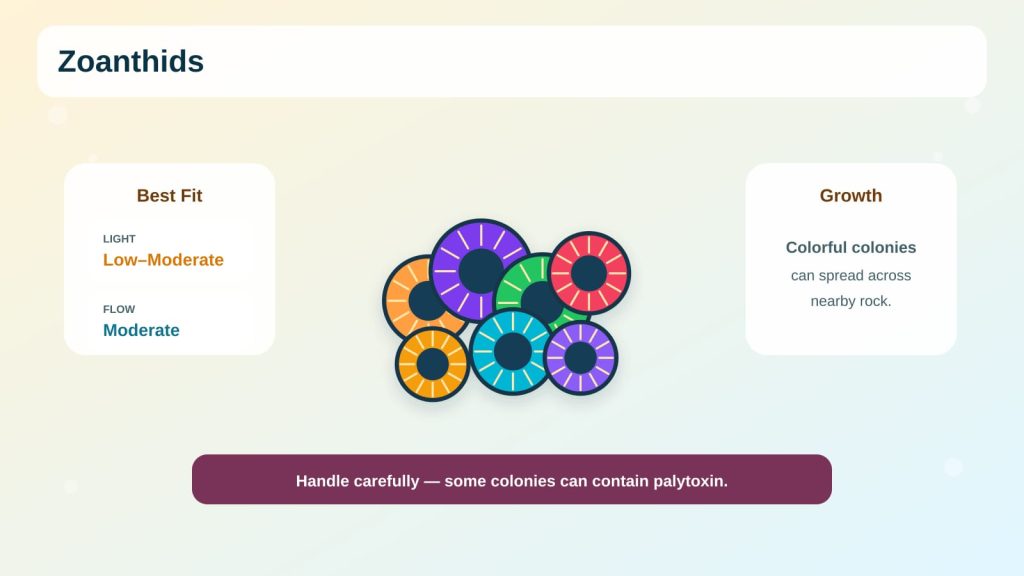
Different varieties of zoanthids are colored in various hues and schemes, from orange to red, green to yellow, and blue to multicolored varieties. Many species find their habitat satisfied with low-to-moderate lighting levels and moderate water current.
It is generally recommended to begin with the frag at a conservative location when fending off newcomers within your aquarium instead of placing them right in the brightest spot of the tank. Once the polyps are starting to open healthily, you can slowly make adjustments to their positions.
Once established, zoanthids can grow on the nearby rocks, which may be just what you need. If, however, you want to limit their spread, you can easily control their growth if you use a separate small rock for their placement.
The safety factor also needs to be considered here. There are some zoanthids and other polyps that can contain palytoxin, so it is better not to take any risks at all. Avoid boiling or washing the zoanthid-covered rocks in hot water, never do anything that would create any kind of contaminants, and be sure to wear protective gear when fragging, or it would end up being hazardous.
3. Green Star Polyps
Green star polyps, or GSP for short, are some of the most recognizable corals in the aquarium hobby due to their bright green extensions waving in the current.
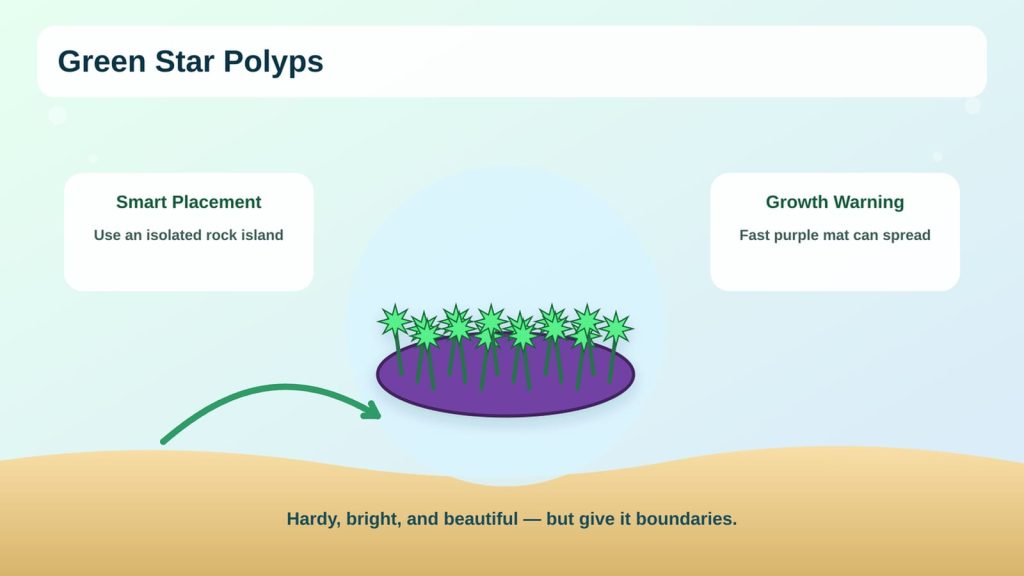
They are beautiful additions to any reef and can survive in a wide range of parameters once they are established. With moderate light and flow variability, GSP can thrive.
The tricky part is not keeping GSP alive, but preventing it from taking over an area larger than desired.
The purple mat on which GSP rests can grow quickly and eventually strangle weak-growing corals. What may seem like a small fragment today can become a huge patch in a matter of weeks.
For that reason, it is advisable to have GSP grow on a separate rock in the aquarium. The sand between the main rock and the fragment will act as an excellent barrier. Some hobbyists also allow GSP to grow on the back wall. Under controlled conditions, this coral is perhaps the best beginner species for salty water tanks.
4. Toadstool Leather Coral
A toadstool-shaped leather coral provides increased height and shape to the reef, which is beneficial when just starting and adding corals near the rockwork.
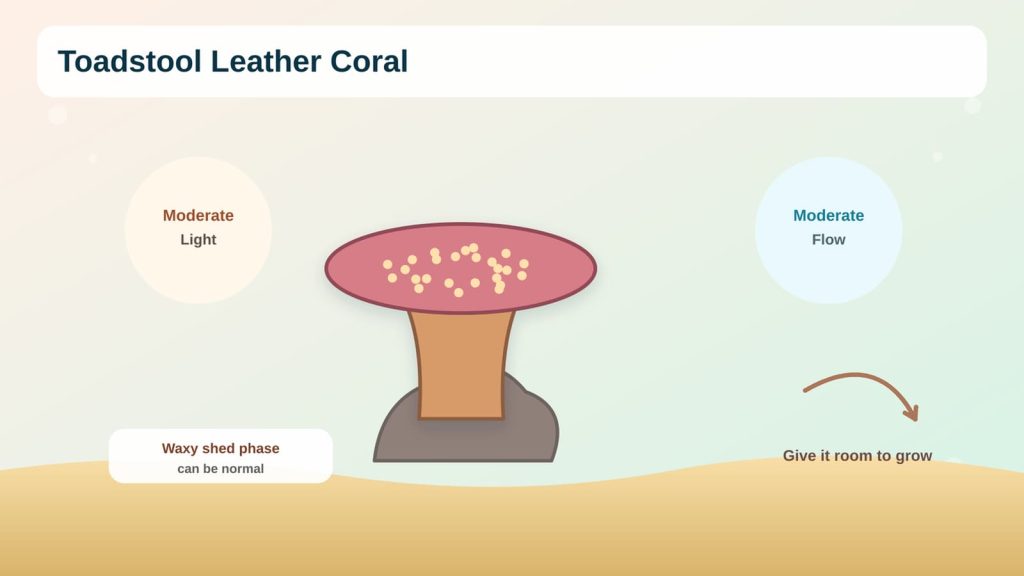
The coral begins to become established, developing a stalk with a wide ‘cap’ of small polyps. This gives a healthy toadstool coral a soft, windswept appearance when polyps are extended and swaying in the current.
They are relatively easy to care for under moderate reef lighting/flow conditions and require more space than expected in the tank since as a small coral, the toadstool can develop into a large, prominent specimen.
Toadstools also go through closed-pore periods when their surface looks smooth and even and waxy before shedding. New aquarists do not have to worry about this. Proper water flow will help remove and carry away the shed tissue. The skin of leather corals might also be releasing chemicals into the water, so regular water changes, effective filtration, good spacing between corals, and activated carbon should be used in a mixed reef.
5. Sinularia Leather Coral
Sinularia has a unique structure that provides an alternate visual effect in an aquarium full of corals, polymorphic organisms, and mushrooms.
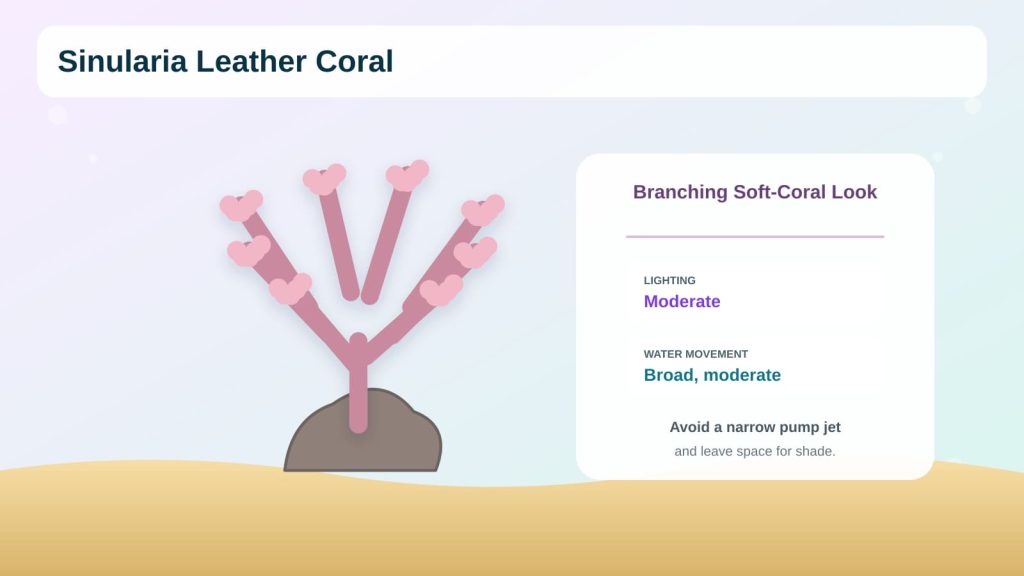
With its branches being flexible, it can sway in the flow effectively if positioned in the middle or back of the aquarium, thus allowing higher layering without hiding other plants.
Most varieties of Sinularia grow well in moderate light and moderate current conditions; however, it is best to avoid having the current flow directed at the colony since this may prevent the Elves from developing naturally.
After Sinularia takes its place, it develops at a pretty solid speed, but one should ensure that the plant is given enough room for growth because large branches can create a shade for nearby plants. For those interested in aquaristics, Sinularia is a good option to consider, as it adds height to the aquarium without drawing on the time-consuming care of SPP corals.
6. Kenya Tree Coral
African tree coral is another type of branching soft coral that is suitable for use in a range of coral tanks.
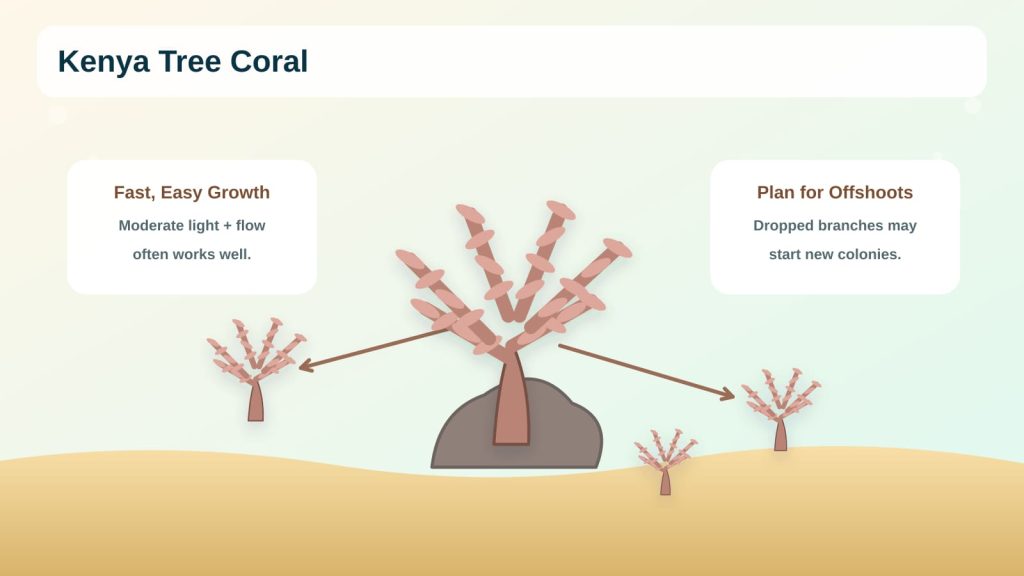
It is good at adapting to average light, average flow, and typical mixed-reef water conditions. Its established colony can grow fast, and that’s when its character becomes more fascinating.
Kenya trees multiply by dropping small branches. The parts may settle on another spot, attach to rocks, and start growing on their own. It is interesting to watch in young aquariums but becomes annoying when you planned each rock.
Put the original colony somewhere that you will be able to make unwanted growth easier to remove. Checking the area near the rocks regularly helps to notice the colonies while they are still small.
7. Pulsing Xenia
Pulsing Xenia can be impossible to ignore. Its polyps constantly swell and shrink, which gives the coral a relatively steady motion despite lower water flow, considering the fact that there is nothing that can be done in order to keep it stationary.
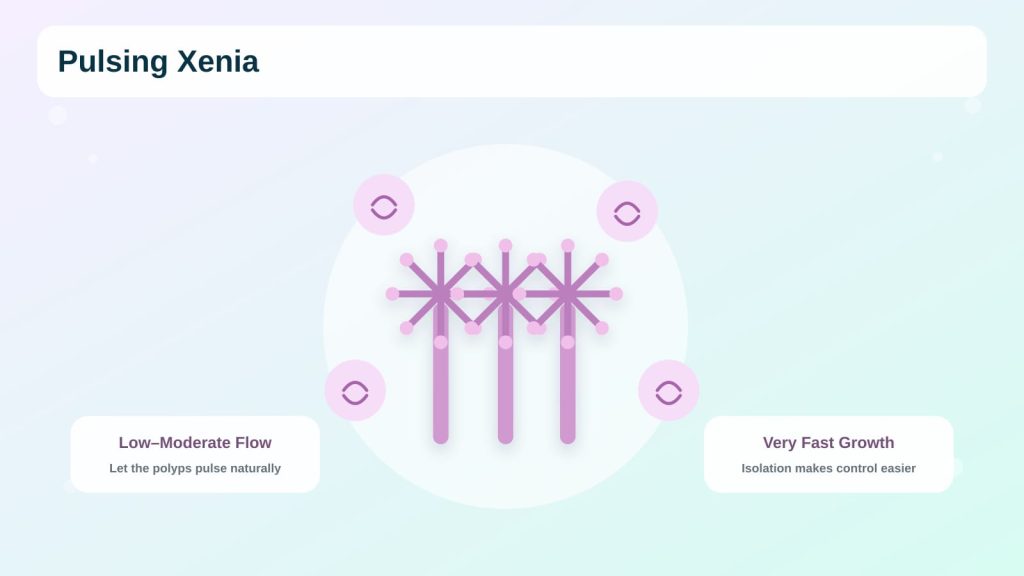
The majority of species not only like little and moderate water flow but also get accustomed to various light conditions in the reef. When the colony feels comfortable enough, the rate of spreading increases remarkably fast.
This speed of growing is exactly what attracts some reef aquarists. A tiny Xenia frag can fill almost any new aquarium, giving it a completely new look without waiting for many years until the plants look big.
Although this fast-growing Xenia may create some troubles as well. It can start spreading over the rocks and make the process of removal extremely hard.
If you enjoy the motion of these corals, it is better to put them on a separate rock if possible. Although Pulsing Xenia is one of the most attractive beginner corals for saltwater aquariums, it is suitable for somebody who doesn’t mind regular trimming.
8. Candy Cane Coral
Candy cane coral is an ideal coral type for getting into LPS maintenance after you have gained confidence in taking care of simple soft corals.
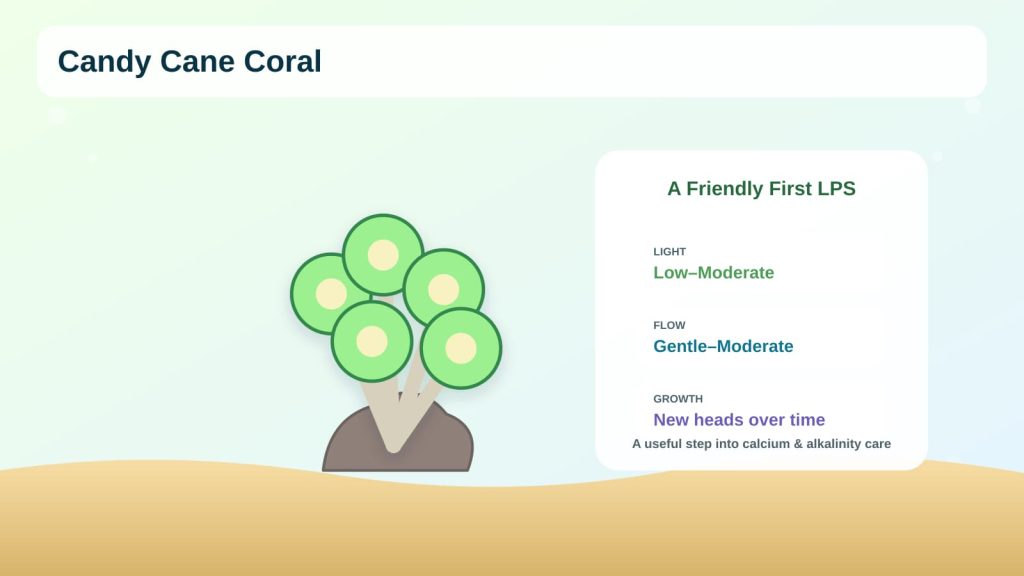
The rounded polyps rest on a well-structured skeleton; thus, distinct coral heads are clearly visible. Candy cane corals could have various colors, including green, striped, and fluorescent, that look stunning under the strong blue light of the reef tank.
Candy cane corals prefer low- to moderate-light combined with gentle- to moderate-flow. Coral polyps should make minor movements, but they shouldn’t be swept away by strong currents.
Moreover, reef aquarists can control the growth of candy cane corals easier in comparison to fast-spreading soft corals. Instead of overtaking rocks completely, a growing colony of candy cane coral adds new heads gradually.
It is worth noting that for beginner aquarists, candy cane coral is a perfect way to study calcium and alkalinity, skeleton growth, and feeding responses without too early introducing more sensitive SPS species.
9. Duncan Coral
Duncan coral visually appears to be a notch above your mundane starter coral, albeit its maintenance is still comparatively simple in a stable environment.
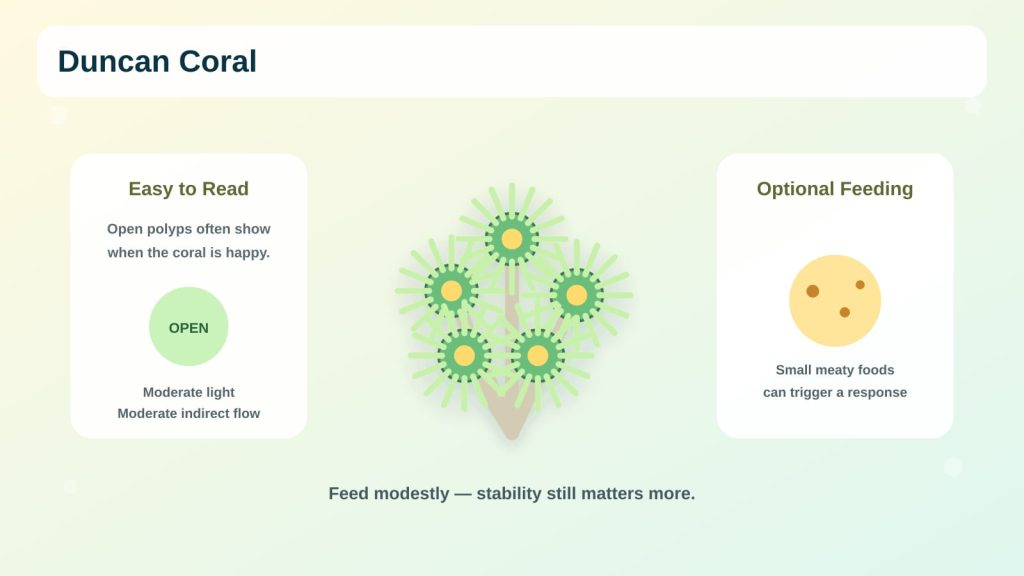
The thick polyps attached to the branched structure clearly remain open for long stretches of time. Such an ability makes any variation in behavior noticeable, which is useful when still learning how corals react to different stimuli.
The lighting and water flow must be moderate and non-direct. If too strong, the corals’ polyps would not fully open.
The coral relies significantly on light for its energy, but it does not back off from seizing opportunities to capture some food. However, it is easy to take it too far. Serious overfeeding inevitably results in higher nutrient levels in the aquarium.
Staying stable with salinity, temperature, alkalinity, and calcium is crucial for the successful keeping of this coral if one wants to move forward from beginner corals to slightly more difficult LPS corals.
10. Hammer Coral
Hammer corals provide the long, wavy motion that one thinks of when picturing a mature mixed reef.
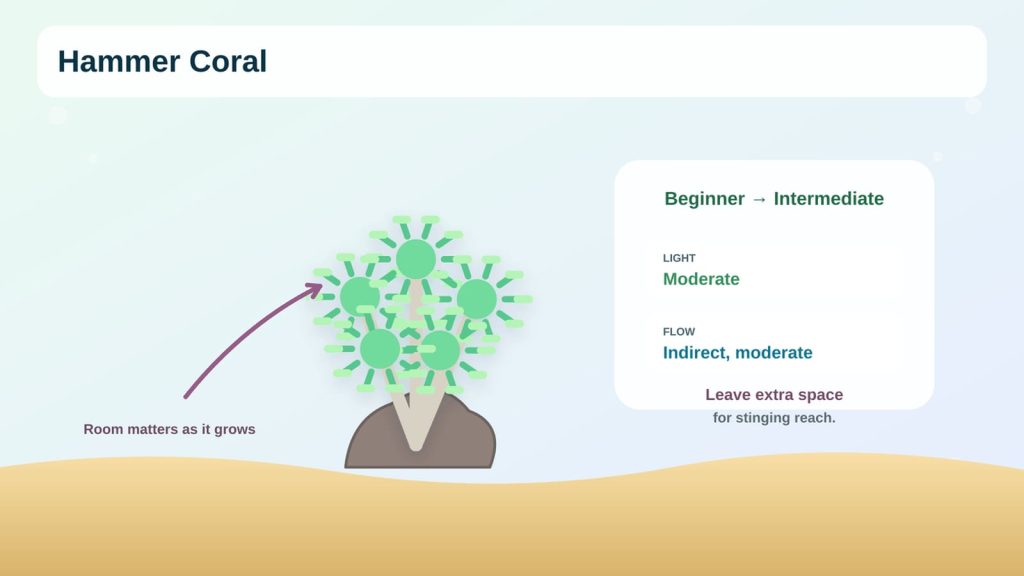
This species is a bit more difficult than mushrooms, GSP, or typical leather corals, which make it more appropriate for a tank with a stable history of good conditions.
Standard conditions will allow the fleshy polyps to expand appropriately without being blown off or bumped into the skeleton.
Placement is especially relevant for this coral species; it can have stinging contact with the nearby ones, and the distance between two small frags can rapidly diminish once the two colonies grow.
In case you have already succeeded with beginner-friendly corals, it makes sense to start with hammer corals before moving to more difficult ones.
Better Coral Placement From the Beginning
A large number of early reef difficulties are associated with coral placement instead of with water chemistry issues.
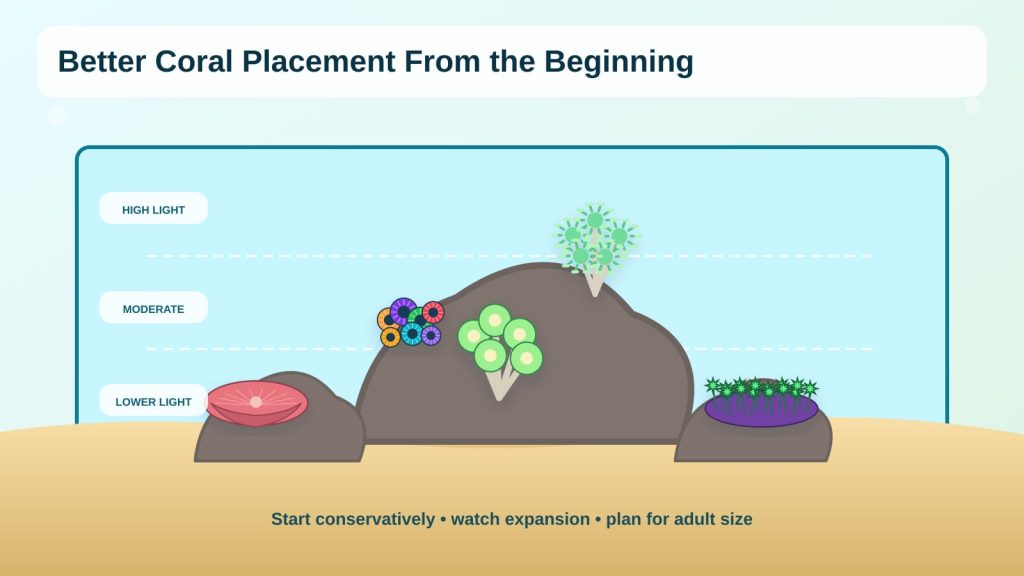
Excessive light can cause certain corals to contract. Direct powerful water flow can hinder the soft tissue of corals from opening. Putting two species of corals too near to each other can cause problems with either aspect of stinging, shading, or competition as two colonies grow.
In case you lack knowledge of the lighting conditions of your coral, it is advised to start it at a lower position in the tank. It is safer to move it gradually than to put a frag with lesser lighting conditions straight under the strongest stream of light.
Keep in mind that the frag size is not the only thing you should consider. You should visualize the enlargement of each coral in size, as giving more space to the corals helps to avoid the problem of reworking the arrangement of established rocks in case you want to keep new objects in the aquarium.
Lighting for a Beginner Reef Tank
The light given to a new coral should not be excessively strong, as many soft corals can do very well under low to medium lighting.
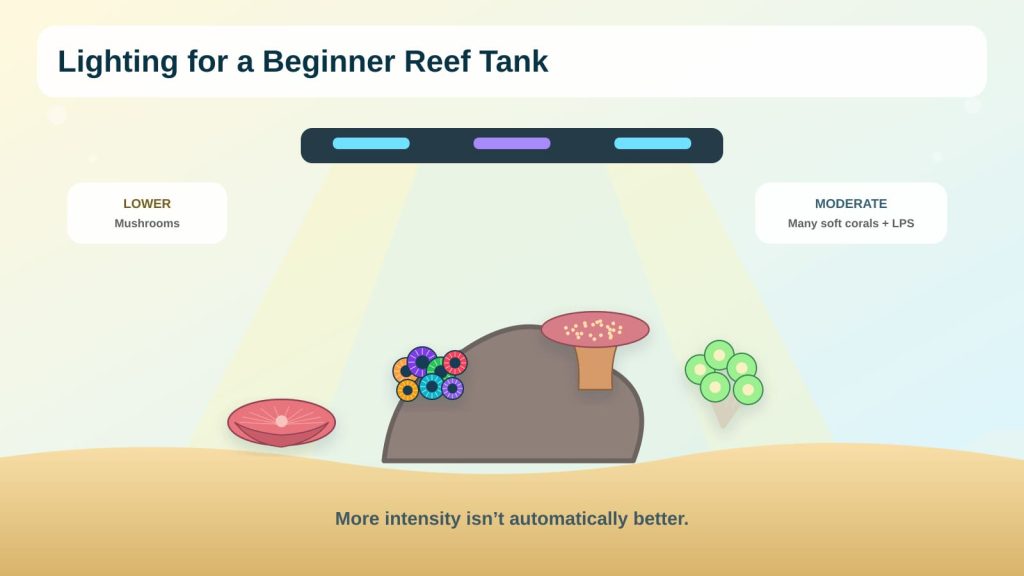
Also, there is a possibility of damaging a coral by buying a high-quality light fixture and using it on the maximum level right away. Corals need enough light to perform photosynthesis, but introducing them to a very strong light after they used to low lighting conditions can cause tissue stress.
The use of a controllable light allows one to make adjustments according to the depth of the aquarium, location of rocks, type of coral, light spectrum, and illumination conditions that the coral was used to before being bought.
Some species of corals, such as mushrooms, may be placed under lower levels of lighting, while some other corals, such as zoanthids, GSP, leather corals, and several LPS species, do well under average lighting.
Water Flow for Beginner Corals
The flow of water is almost as important as having the right level of lighting inside a tank because it helps circulate water over coral tissue.
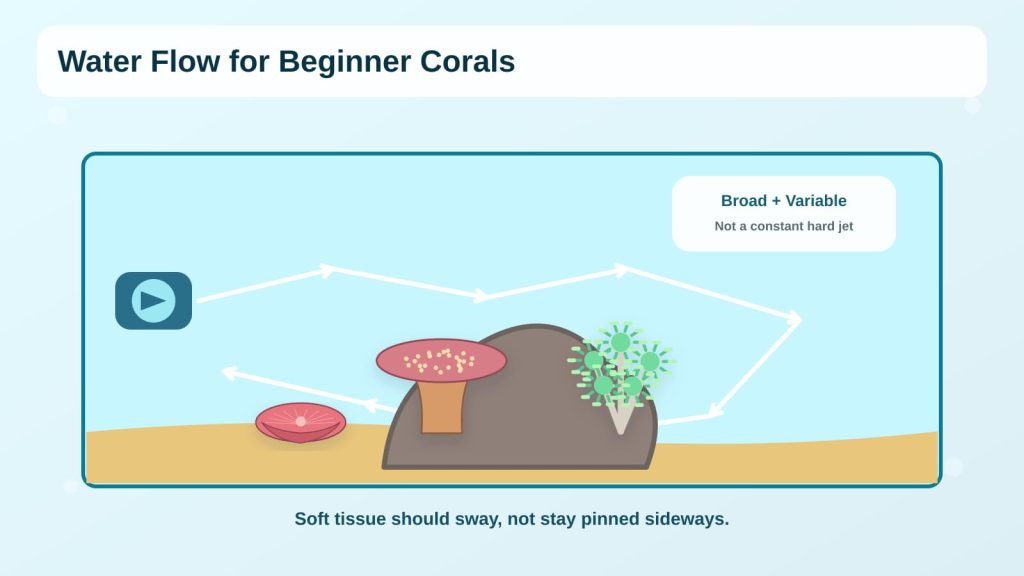
Good current helps with gas transport and suspended material. Additionally, it prevents unnecessary waste from accumulating on the coral colony. For most beginner aquariums, it is recommended to use a wider flow pattern and avoid using a concentrated stream that will not change direction.
Soft coral should be swaying instead of remaining stiff as the flow pushes it sideways. The fleshy corals of the LPS variety should be able to swish in the current without being pressed against their skeletons several times.
Make sure to view the aquarium from different angles before making any adjustments to the pumps. Rock and glass can be used to make the water flow in a very surprising direction, and what seems like a gentle flow may actually be very forceful elsewhere in the aquarium.
Feeding Beginner Corals
Most photosynthetic beginner corals don’t require daily target feeding in order to stay alive.
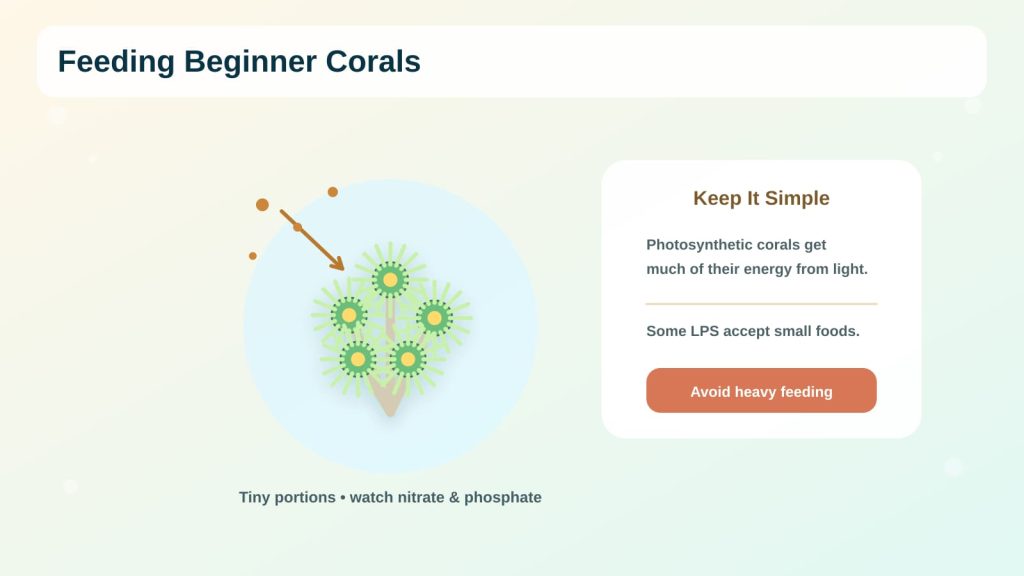
The symbiotic algae provide a large part of the energy they get, and any dissolved nutrients and fine particles in a normally stocked aquarium can contribute to their feeding.
Some LPS, like Duncan and candy cane corals, take small meaty foods without difficulty. Some mushrooms and other fleshy corals may also respond when the appropriate food reaches them.
More food does not always equal better results. Anything that the coral can’t use later becomes part of the nutrient load of the aquarium. For a safe feeding practice, one must observe the levels of nitrates and phosphates and adjust the feeding approach instead of just following strict feeding requirements.
Common Beginner Coral Mistakes
The most common error is over-committing to coral purchases. A young reef can be monitored better if the corals are introduced slowly and one has more time to assess the impact of each newcomer.
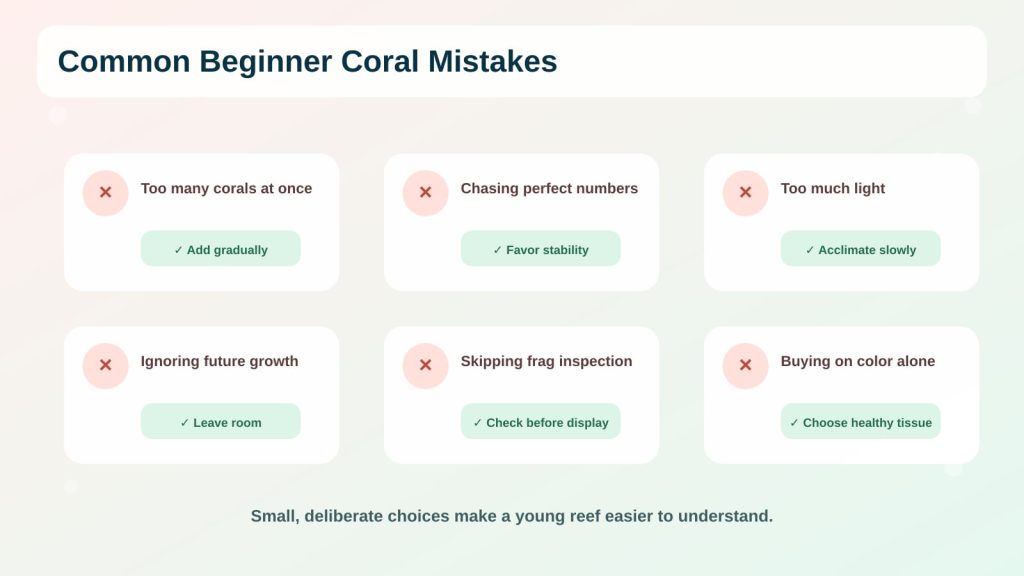
Another wrong approach is pursuing numbers. Minor changes would usually be safer than constantly adjusting salinity, alkalinity, nutrients, or other parameters.
Placement contributes to several problems as well. New reef owners often think that every bright coral needs to be positioned at the top under the brightest light, while there are many species that would prefer a dimmer neighborhood.
The future development of corals can be underestimated. Green star polyp (GSP), Xenia, Kenya tree, and quickly growing zoanthids can spread widely around the frag, so the placement is supposed to be thought of not only in the present moment but also considering the future as well.
It’s also better to scrutinize every frag carefully before putting it in the aquarium. Contaminating algae, hitchhikers, and coral diseases are easier to deal with before they infest the entire aquarium.
Finally, when selecting coral, do not pick one just because it looks fantastic. A healthy coral has all of its tissue intact, has a solid base, and has no signs of injury; this is better than a beautiful piece that appears to be under stress already.
Corals Better Saved for Later
There is no point to making your first reef tank any more complicated than necessary by getting the hardiest animals.
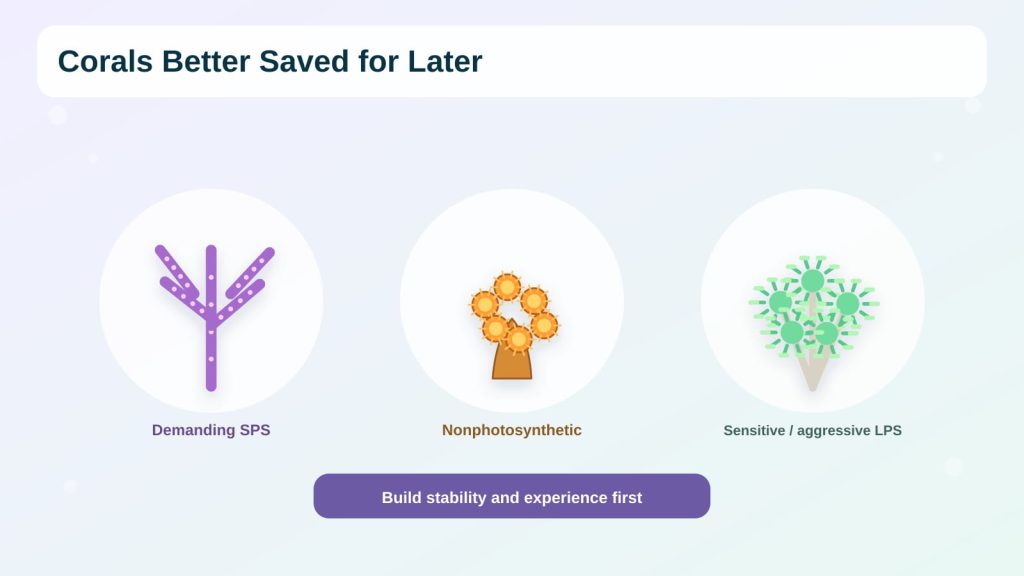
Corals such as Acropora and many others require more strict control of light, water movement, nutrients, the parameters of water chemistry, and water stability. Once the corals start to grow, they require constant updating of various types of nutrients in the water in order to keep their skeleton growing.
Certain coral species lack the ability to get their nutrition from the sun; others do not tolerate rapid changes that occur in a new aquarium. Even corals that sting are not always the best choice.
By starting with mushrooms, zoanthids, leather corals, and other easy species, you will gain the experience and skill needed to better care for these more complicated life forms.
Building a Beginner Coral Tank That Lasts
The corals recommended for novice aquarists have something common: they need to be placed in aquariums where the user constantly monitors any minor changes and reacts before they may cause serious issues.
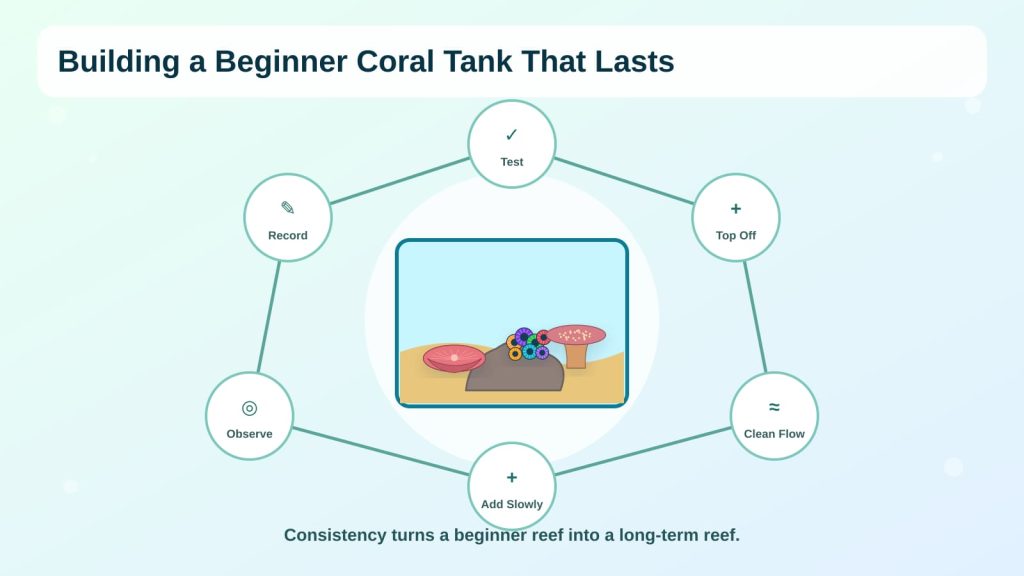
Make sure to regularly check salinity and temperature on a daily basis. Key parameters need to be tested regularly, circulation pumps need to be cleaned before their function gets compromised, and evaporated water has to be replaced before salinity changes and goes up. Routine maintenance might not seem particularly interesting, but that is what keeps corals healthy.
Adding new livestock to the aquarium should be done gradually, and taking a photo when every frag is put into it is a good idea. They grow regularly, and though you might not see it every day, if you take some photos a month or two apart, you will notice how much things have changed.
A properly constructed initial reef setup might consist of mushrooms in lower light areas, a GSP island, a toadstool or Sinularia for vertical heights, a vibrant zoanthid colony, and a candy cane or Duncan coral in order to have an introduction to LPS. With this combination, you will achieve movement, texture, colors, and a variety of growth types without converting your aquarium into an advanced reef system.
To summarize, the perfect beginner corals for saltwater tank conditions are corals that fit the given environment. One should build slowly so as to make sure that there is enough space for the corals to grow and develop as well as avoid changes that are not necessary and allow one’s reef to develop into an established system.
Quick answers
Frequently asked questions
What beginner coral is best for a saltwater tank?
Mushroom corals are perhaps the least problematic first option, as many mushroom species can thrive in low light, low flow conditions, and fluctuations typical for the reef. Other good categories of beginner corals for saltwater tanks include zoanthids, toadstool leathers, and even the single isolated green star polyp.
Which saltwater aquarium coral is best for beginners?
Mushroom corals, green star polyps, toadstool leather corals, Sinularia, Kenyan tree corals, zoanthids, and even pulsing Xenia would be the simplest amongst popular soft corals to care for in an aquarium. Candy cane corals and Duncan corals could work well once the aquarium is stable and has been guarded for some time.
How many corals can be added in one go for a beginner in coral reef keeping?
It is generally a good idea to start with 2-3 healthy coral frags. Allow enough time for corals to acclimatize themselves in the aquarium and monitor pending changes before acclimatizing further. Gradual aquarium stocking gives you more time to observe any changes in corals and the quality of the water.
How long does the aquarium need to run before introducing corals?
There is no specific number of days/weeks that assures you that your aquarium is ready. The required conditions for adding soft coral to the aquarium are that the nitrogen cycle and its phases are complete, and they should be able to detect the presence of ammonia and nitrite in the water while maintaining certain temperature, salinity, and other conditions.
Should the beginner corals be given special lighting?
The aquarists should use adequate reef lighting for photosynthetic saltwater aquarium corals. However, it does not imply that all corals need high-intensity lights. Some types of mushrooms prefer weak lights, while the zoanthids, leather corals, GSP, and many LPS corals generally enjoy moderate light only when they are properly acclimatized to new conditions.
Do novice corals require feeding?
Most novice corals would do just fine without regular feeding as long as proper lighting and general fish food are provided. Some species of mushrooms and LPS corals will eat additional food; however, overfeeding may quickly raise levels of nitrate and phosphate.
Do soft corals make better beginner reef tank corals?
For many beginner reef keepers, the answer would be yes, because soft corals are generally more tolerant and forgiving than delicate SPS corals and are easy to see in regard to polyp expansion compared to SPS corals.
Is GSP suitable for beginners?
Yes. GSP is hardy, colorful, and fast-growing, and the only real concern presents the fact that sometimes Green Star Polyps may take over the entire aquarium.
Are Zoanthids good for a new aquarium?
Zoanthids are easy to keep but may contain palytoxin in some of their varieties. When handling or cutting them, one must wear proper gloves and eye protection, as hot or boiling water can ruin them completely.
Can LPS corals be kept by beginners?
Some of them can. Candy cane and Duncan corals can be good corals for a beginner reef tank. The hammer coral can also be used by you if you have mastered keeping stable levels of salinity, alkalinity, calcium, etc.
Can beginner corals survive in a small aquarium?
Yes, many corals for beginners are perfect for a nano reef. The only issue with such systems is that stability. Since the amount of water is small, it will change fast, and it is necessary to use consistent refill methods, stock carefully, and test the water regularly.
Which kinds of beginner corals grow the fastest?
If the conditions are favorable, green star polyps, pulsing xenia, Kenya tree coral, and some kinds of zoanthid colonies are the fastest-growing corals. Make sure to position them correctly since they can overtake other corals later on.
What types of corals can a beginner keep in dim-lit aquariums?
When it comes to corals that thrive in low-light aquariums, mushroom corals can be some of the best choices for low-light tanks. In addition to these corals, zoanthids and some other soft corals can also do well in such environments despite showing different responses in conditions of low light.
Which corals should be avoided by a beginner?
When looking for coral that is adequate for beginners, it is advisable to avoid SPS corals and complex non-photosynthetic types as well as LPS corals. These, especially LPS corals, must be provisioned only after the aquarium has been stable for a longer period of time.
What are the most important aspects to consider for beginner coral reef tanks?
It is necessary to understand that consistency is more significant than striving for the perfect values of water parameters. The stability of the lighting, temperature, and salinity of the tank, together with gradual stocking, will be the most favorable factors for the enduring success of beginner corals for marine aquariums.

About the author
Ethan Cole
My name is Ethan Cole, and I have been a writer on saltwater aquariums and reef tanks for over eleven years. My work essentially deals with practical aspects of reef-keeping, such as keeping marine fish and corals; the use of live rocks, protein skimmers, and understanding filtration; analyzing water quality; and performing routine maintenance of an aquarium. I write for aquarists looking for easy-to-understand answers as well as those looking for practical advice.
Reader Fishkeeping Feedback
Comments, questions, and aquarium reviews
Share your aquarium experience, ask a fish care question, or write a helpful note about tank setup, water quality, filters, algae control, or maintenance for other readers.
No aquarium reviews yet. Be the first to share a helpful review on content or fishkeeping question, setup tip, or care experience.