
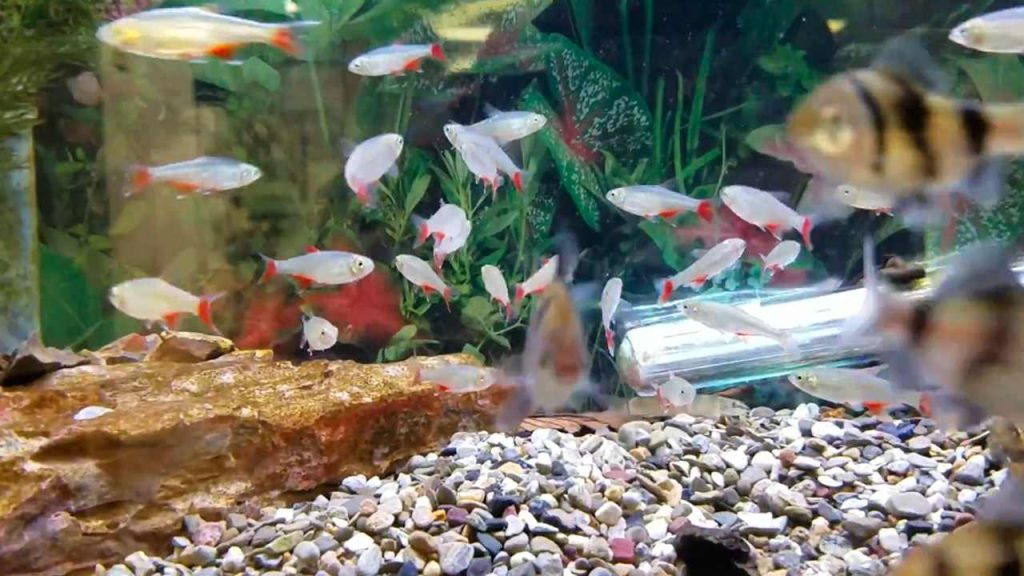
For a novice fish keeper, it is usually better to start with hardy freshwater fish species rather than sensitive species that need specific water conditions. Fish species such as zebra danios, platies, harlequins, cherry barbs, white cloud mountain minnows, bettas, corydoras catfish, guppies, neon tetras, and bristlenose plecos have some characteristics that make them good candidates for beginner fish if kept in the right setup.
The last section is vital. Hardy fish still need a properly cycled aquarium, right filtration, clean water, the right temperature, reasonable space for swimming around, and the right tank mates. Being “hardy” doesn’t mean that fish can survive with bad water quality and in an aquarium that hasn’t completed the nitrogen cycle. Fishless cycling is a smarter way of preparing the aquarium before adding any fish to it.
This beginner’s guide to aquarium fish features descriptions of 10 popular species along with evaluations of the reasons why each of them is a good choice for a beginner’s aquarium.
Quick Beginner Fish Selection
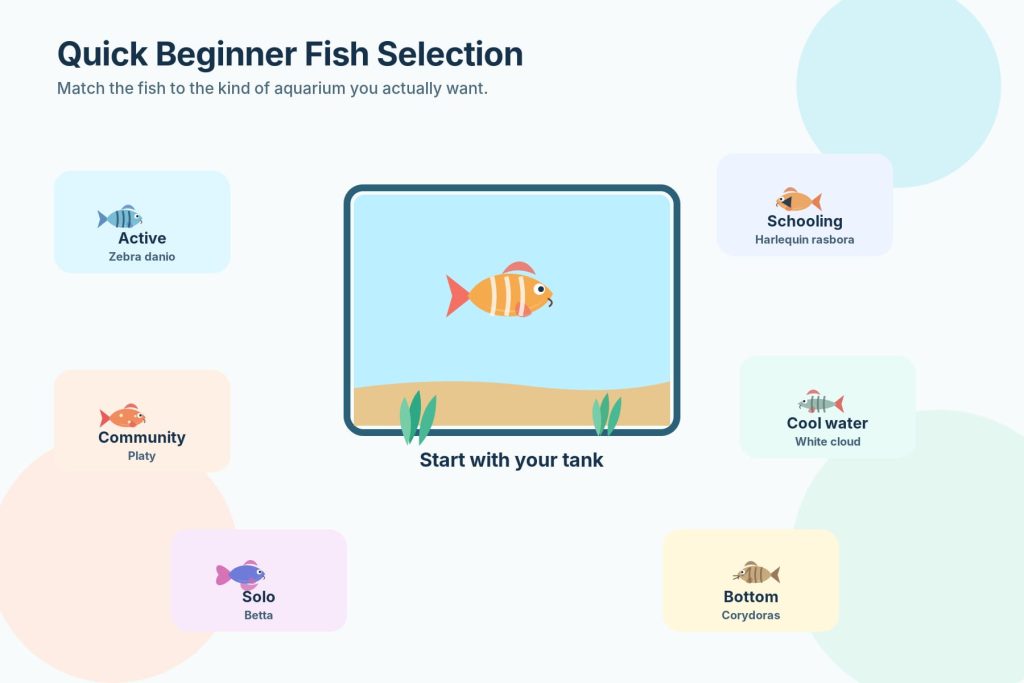
For a simple starter aquarium, there are a few species that are the best fit depending on the type of tank one is planning to have.
| Beginner need | Strong choice |
| Best all-around active fish | Zebra danio |
| Easy community fish | Platy |
| Peaceful schooling display | Harlequin rasbora |
| Colorful planted community | Cherry barb |
| Cooler-water aquarium | White cloud mountain minnow |
| Single-fish aquarium | Betta |
| Peaceful bottom-dweller | Corydoras |
| Colorful livebearer | Guppy |
| Small schooling classic | Neon tetra |
| Larger peaceful bottom fish | Bristlenose pleco |
It is difficult to identify a single fish species as the perfect one for novice aquariums. A betta is ideal when it comes to choosing a centerpiece fish. As for zebra danios and harlequin rasboras, they should suit an aquarist who is interested in swarms of fish. Platies are also well-known to cope with hard water, while White Cloud mountain minnows thrive in colder temperatures.
To decide which fish would be better to keep, it is better to start from the conditions in the aquarium.
Traits of Good Beginner Aquarium Fish
Most beginner fish have some traits in common, which is much more important than picking some fish labeled as “easy” in the fish store.
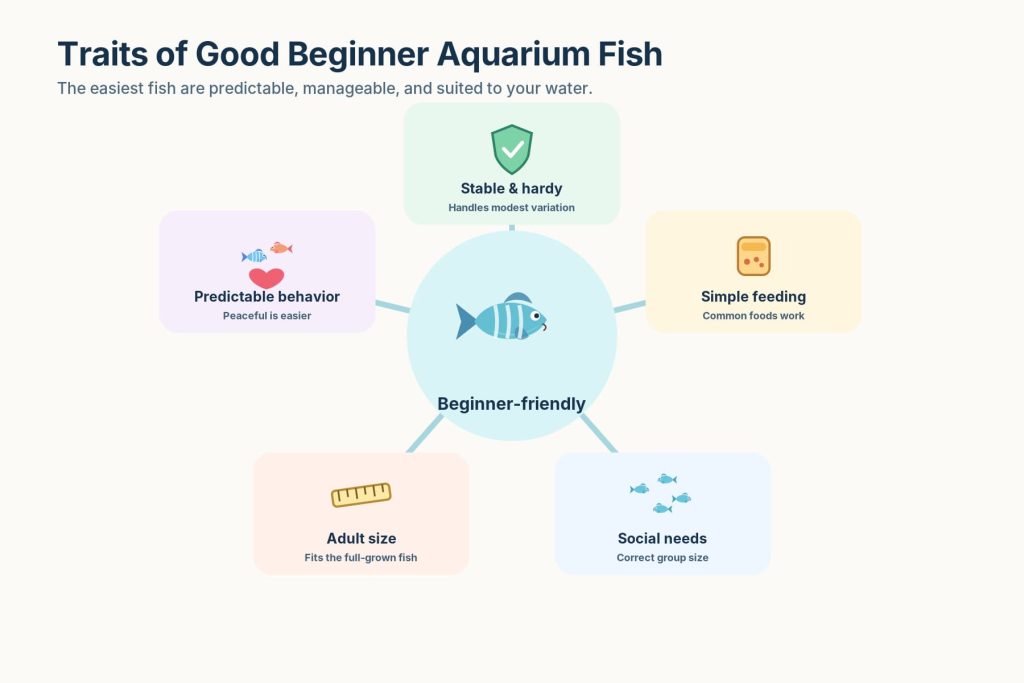
It must be noted that hardiness is important, though it is far more important to maintain stable water conditions. Such fish as hardy ones are known for their ability to withstand slight deviations in the water quality, but no fish can live in a tank with a high concentration of ammonia or nitrites, low oxygen content, or other issues.
Easy feeding is a big plus. Most fish on the market are not picky eaters and will eat fish flakes, fish pellets, frozen foods, or sinking food without trouble. This is better for the new fish keeper than an exotic fish that requires special food.
A big benefit of peaceful fish is their predictability. It is easier to manage peaceful fish in community tanks than territorial or aggressive fish. Such species can be rewarding, although extra consideration is needed when choosing tank mates or the volume of water a given species needs.
Another important factor in owning fish is the adult size of the fish rather than the size at the store. A small fish can grow much bigger than expected. This is one reason why common goldfish are classified as easy fish to keep, but they may not be ideal for a small beginner aquarium, as they get large and create a lot of waste.
Social needs can’t be overlooked either. Danios, rasboras, tetras, and barb species, among others, are social species. Keeping just one individual might mean that it fits in the tank, but it doesn’t mean that it’s living in the right conditions.
These examples provided some better beginning points for novice aquarists than simply searching for the “toughest” fish out there.
Top 10 Aquarium Fish for Beginners
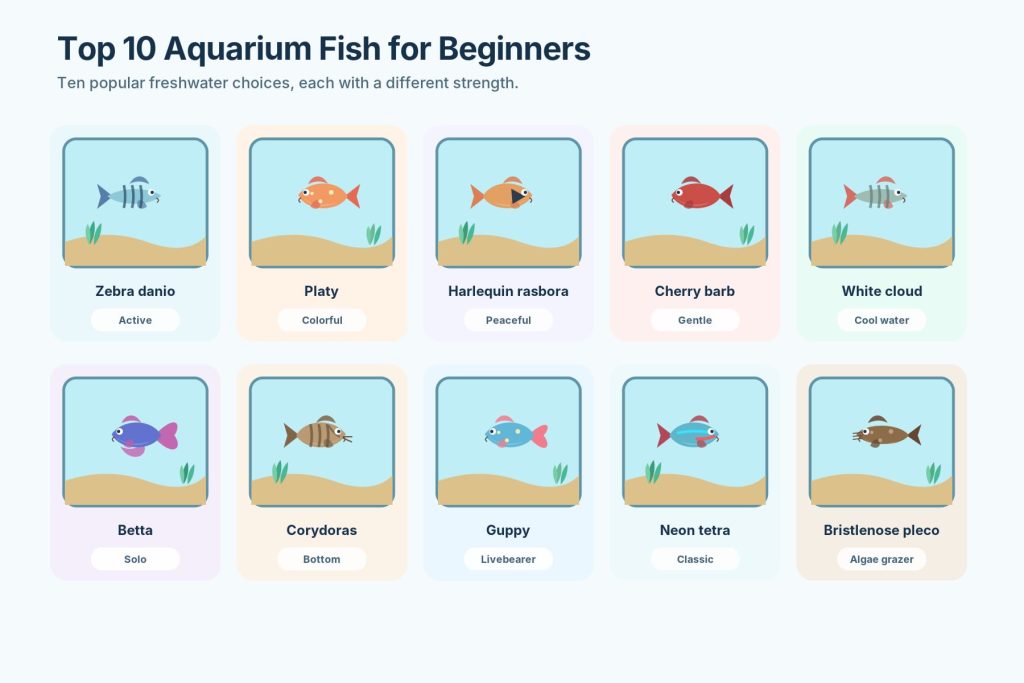
1. Zebra Danio
The zebra danio (Danio rerio) is one of the best choices for those who want active freshwater fish. Its coloration, constant movement, size, and eating habits make it a great addition to your aquarium.
Danios live in a school, so they shouldn’t be kept alone. Individuals should be kept in groups of at least six, and the bigger the school, the better if space allows. They spend most of their time above and in the middle area of the water column.
Despite the fact that zebra danios are small in size, they possess a great way of swimming. Both for the fish and the person with minimal aquarist experience, a 20-gallon-long aquarium provides better horizontal swimming space than a smaller fish tank.
Zebra danios are capable of living in a temperature range of approximately 70–78°F. In some houses, they may thrive even without a heater as long as the room temperature stays high enough, but temperature stability is still more important than an attempt to do away with any equipment.
Since the danios are fast swimmers, they might not be the best tank mates for slow, fragile, or long-finned species. It is safer to choose fish that have the same level of activity as a zebra danio.
Beginner fit: Excellent
Suggested beginner tank: 20 gallons or larger
Social need: Group of at least 6
Best feature: Hardy, active, adaptable
2. Platy
Platies are very easy and practical types of fish that are good for new aquarists, especially in areas that have moderately hard water. They can come in a variety of colors and can be almost all colors like orange, red, blue, grey, yellow, black, and more.
Even when they are adults, platies do not grow more than a few inches long, which makes them a good choice for community fish. They are livebearers, as female fish will give birth to swimming fry rather than laying eggs.
Seeing that happen is pretty neat, but it can also become a problem if you are not prepared for it. A tank with male and female fish may end up with fry regularly, and beginners might want to keep this in mind while picking their first fish.
Platies prefer harder, mineral-rich waters and are not a good choice for soft waters unless the aquarium owner knows how to deal with those conditions. They are uncomplicated omnivores and are very easy to feed in general, as they will eat any quality food.
For a beginner community tank, a 15-20 gallon aquarium or more creates an adequate space that allows a keeper to achieve a low level of error concerning water quality.
Beginner fit: Excellent
Suggested beginner tank: 15–20 gallons or larger
Social need: Small group
Best feature: Colorful and forgiving
3. Harlequin Rasbora
Harlequin rasboras embody almost everything that most beginners would want from their peaceful community aquarium: eye-catching beauty, synchronized swimming, small adult size, and nice behavior.
They grow up to two inches in length and are distinguished by a dark triangular pattern on the back half of the body. When placed in a good environment, their reddish-orange color becomes prominent. The minimum number of fish recommended for the community of harlequin rasboras is six; however, eight or more fish would provide an even more spectacular picture.
These rasboras look good in a planted freshwater aquarium. Plants, dark background, driftwood, and shaded areas will help show the bright colors of the rasboras and also create hiding spots for them.
The 20-gallon-size tank provides a budding aquarist with adequate space to set up its first school of fish and still leave room for bottom dwellers. Harlequin rasboras prefer stable and clean water, and once the tank is cycled, they can turn out to be even better than the fish mentioned earlier.
Because they are so peaceful, they are also one of the best fish to have for beginners who prefer community rather than a single-species tank.
Beginner fit: Excellent
Suggested beginner tank: 20 gallons or larger
Social need: 6+, preferably more
Best feature: Peaceful schooling behavior
4. Cherry Barb
Cherry barbs can be an amazing option for an aquarium novice who wants to see some color but does not want to deal with aggressive fin-nippers like some other barbs.
Males of this species can reach a deep red color through maturity, whereas females will be more on the subdued side. Their small size allows keeping a decent number of them in a beginner’s aquarium of medium size.
These creatures are always sociable; hence, they mustn’t be kept in a solitary habitat. Schools of at least six individuals help ensure social interaction and make fish feel much more comfortable. In addition, a well-planted aquarium will ensure that these fish have both cover and swimming room.
Cherry barbs can have a peaceful coexistence with both harlequin rasboras, many other peaceful tetras, Corydoras, and many other community fish, as long as the water conditions are the same.
Thanks to their bright appearance, easy maintenance, and peaceful nature, these fish have become some of the most popular hardy aquarium fish for newcomers. These fish are not completely devoid of care, however. Implementing regular water changes, stocking properly, and providing them with a well-balanced diet are essential to keeping these fish happy and healthy.
Beginner fit: Very good
Suggested beginner tank: 20 gallons or larger
Social need: Group of 6+
Best feature: Color without excessive aggression
5. White Cloud Mountain Minnow
The white cloud mountain minnow (Tanichthys albonubes) is a species that is ideal for those who are new to fishkeeping and wish to create a freshwater aquarium that does not have the same warm temperature requirements as many tropical setups.
These small, active fish are peaceful creatures that are best kept in schools in order to experience them in all their beauty. They exhibit attractive silvery bodies, darker markings on their bodies, and red fins once they feel comfortable in the tank.
As compared to other tropical fish, white cloud mountain minnows like cooler water, i.e., water temperature should be in the low-to-mid-60s to low-70s range. This particularity means that the fish can be kept in an unheated aquarium at home if the room temperature is suitable.
However, it does not mean that temperature is not important anymore. Temperature fluctuations can negatively affect white cloud mountain minnows even if the species prefers cooler water.
A ten-gallon aquarium may be suitable for a small group if set up correctly, but a larger aquarium, such as the fifteen-gallon or twenty-gallon versions, would allow an active fish species to thrive better while giving the beginner a more stable amount of water.
White clouds should not necessarily be mixed with warmer animals because they prefer warmer water.
Beginner fit: Excellent
Suggested beginner tank: 10–20+ gallons
Social need: Group of 6+
Best feature: Excellent cooler-water option
6. Betta Fish
The betta (Betta splendens) is one of the most famous beginner fish, and a correctly set up aquarium for a single betta is easier to understand than a bigger community aquarium.
This simplicity is due to the fact that only one fish is kept and not due to the use of a small bowl for the fish.
Generally, bettas should be kept in heated and filtered aquariums with enough space to swim and move around the tank. It is normally recommended that bettas be kept in aquariums of at least five gallons in volume, although bigger tanks would produce better water conditions for the fish. The ideal temperature for this species is in the range of 78-82 degrees Fahrenheit.
It is better to establish gentle filtration in an aquarium with bettas since they have long fins and have no great adaptation to fight against strong currents. Having plants, shaded areas, and places to rest at the surface makes an aquarium more comfortable for the betta.
Male bettas should not be kept in a tank together. The betta can live in the community tank sometimes, but its temperament can differ. One fish may never pay attention to tank mates, while the other may easily become territorial.
If a person wants only one beautiful fish in one aquarium instead of a tank full of schooling fish, the betta fish can be one of the right choices for beginners.
Beginner fit: Excellent as a solo fish
Suggested beginner tank: 5 gallons or larger
Social need: Usually kept singly
Best feature: Simple stocking and strong personality
7. Corydoras Catfish
Corydoras fish introduce a different style of swimming in aquariums because they reside mostly at the aquarium’s bottom rather than swimming with other fish species in the middle of the water column.
Many species of Corydoras fish are present, but none of them all attain the same size. Species such as bronze, albino, peppered, panda, etc., all should be checked before being decided upon for ownership.
One of the main rookie mistakes is thinking of Corydoras as cleaning machines. Hence, even though they eat anything that drops on the ground of the tank, they need to be provided with a full diet of specific food as well.
Corydoras fish species are not only popular with aquarists because they were the first ones to be introduced to aquariums but also because they are a social fish species, and having these fish from the same school definitely gives a boost to their confidence when it comes to natural behavior.
Because of its size, a 20-gallon-long aquarium is an excellent choice for homeowners. The large size allows for both the addition of more fish, often as a school, and still allows for a compatible school of fish species.
Additionally, smooth sand or any kind of fine substrate can help to make their scavenging habits more watchable and enjoyable.
Beginner fit: Very good
Suggested beginner tank: Often 20+ gallons; species dependent
Social need: Usually 6+ of the same species
Best feature: Peaceful bottom-level activity
8. Guppy
Guppies are one of the most popular beginner fish among beginning aquarists. They are usually quite small, available in various colors, and are a popular choice in freshwater aquariums because of their high activity levels.
Male guppies are especially popular due to their colors and tail designs. While guppies can work well in many community setups, they do need to have their water requirements considered more closely than the general belief that guppies are just easy fish to keep. Guppies usually do better in not very soft water conditions.
Similar to platies, guppies are livebearers. With this in mind, one should recognize that the introduction of females can lead to a rapid increase in fish population sizes in a short time interval.
Carefully selected tank mates are important for fancy guppies with long fins. There are fish that could nip at guppies’ fins and cause damage, and too aggressive companions could put the guppies under constant stress.
A tank of 10 gallons can be enough to keep guppies, but it is easier to look after guppies in tanks of 15 or 20 gallons. There is a need for a larger tank if fry appear unexpectedly.
Guppies are among the great starter fish as long as the tank is cycled, water is suitable for them, and the owner is ready to deal with the issue of reproduction in guppies.
Beginner fit: Very good
Suggested beginner tank: 10–20+ gallons
Social need: Group
Best feature: Exceptional color and activity
9. Neon Tetra
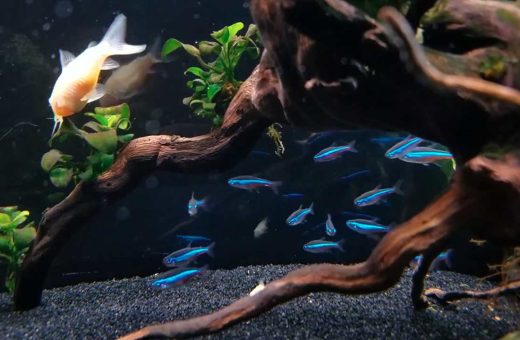
Neon tetras are one of the most recognizable small freshwater fish. A group of such fish moving around the tank creates a strong color impression thanks to their blue stripes and red coloring.
Neon tetras can be considered good first fish, but they are more suitable for aquariums that have already been cycled.
Since neon tetras are schooling fish, it is very important to have a proper-sized school. A larger school is more natural-looking than a single fish or two or three wandering about. Their small size allows them to fit in a small tank; however, a 15 or 20-gallon tank is a better option for beginners since it allows for more stable water parameters.
Because neon tetras are non-aggressive, they tend to mix quite well with many community-type fish as long as the other fish are not too big or too aggressive.
Neon tetra grow to about 1.5 inches long and are only kept in tropical water with members of their own species.
If your main aim is to find the easiest fish, zebra danios or platies may pave a smoother path for you. However, after some time has passed and the tank has become mature and stabilized, neon tetras begin to make an acceptable beginner species.
Beginner fit: Good in a mature tank
Suggested beginner tank: 15–20+ gallons
Social need: 6+, preferably more
Best feature: Iconic schooling color
10. Bristlenose Pleco
A bristlenose pleco is not only a better bottom feeder than the common pleco for an amateur aquarist, but it can also be far easier to keep.
The main disadvantage of the common pleco for an aquarium beginner is that it can grow to enormous sizes and quickly outgrow almost any home aquarium. Bristlenose plecos, on the other hand, are much more compact with a maximum size of about five inches for many species and types.
The bristlenose pleco does consume algae but should not be viewed as a living filtration system. The species produces waste just like any other fish and needs to be fed properly. Algae wafers, vegetables, and other foods should be included in the fish’s diet. The setup should also have some driftwood, caves, and shady places to hide.
A 20-gallon tank may fit some bristlenose setups, although in general, higher tank capacities facilitate maintenance and stocking of tanks with other fish. Nonetheless, beginners should stick to 20-30 gallon tanks.
If you are lucky enough to have a spacious aquarium and want to keep some exciting fish species, the bristlenose pleco will be a great addition to your aquarium!
Beginner fit: Good
Suggested beginner tank: 20–30+ gallons
Social need: Can be kept singly
Best feature: Manageable pleco with unusual behavior
Beginner Aquarium Fish Comparison
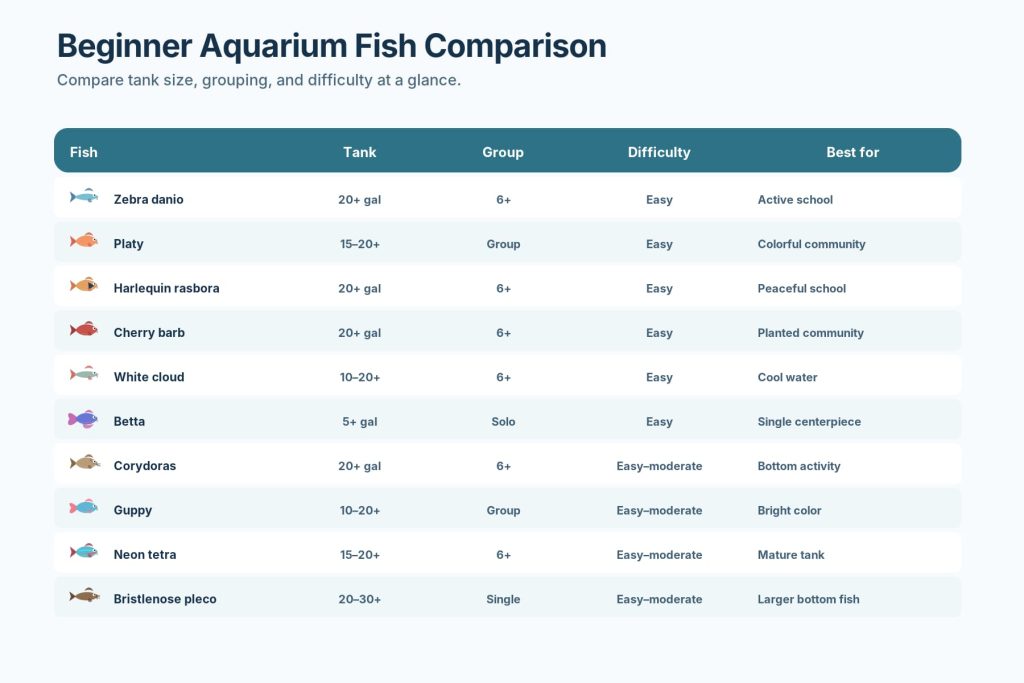
| Fish | Beginner difficulty | Starting tank | Grouping | Key consideration |
| Zebra danio | Easy | 20 gal preferred | 6+ | Very active swimmer |
| Platy | Easy | 15–20+ gal | Group | Prefers mineral-rich water |
| Harlequin rasbora | Easy | 20+ gal | 6+ | Peaceful school |
| Cherry barb | Easy | 20+ gal | 6+ | Best with cover and companions |
| White cloud minnow | Easy | 10–20+ gal | 6+ | Prefers cooler water |
| Betta | Easy | 5+ gal | Usually single | Needs heat and gentle filtration |
| Corydoras | Easy–moderate | 20+ gal | Usually 6+ | Needs dedicated sinking food |
| Guppy | Easy–moderate | 10–20+ gal | Group | Can reproduce rapidly |
| Neon tetra | Easy–moderate | 15–20+ gal | 6+ | Best in a mature aquarium |
| Bristlenose pleco | Easy–moderate | 20–30+ gal | Often single | Needs food beyond algae |
Aquaria of these dimensions are intentionally designed for the novice aquarist, rather than being dictated by the minimum number of liters of water required for fish to exist. Since large aquariums typically adjust to temperature and water chemistry more slowly than small aquaria, this allows for a sort of a ‘grace period’ for novice aquarists to identify and fix any problems that might arise.
Best Aquarium Fish Combinations for Beginners
The most convenient combinations of fish species for beginner aquarists are those that contain the least number of fish species. In the majority of cases, the simplest community of congenial species is much easier to feed, observe, and care for.
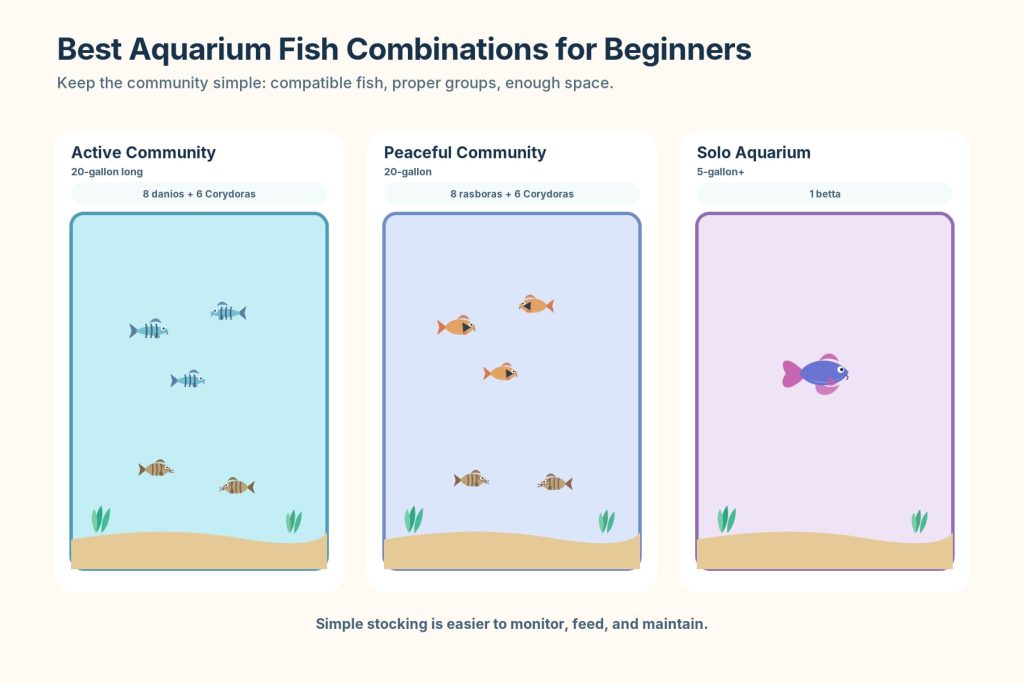
Easy 20-Gallon Active Community
A reliable cooler-and-moderate temperature combination can consist of the following species:
- 8 zebra danios;
- 6 properly sized and compatible Corydoras (for instance, peppered Corydoras);
- Plants or decorations at the edges of the tank, but sufficient space for swimming.
Before the fish are placed into the new aquarium, it has to be cycled, and the fish must be added gradually rather than in one batch at once. In fact, both species prefer living in groups, while their preferred swimming zones allow placing them into a longer tank.
Easy 20-Gallon Peaceful Community
In order to achieve a fairly warm and peaceful habitat, the following species may be combined:
- 8 harlequin rasboras
- 6 smaller Corydoras of one species
- Fish plants and swimming area
The described arrangement creates one school of fish and a group of bottom fish but does not create any complicated cohabitation setup.
Simple 5-Gallon Solo Aquarium
In case you do not want to deal with the compatibility problem of communality:
- 1 betta
- Heater
- Gentle filter
- Plants and rest areas.
A properly prepared betta aquarium may be easier to understand than having a small tank with several different fish species that are not tolerant towards each other.
The given samples are ideas but not strict formulas. The conditions of a particular tank depend on current running water capacity, sizes, fish sizes, and type of substrate for the fish tank.
Beginner Fish Tank Setup for Better Success
Selecting the right kind of fish for beginners is only part of the task at hand. Before the aquarist starts putting livestock in the tank, the tank itself needs to be prepared well.
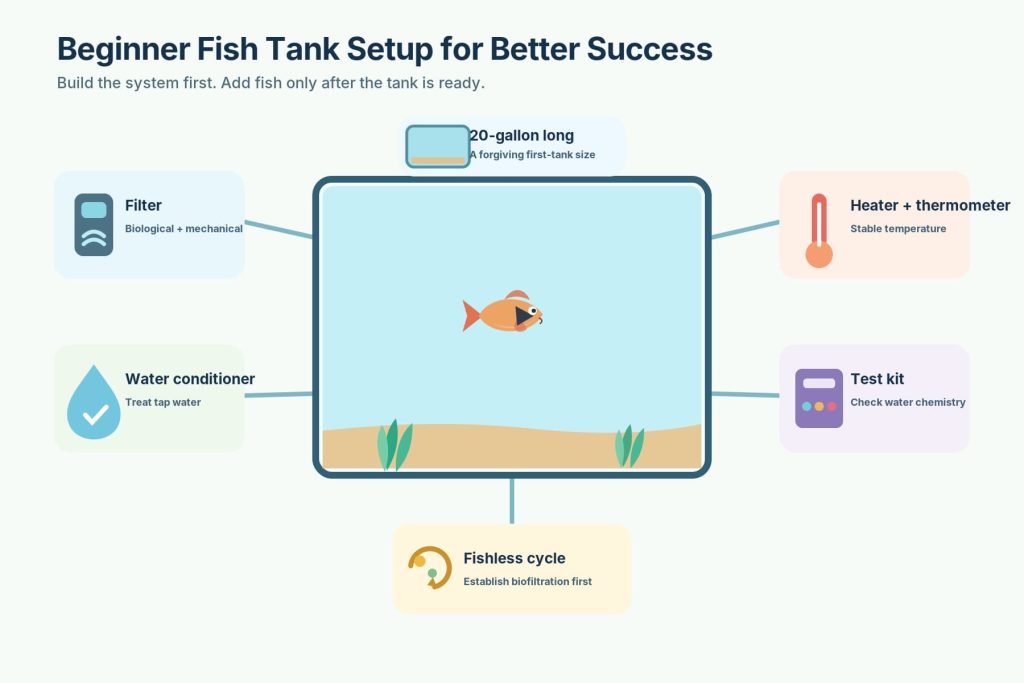
Choose the biggest tank that you can manage comfortably. The 20-gallon long tank is ideal for beginners, as it gives proper swimming space, is wide enough for the establishment of proper social groups, and is able to achieve better water quality than a smaller tank.
Ensure that the filter is suited both to the tank being used and to the fish being kept. The operation of a filter is not simply to clean the tank of dirt but also to provide an environment for microorganisms that make the biological filtration process possible.
Install a heater in case the fish you choose come from warm-climate habitats and do not want the water temperatures to go below a certain point, and ensure that you use a thermometer and do not only guess the room temperature.
Water obtained directly from the tap should be treated with conditioner if the water has chlorine or any other chemicals that have been used in the treatment process.
A biological filtration should be set up before normal stocking. Fish waste eventually results in the formation of ammonia, which is processed into nitrite and then nitrate by beneficial microorganisms. It takes time for a newly set aquarium to have enough such microorganisms to fully process the fish load. In the case of fishless cycling, the process occurs without the introduction of fish into the system.
An aquarium test kit is helpful during the setup stage and is also relevant afterwards, as it enables the confirmation of the tank’s stability, investigation of unusual fish behaviors, and checking whether the maintenance efforts help keep the quality of the water at the appropriate level.
Do not use a “hardy fish” to check whether the aquarium has reached its maturity.
Simple Care Routine for Beginner Aquarium Fish
Effective fishkeeping normally relies on being consistent as opposed to making constant adjustments.
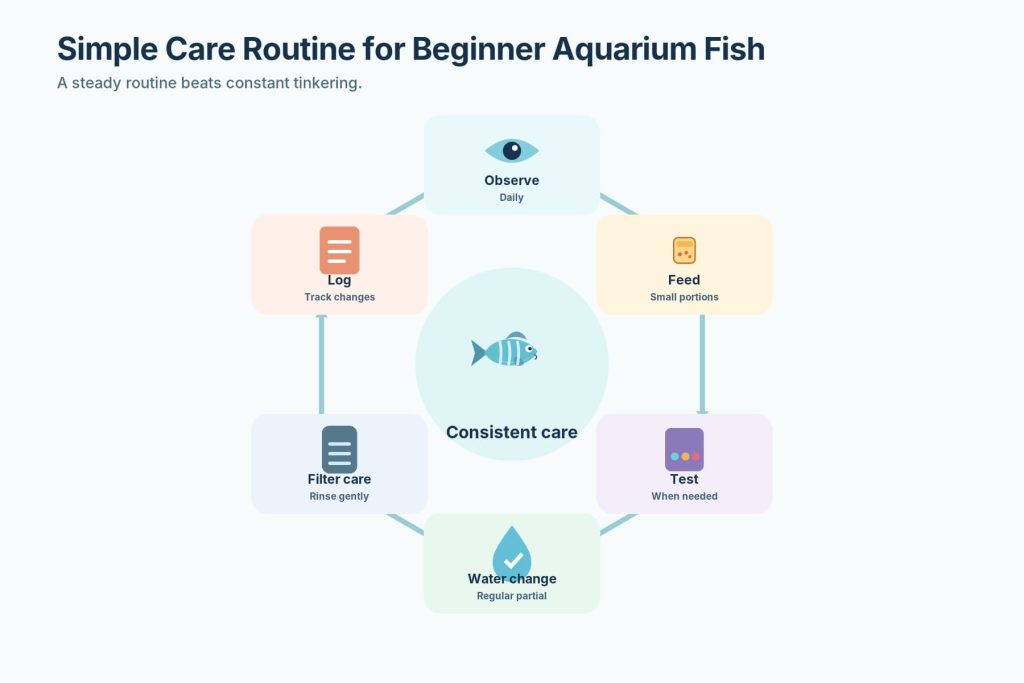
Take the time to observe fish on a daily basis. Comfortable fish are known to swim normally, eat as expected, and display intact fins and natural behavior according to their species. Schooling fish hiding alone are fish that gasp at the surface, breathe rapidly, keep fins clamped, and lose their appetite.
Use little quantities of food instead of putting extra food into the tank. Unconsumed food rots and creates waste that puts extra strain on the tank’s filtration system.
Never miss partial water changes. Most beginner aquariums can maintain a weekly water-change schedule, but the exact amount may vary depending on the level of fish stocking, feeding, nitrate reading, water plants, and water parameters.
Rather than changing every piece of filter media all at once, make sure to clean them properly. This is because cleaning all biological media at once can lead to the loss of a good number of healthy microorganisms from the fish tank.
It is always advisable to keep a simple maintenance log in which important events like fish additions and water tests as well as any unusual occurrences are recorded, which makes it much easier to detect some patterns before they turn into serious issues.
Common Beginner Fishkeeping Mistakes
There are some common errors that can make the task of taking care of simple aquarium fish more difficult.
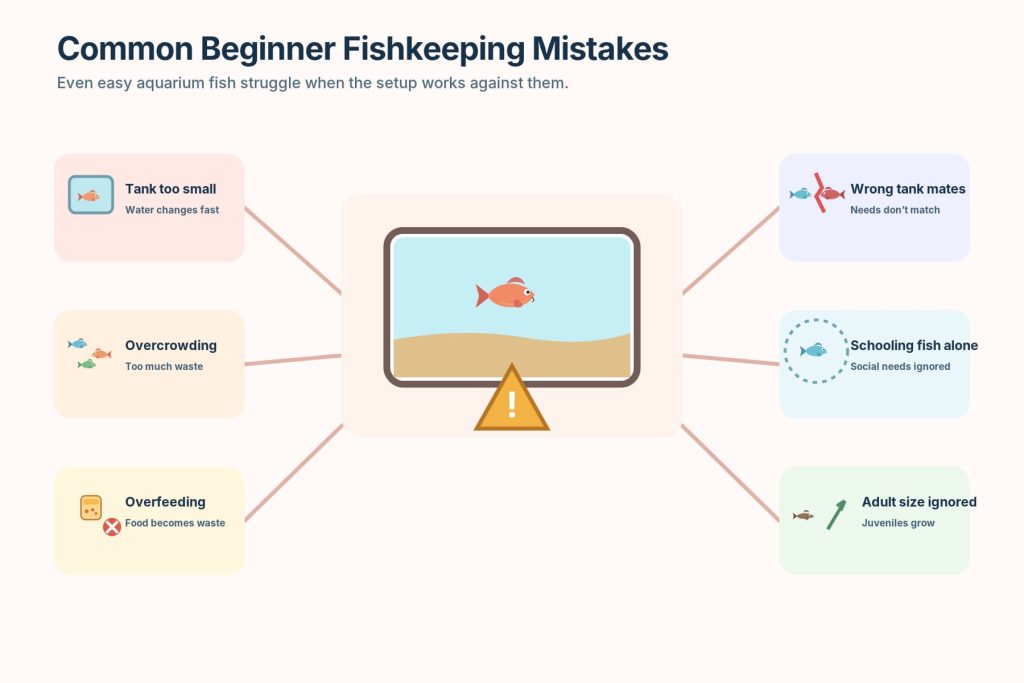
Very small aquariums have a tendency to change fast, particularly in terms of water quality and temperature. Adding fish in large numbers at once is another problem because the aquarium’s biological filtration system will not be ready to cope with the waste produced by all the new fish.
Choosing tank mates based just on their looks is another mistake. In this case it is necessary to match fish according to their needs for temperature, water chemistry, temperament, size, and swimming behavior as well as feeding requirements.
Social animals shouldn’t be cared for alone just because one fish takes less space. One schooling fish doesn’t mean that you were successful in keeping the species.
Overfeeding is another thing to worry about too. Any uneaten food decays and creates extra waste.
It’s necessary to consider adult size before the purchase of the fish. It is possible that the fish may seem small at the shop but grow bigger than the tank you are going to provide.
All in all, simple habits are more important than searching for a particular invulnerable fish. Reasonable tank size, properly cycled tank, good feeding habits, proper tank mates or animals, and good maintenance are the keys to success.
Final Beginner Fish Recommendation
For a lot of first-time aquarists, the best possible choices are likely zebra danios, platies, and harlequin rasboras, as these are not difficult to maintain, they can be good-looking, and they can easily create a simple beginner community in one’s aquarium.
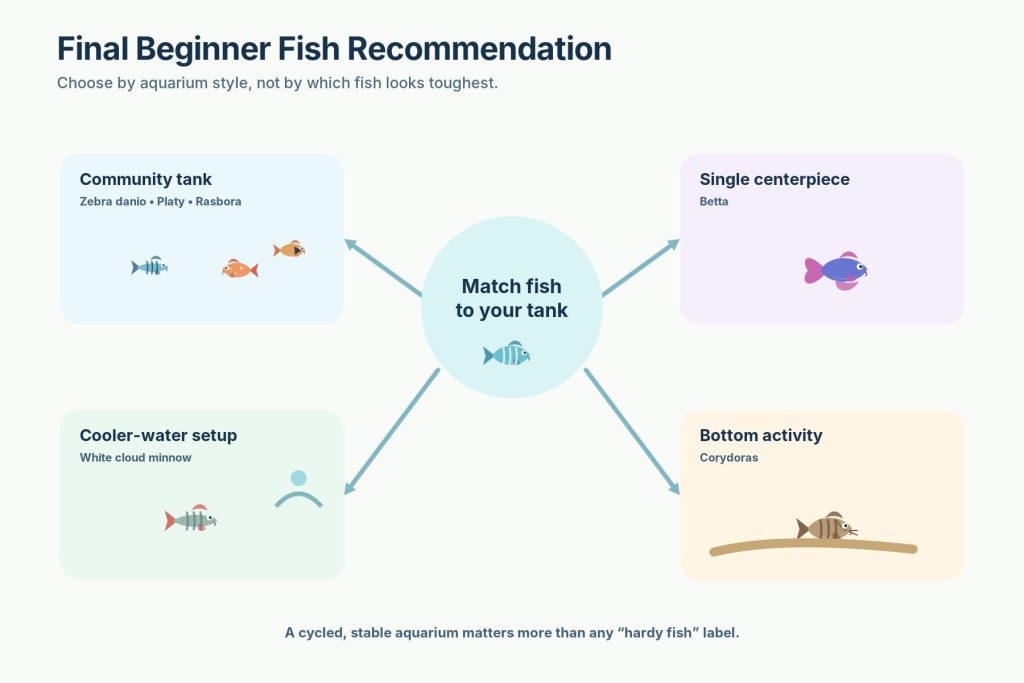
If you want to keep only one centerpiece fish in a properly heated and filtered tank, you can opt for a betta. If you would like to establish a proper cold-water aquarium, opt for white cloud mountain minnows. Go for some tank variety, such as Corydoras, if you have enough bottom space in your aquarium.
The most suitable fish for a beginner aquarium is basically the species with an adult size, social character, water parameters, and temperature that can match the tank.
In many cases, a well-cycled 20-gallon tank with one or two compatible species is a better option for beginners than having a tiny tank filled with several fish species that should be easy to take care of.
Quick answers
Frequently asked questions
What is the correct fish to start with in the aquarium?
Zebra danios are among the best fish to have in an aquarium tank because they are easy to care for, they eat almost anything, and they are readily available. The platies are also suitable fish where hard water is present. But if one is looking to have one fish in the tank, a betta is the best alternative, provided the tank has the proper heating and filtration.
Which fish to keep when starting out in a 10-gallon aquarium?
Having a single betta fish in a properly heated and filtered 10-gallon tank is one of the easiest choices. There are several small schooling fish that may also be kept in such a tank, but they usually require more planning to sort out their social and swimming needs.
Which fish are considered good for beginners in a 20-gallon tank?
A 20-gallon aquarium gives one a few options of fish to start out with. Generally, zebra danios, harlequin rasboras, cherry barbs, guppies, platies, and other appropriately sized species of Corydoras will work.
Do hardy fish do well in newly created aquariums?
It is not, even though hardy fish can survive in slightly changed conditions, but there are still no chances of them tolerating ammonia or nitrites. The best decision would be to cycle the aquarium before fish are added to it.
Are bettas ideal aquarium fish for beginners?
These fish make great beginner fish if they are put in a well-sized, heated, and filtered aquarium. Bettas are not to be considered bowl fish, and male bettas should never be kept together.
Are goldfish suitable for a beginner aquarium?
Even though goldfish can survive well, they need a lot of swimming space, and their biggest disadvantage is that, in fact, they grow very big. There are many easier aquarium fish to choose for a simple aquarium.
Should beginner aquarium fish be provided with a heater?
That would depend on the species. Bettas and many tropical fish prefer warm water consistently, whereas white cloud mountain minnows and zebra danios can thrive in cooler environments. Therefore, one should choose the right equipment based on the fish species instead of following some generalized assumptions regarding keeping freshwater aquariums at the same temperature.
How many fish can beginners keep in their first aquarium?
It is hard to answer this question just with a number because many factors should be taken into account, such as adult size of the fish, activity, social behavior, aquarium size, filtration, and compatibility. Thus, it would be unwise to apply a simple rule such as “one inch of fish for one gallon" for estimating the stocking rate.
How regularly does a beginner fish aquarium need to be watered?
For many aquariums, a weekly water change is a good point to start with. Based on how many fish you have, what you are feeding, the water test results, how quickly your plants are growing, and the quality of water you have, the exact quantity may need to be modified accordingly.
What kind of fish can be classified as beginner-friendly?
The best beginner-friendly fish for tanks will not grow too big, will not have complicated feeding needs or behavior, and will not require excessively complicated water needs. However, even the best fish for beginners can only thrive where water is stable, the tank has been cycled properly, and maintenance is done regularly.

About the author
Chloe Adams
I'm Chloe Adams, a beginner aquarium expert and writer for Stardexa with more than 11 years of experience in the field of fishkeeping. As many beginners find aquariums hard to comprehend, I've kept learning, practicing, and sharing all the basic information from choosing the right aquarium to cycling it, filtering it, feeding the fish, and taking care of water quality as well as maintaining it regularly. My aim is to ensure each novice fishkeeper knows how to turn his/her aquarium into a pleasant and healthy habitat for fish.
Reader Fishkeeping Feedback
Comments, questions, and aquarium reviews
Share your aquarium experience, ask a fish care question, or write a helpful note about tank setup, water quality, filters, algae control, or maintenance for other readers.
No aquarium reviews yet. Be the first to share a helpful review on content or fishkeeping question, setup tip, or care experience.