
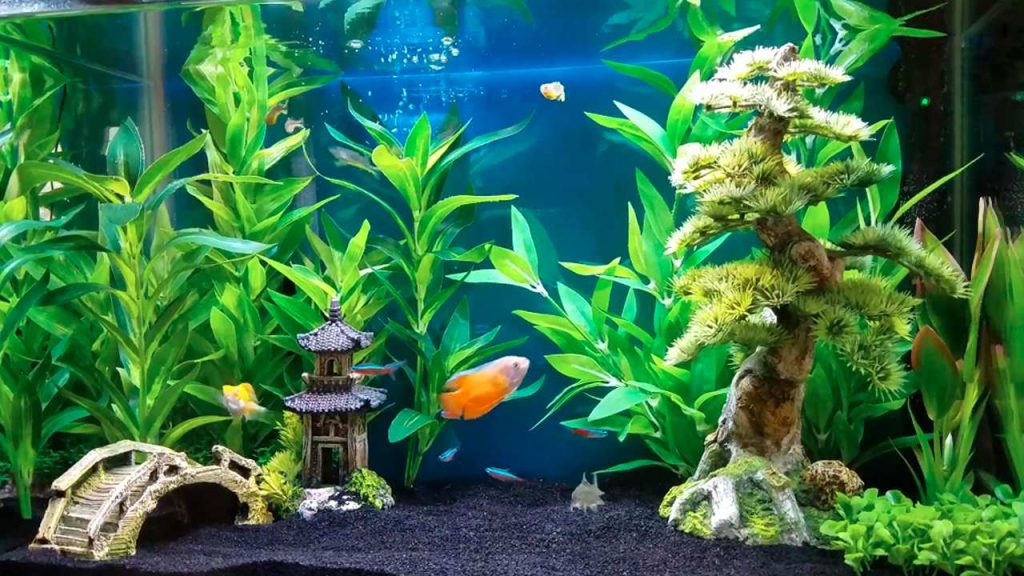
For beginners, Anubias, Java fern, Java moss, Cryptocoryne wendtii, Amazon sword, Vallisneria, hornwort, water wisteria, Bacopa caroliniana, and dwarf sagittaria are excellent plants to use in the first planted aquarium. All of these plants give plenty of options for decorating different levels of the aquarium and creating highlights with hardscape without making the process of maintaining the aquarium complicated.
In addition, there is no need to buy each plant that seems attractive while designing an aquarium for beginners with live plants. Most of the time, a good mix of plants is more effective than using all the sophisticated types of plants. Ground-covering, slow-growing plants will add to the overall structure of the aquarium; planted aquarium plants will help with filling the substrate, and fast-growing plants will create a neat illusion of a full aquarium until the slower types of plants take their roots.
Quick Comparison of the Best Beginner Aquarium Plants
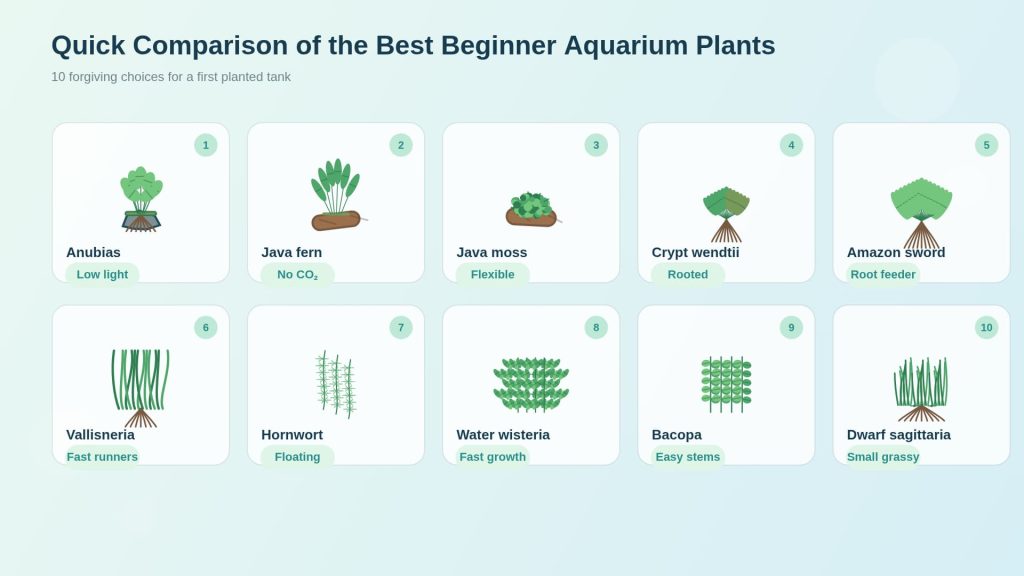
| Plant | Placement | Light | CO2 | Growth | Main Beginner Tip |
| Anubias | Foreground to midground, hardscape | Low–moderate | Not required | Slow | Keep the rhizome exposed |
| Java fern | Midground, rock, driftwood | Low–moderate | Not required | Slow–moderate | Attach rather than bury |
| Java moss | Hardscape, foreground accents | Low–moderate | Not required | Moderate | Trim dense growth |
| Cryptocoryne wendtii | Foreground to midground | Low–moderate | Not required | Slow–moderate | Avoid moving it repeatedly |
| Amazon sword | Midground to background | Low–moderate | Not required | Moderate | Feed the root zone |
| Vallisneria | Background | Low–moderate | Not required | Moderate–fast | Give runners room |
| Hornwort | Floating or background | Low–moderate | Not required | Fast | Thin surface growth |
| Water wisteria | Midground to background | Low–moderate | Not required | Fast | Trim and replant tops |
| Bacopa caroliniana | Midground to background | Low–moderate | Not required | Moderate | Space stems apart |
| Dwarf sagittaria | Foreground to midground | Low–moderate | Not required | Moderate | Keep the crown uncovered |
The main feature that these plants have is precisely what most people look for in simple aquarium plants for beginner aquarists: they are forgiving, adjustable, and appropriate for simple low-tech freshwater setups. All you need to do is acquire the basic knowledge for planting and taking care of the aquarium plants without complicating the issue.
Traits That Make Aquarium Plants Beginner-Friendly
The dependable beginner aquarium plants will relieve a lot of pressure while starting a planted tank. They usually survive under illumination due to low- to moderate-level lighting and do not require pressurized CO₂. Moreover, they will adjust to a big variety of freshwater conditions without requiring daily trimming of their sprouts.
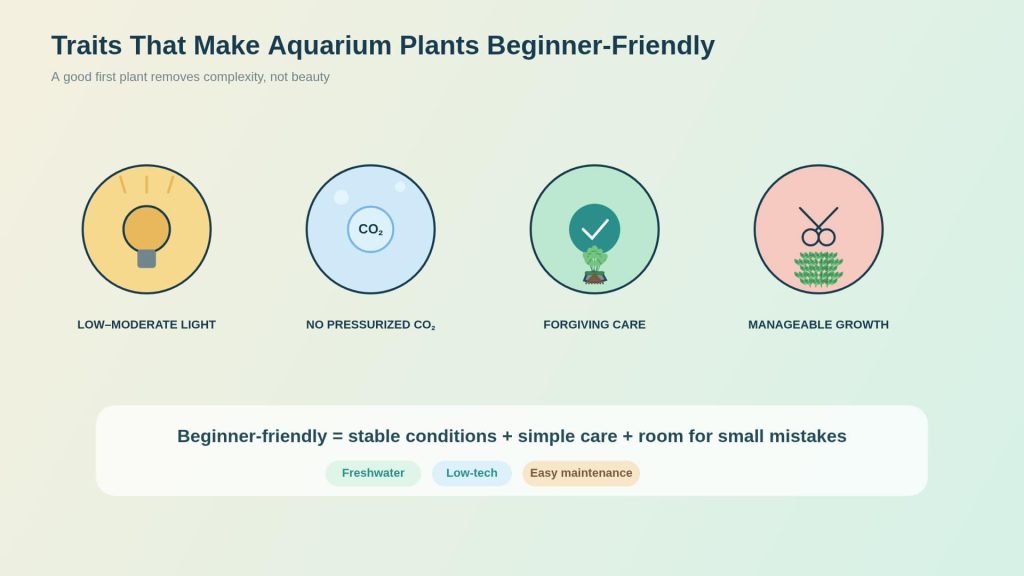
Of course, “low-maintenance” does not equal “no-maintenance.” Live plants still need light, nutrients, favorable conditions of the water, and some time to adapt, but the benefit of beginner aquarium plants is that they give you more time to find your way in aquarium-keeping.
It’s crucial to know that a successful initial batch of freshwater aquarium plants must consist of several different species. For example, Anubias and Java fern are great for learning how epiphytes use your hardscaping materials, while Cryptocoryne and swords will help you learn how plants absorb food through their roots. Additionally, stem plants like Bacopa and water wisteria will let you learn about cutting and propagating plants. The difference in plants will make a beginner’s plant guide much more practical than simply going to a store and picking whichever plants look nice.
1. Anubias
One of the most popular aquarium plants for beginners is Anubias, and the reason for that is not hard to grasp. First of all, its dark green leaves are hard and very durable. Another important advantage of Anubias is its slow growth.
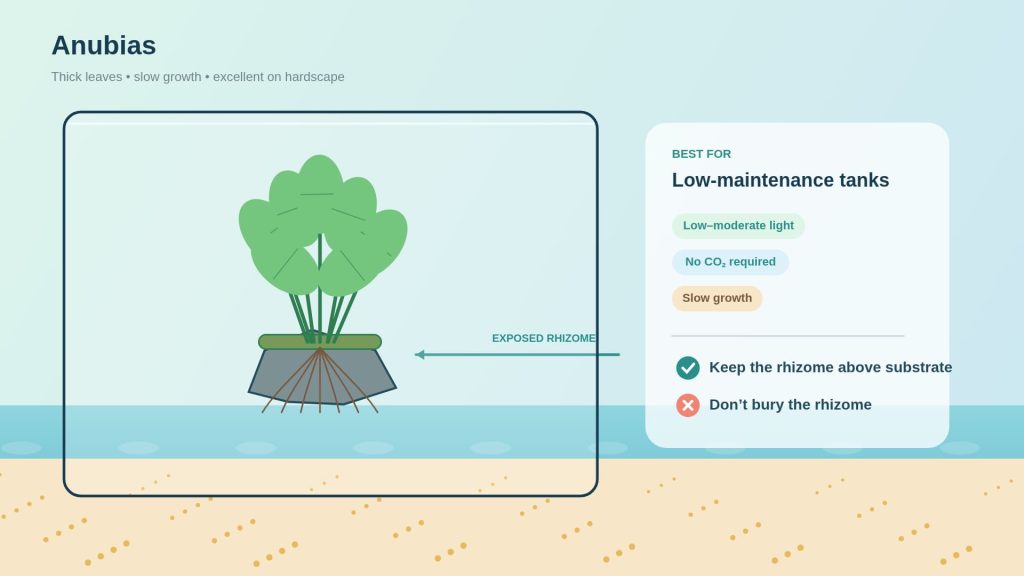
What is most important for newcomers to know about anubias is its rhizome. It is essential that this thick horizontal part of the Anubias plant remain above the substrate. It should either be attached to a rock or piece of driftwood or submerged into the substrate only by the root system, leaving the rhizome above the substrate. Otherwise, the rhizome may rot in the future.
Given that Anubias has a slow growth rate, it will not require much pruning. This is why it is among the best low-maintenance aquarium plants for beginners. A downside to its slow-growing leaves is that they can attract algae if the illumination is excessive, which is why it’s best planted in the shadow.
If you are looking for small aquarium plants for novice owners, Anubias nana and other tiny varieties are extremely useful since they can be placed in decorative stone and wood structures without possessing excessive growth potential.
2. Java Fern
Java fern is one more good aquarium plant for novices. It has a lot of merits such as durability, adaptability, and easy use in freshwater aquariums. Just like Anubias, Java fern originates from rhizomes, meaning the rhizome must be left above the soil.
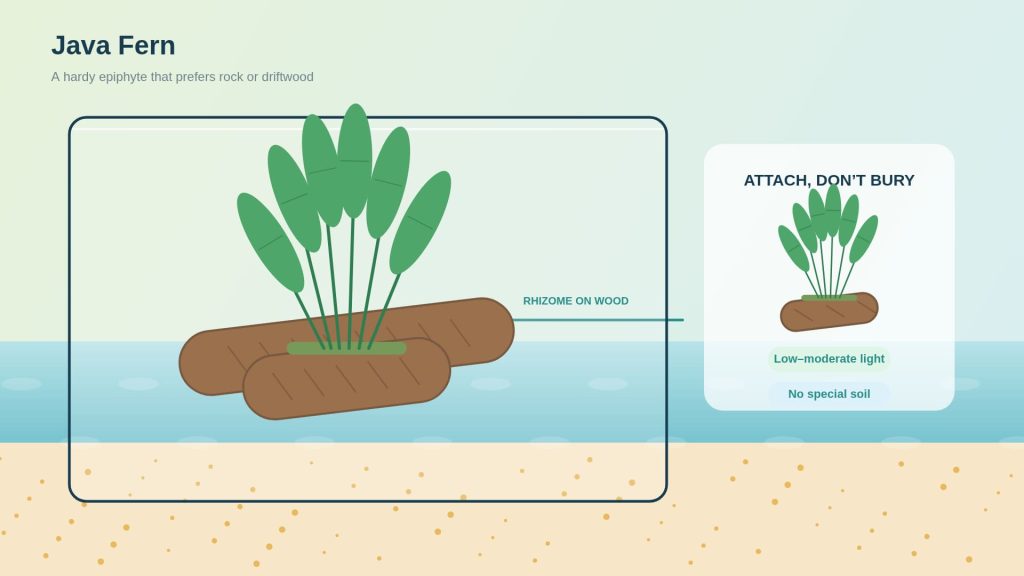
In fact, Java fern should be attached to various types of natural surfaces in order to achieve the best results. This property makes it popular in aquariums with gravel or sand substrates.
You can also find a number of varieties of Java fern, such as the typical form, the narrow-leaved version, trifid, and Windelov. Although the plants look different, they generally need the same kind of care. The majority of them do well in low- to moderate-lighting and do not need the addition of CO₂.
As the plant grows older, the older leaves may produce small plantlets. When they are mature enough, the plantlets can be detached and placed in a new place.
For anyone looking for a very simple aquarium plant that involves no pressing care of trimming, Java ferns are definitely one of the best choices. Find a suitable location for this plant and do not bury its rhizome. The Java fern can survive in the aquarium for a long time.
3. Java Moss
Java moss is regarded as one of the most adaptable fish tank plants for start-ups in the aquarists’ world. There is no one “right” way to use this plant. It can grow on wood, stones, mesh, or any other aquarium-safe areas and eventually develop a soft layer of green.
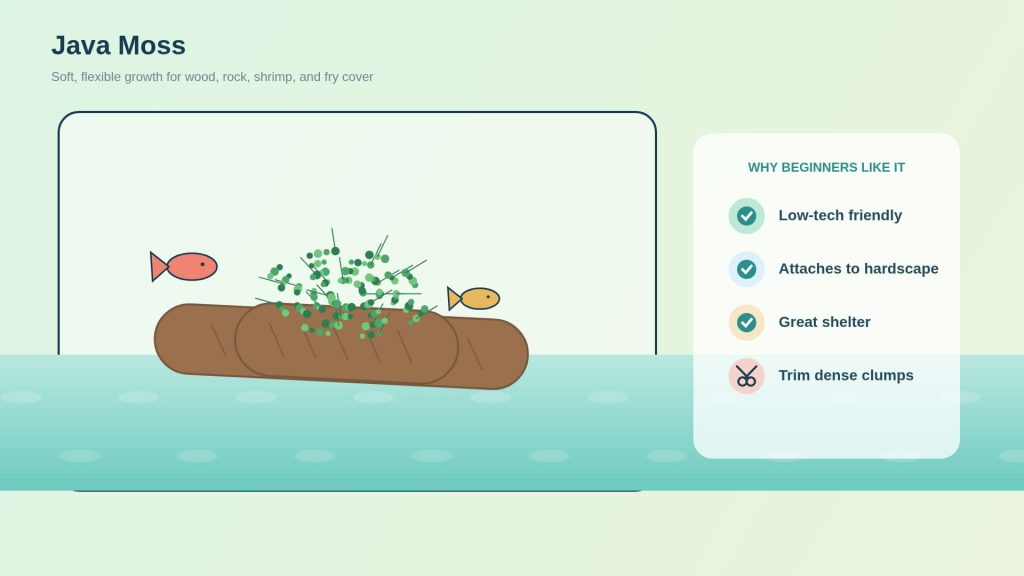
The moss does not demand lots of light and does not require any CO2 injection. The delicate structure of Java moss provides shelters to shrimp, fry, and other small fish living in an aquarium.
Java moss is an easy-to-care-for plant, but very thick clumps of moss may trap debris and block underlying growth. In most cases, regular maintenance of plants in aquariums will help Java moss stay neat. Using small portions of the Java moss instead of tying thick bunches produces better results.
Java moss is a good choice for aquarists who want an easy-to-care plant because it is adaptable to various aquarium conditions and it can be easily formed.
4. Cryptocoryne Wendtii
Cryptocoryne wendtii is quite a reliable rooted plant, which is available in shades of green, brown, and reddish colors. It has soft leaves, which provide texture contrast when planted along with plants having harder leaves like Anubias and Java fern.
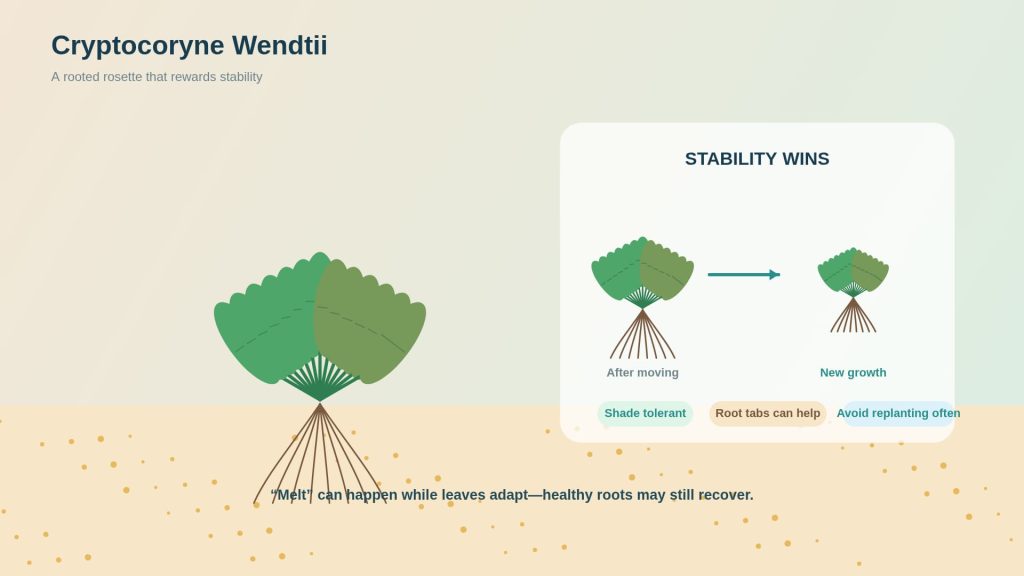
It thrives well in shaded areas, growing at a normal rate, which makes it one of the recommended plants for beginners. It should be planted so that roots go into the substrate with the crown left above the substrate. In case of using plain sand or gravel in the tank, placing fertilizer tablets into the substrate will nourish the plant.
One thing that may shock novice aquarists is the crypt melt phenomenon. That is when, after being moved to a different aquarium, Cryptocoryne loses most of its leaves while caught in adapting to a new environment. The plant may look dead, but in fact, it may still be alive underwater.
Don’t keep uprooting it too often to verify if it survived! Using a stable position and some patience are better options. If both the root system and the environment are good, the plant is likely to produce new leaves.
5. Amazon Sword
The Amazon sword is a popular option for anyone looking for a main or supporting plant. Its large leaves can help a planted aquarium to look mature very fast, but care should be taken since the plants can become large and need enough space.
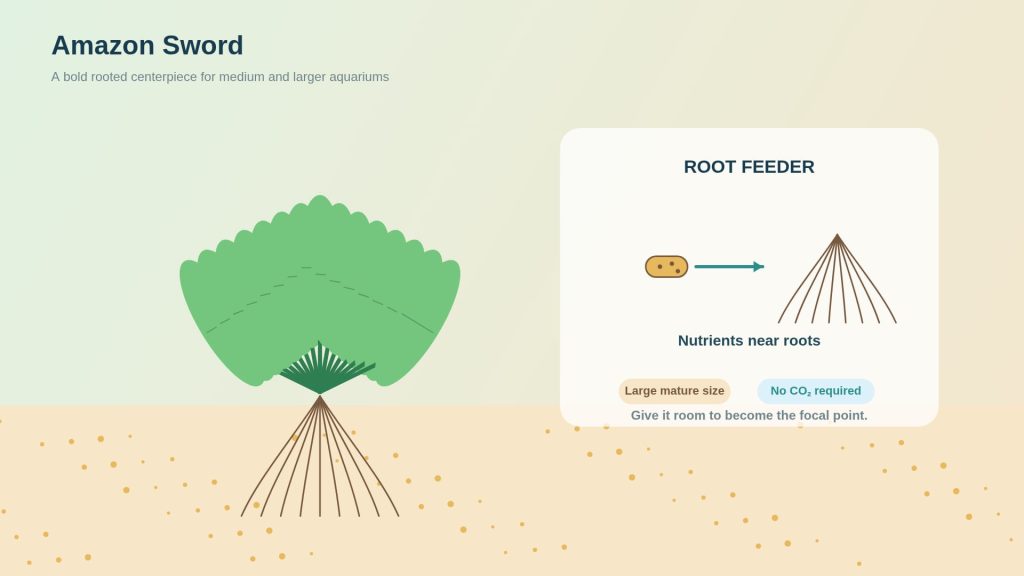
Unlike Anubias or Java fern, the Amazon sword obtains most of its nutrition via its root system. That’s why it should be planted directly into the substrate, and its root zone has to be able to absorb nutrients. The good option here is a substrate that contains nutrients, although even plain sand or gravel can be used together with root tabs.
The Amazon sword is considered one of the best aquarium plants for beginners and would suit any larger aquarium. The plus point is that it does not need the injection of CO₂ and easily makes a great focal point in the aquarium once it starts to develop well.
Do not worry if you notice that some of the mature leaves seem to die a bit after the arrival of the plant. What is more important is how well the new underwater leaves look; made ones are way better evidence for the good adaptation of the plant.
6. Vallisneria
Vallisneria is a wonderful way to create a natural grassy background in the aquarium. Its long ribbon-like leaves are dancing in water, but at the same time, the plant is producing new plantlets spreading through water.
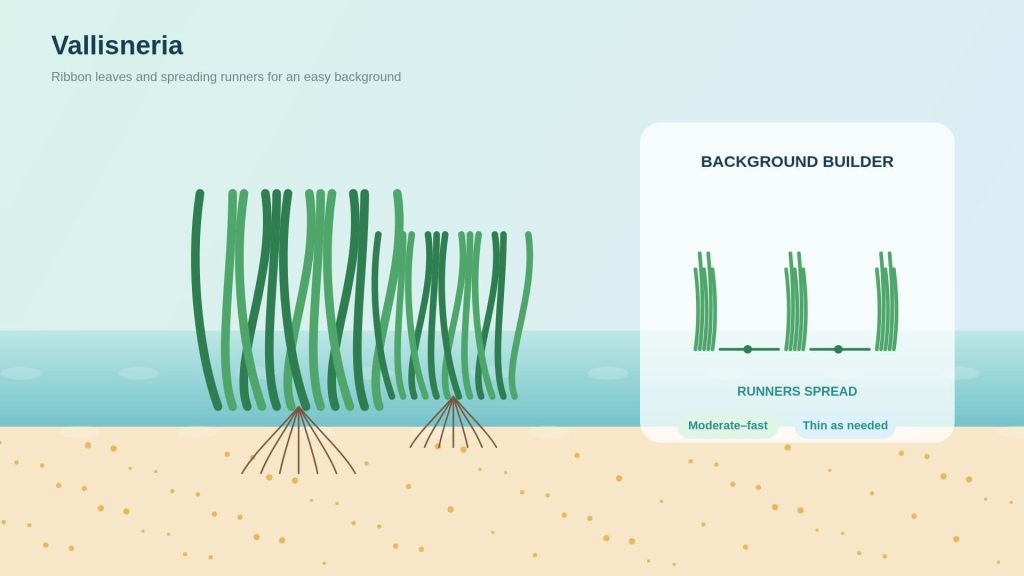
The reason why Vallisneria is one of the best novice plants for aquariums is its spreading habit. So it is necessary to bury the roots under the substrate but not the crown, which should be out of water.
After Vallisneria has settled in, it can begin to expand from the point where it has been initially planted. This does not have to present an issue, but you may occasionally need to clear or redirect some of the plants in order to maintain space for swimming.
For aquarists who are looking for fast-growing plants that are easy to care for, Vallisneria is a feasible choice, as it will fill a good amount of the space in the background without the need for advanced setup. However, in the case of a smaller aquarium, more compact varieties are usually preferred, as they can reduce difficulties in maintaining the aquarium.
7. Hornwort
Hornwort can be a good choice when there is a need to increase the mass of the plants in a short period of time. This plant does not possess real roots and is often grown floating, which allows for avoiding issues related to planting in the soil.
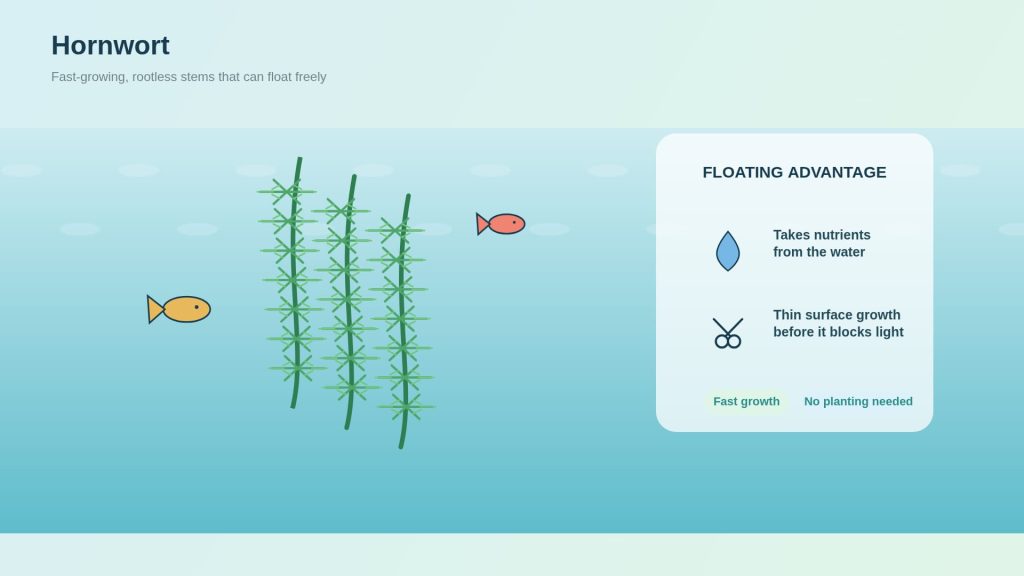
The part of the plant that branches provides plenty of cover, while the plant itself extracts minerals directly from the water. This can be especially handy when slower-growing beginner plants are still growing and may need some time to adapt to their new habitat.
The significant disadvantage to using hornwort is its rapidly growing nature. If left unattended for an extended period of time, hornwort creates a thick layer on the surface that prevents light from getting through to the plants beneath it. This is why it is important to keep its growth in check so that it does not overcrowd the other plants in the tank.
Hornwort is an excellent choice for novice aquarists looking for low-maintenance fish tank plants who wish to have a plant that is easy to establish and grows rather quickly.
8. Water Wisteria
Among easy-to-grow plants for freshwater aquariums, water wisteria is the top choice due to its delicate leaf structure, which gives the tank a lighter feel while nicely accenting the broad-leaved plants like Anubias, Cryptocoryne, and Amazon sword.
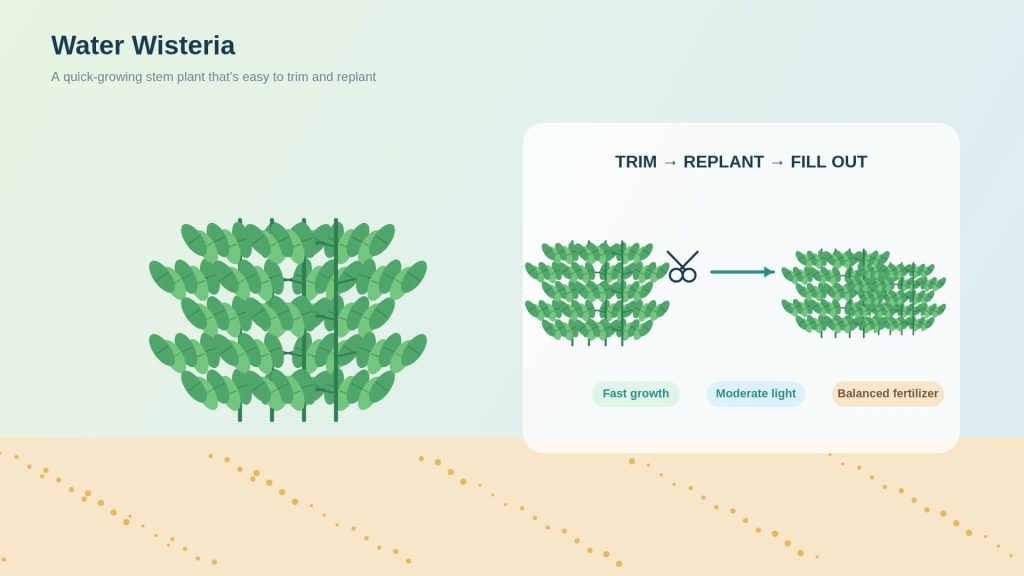
When the stems of water wisteria reach a certain height, the tips of the plant can be removed and planted back into the substrate. This will allow the aquarists to make the tank much fuller without acquiring new plants again and again.
Although water wisteria does not use injected CO₂ for growth, the plant’s quicker growth increases the requirement for light and nutrients for the plant in light of the importance of light to the water plant. If any aquarist wants his initial aquarium to resemble a normal aquarium, it would be easier to manage average lighting and balanced aquarium plant fertilizer.
Due to the fast growth of the plant, regular trimming is essential for the aquarist. The very tall stems of water wisteria can block sunlight from reaching other plants, especially slow-growing plants that need to be established over time.
9. Bacopa Caroliniana
Bacopa caroliniana is an easy-to-manage and easy-to-grow stem plant that has rounded leaves and controlled growth. It grows more slowly than aggressive stem plants and gives a novice aquarist time to prune and keep the plant.
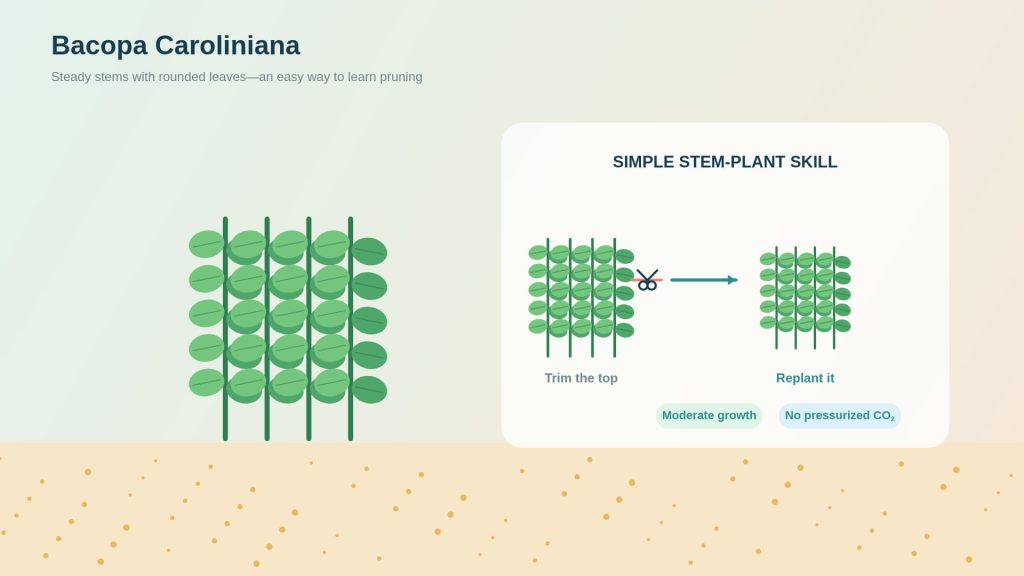
Plant the stems of Bacopa caroliniana in isolation or in a few centimeters of space so that the lower leaves can receive enough light. In case the stem has grown too tall, it is recommended to cut off the top part of the stem and replant it. The lower part will develop new offshoots and become bushier gradually.
Bacopa is an ideal, easy-to-maintain aquarium plant for beginners, because with it, they can learn the basics of cutting and propagation without having to inject CO₂ into their aquariums. Bacopa can be used in the mid-background area of the aquarium.
Having a slow and stable growth of bacopa gives better control over the aquarium from the visual perspective. You will get a stem plant, which does not require constant trimming.
10. Dwarf Sagittaria
Dwarf sagittaria is a grassy rosette plant that can grow well in the foreground or in the midground of the aquarium. During the settling period, the plant will spread with the help of runners and then form groups that create softer transitions between the bare substrate and taller plants.
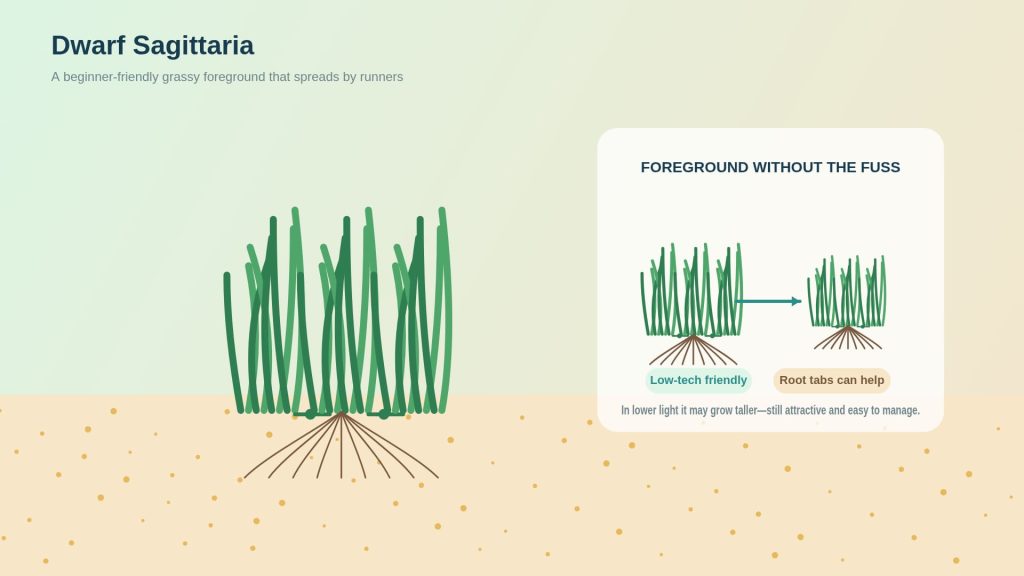
In general, dwarf sagittaria is easier to take care of than characterized carpeting plants that require advanced lighting as well as additional CO₂ sources. In a low-tech tank, dwarf sagittaria may grow taller than in other tanks; thus, there is no possibility of creating a tight carpet, but the natural look of the plant is very attractive.
When planting each crown, be sure the roots are placed under the substrate but that the crown’s center is left above ground. An inert substrate may benefit from occasional rooting tablets to supply nutrients for proper growth.
When you want to select ideal aquarium plants for beginners, you can think about dwarf sagittaria, which is a superb example of non-open foreground plants that don’t require advanced tanks.
A Simple Low-Tech Planting Plan
Beginner aquarists creating will have much more success with these live plants simply by including each type of plant with a purpose in the layout. Rather than making each spot full of plants, you should start from several kinds of plants with different functions.
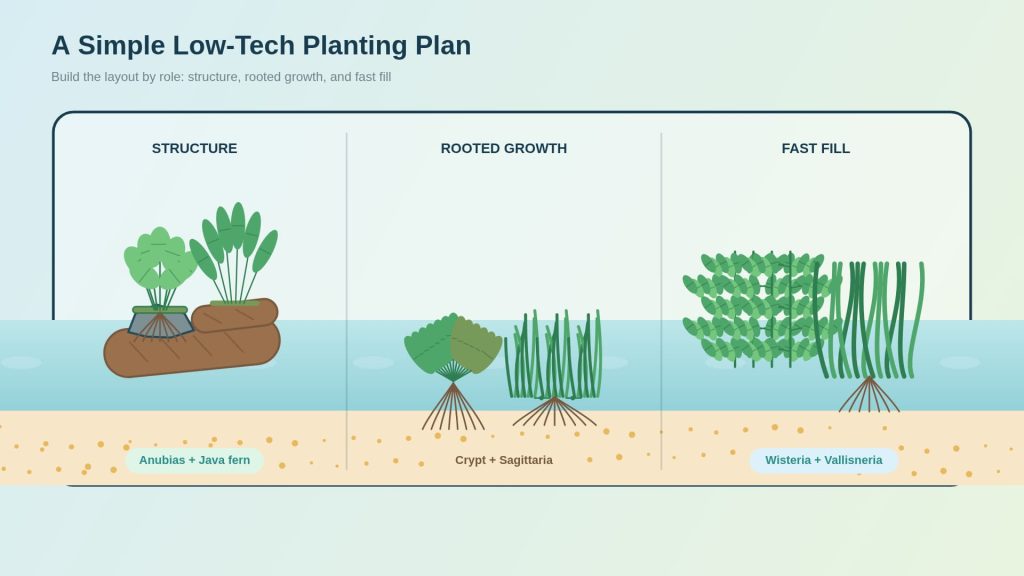
Anubias or Java fern can be used to provide structure, such as on driftwood or rocks. Cryptocoryne, dwarf sagittaria, or Amazon sword can be used to add rooted plants, while you can add one of the fast-growing plants such as water wisteria, hornwort, or Vallisneria for initial plant mass creation.
In a typical aquarium of 10-20 gallons in size, you could use a small Anubias on a foreground rock, a Java fern growing on a piece of driftwood somewhere in the middle, a Cryptocoryne in the middle, and some water wisteria at the back. You could also use some small sword plants, but you should skip the large varieties, as they wouldn’t be able to grow properly in a small aquarium.
The best aquarium plants a beginner should choose would not be those that grow the best. A combination of fast-growing and slow-growing species usually works well and is easier to maintain as well as gives more balanced visual results. Thus, the general rule for aquarium plants for beginners is to be beautiful while not requiring constant maintenance.
Beginner Aquarium Planting Steps
If you want to know how to make an aquarium for beginners, start with the hardscape and substrate and leave space for the plants. Place rocks and driftwood in their position but leave enough space free for plants that occupy the foreground, midground, and background parts of the aquarium.
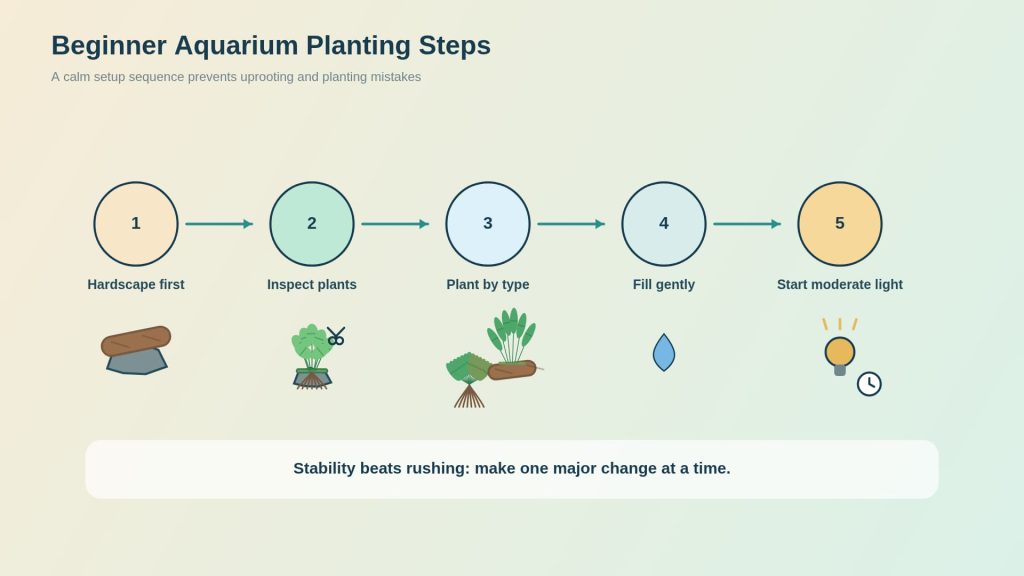
It is important to inspect every new plant before placing it in the water. Remove the leaves that show the signs of damage and decay, and clean the plant properly before planting. You should never throw away the aquarium plants that you don’t want anymore.
For plants that develop from the rhizome, like Anubias and Java fern, you need to attach them to a piece of rock or wood and keep the rhizome free. Inhabiting plants that have roots, like Cryptocoryne and Amazon sword, must have their roots buried underground, but their crowns visible.
Stem plants, such as stem plants, shouldn’t be planted in bunches, and growing individually or in twos is better. Stems need to have a little free space in between so that light reaches the lower leaves.
After everything is in place, fill the tank with water cautiously so that it does not lift freshly planted stems and bulbous plants out of the substrate. You could also use a timer. It’s better to start with light intervals instead of having the aquarium light on all day.
It may be tempting to think that more fertilizers, better lights, or better CO₂ leads to better plants, but that’s not how things work in a beginner-planted aquarium. Often stability is more important than maximum growth. Change one important thing at a time and then give the plants time to react to the changes made.
Light, Substrate, and Fertilizer Basics
Lighting
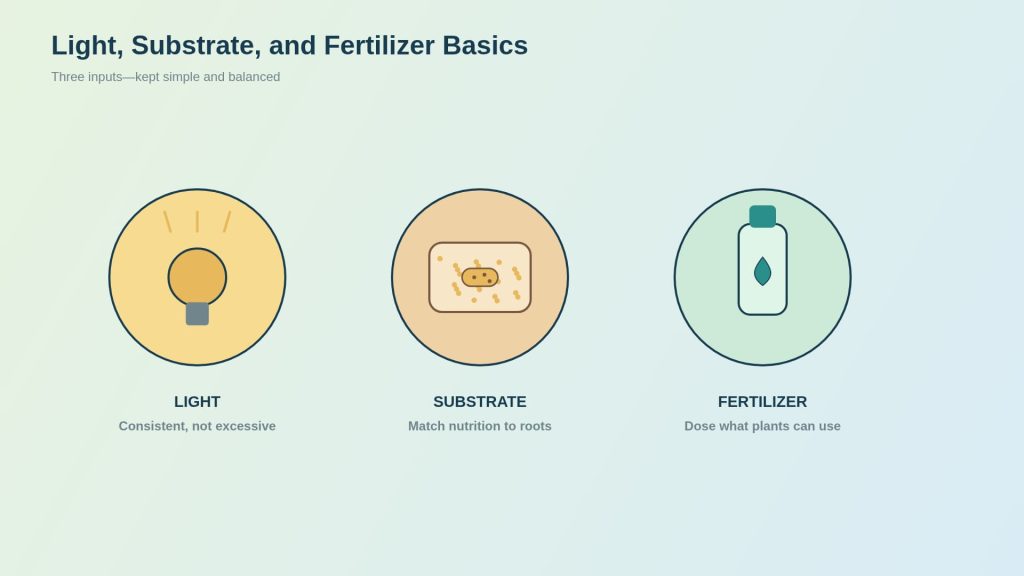
Even low-light aquatic plants require a proper day/night cycle. Start with some reasonable photoperiod and change it slowly depending on what actually happens with plants and algae.
Using brighter light may increase growth of plants, but it also increases their demand for nutrients and carbon. Therefore, strong light can make maintaining a planted aquarium even more complicated for a novice.
It’s advisable to also keep the tank away from direct sunlight. Using a timer connected to a proper aquarium light gives you more control over your job.
Substrate
Some plants do not need expensive planted aquarium soil. Even beginner plants can do well without depending on the soil for their nutrients.
Plants such as Anubias, Java fern, and Java moss as well as floating hornwort do not depend on nutrient-rich soil, which makes them the best plants for novice aquariums.
However, rooted plants such as Amazon swords, Cryptocoryne, Vallisneria, and dwarf sagittaria do need more nutrients surrounding the roots. Simple sand or gravel can still be applied, but root tabs will be necessary for this type of aquarium plants.
Using a specialized substrate for a planted aquarium can ease the nutrition of the roots but is not mandatory, especially for a beginner tank that is less populated with plants.
Fertilizer
Aquarium plants need nutrients, but you shouldn’t add fertilizer just for the sake of adding fertilizer. The idea is to give plants nutrients that they can utilize.
For plant stems and other water column feeders, a balanced liquid aquarium plant fertilizer usually works well, but in the case of heavy root feeders, it is usually better to use root tabs in the substrate.
Use instructions that come with fertilizers instead of thinking that a stronger dose will make things go faster. The fish load, plant mass, type of substrate, water changes, and even the source of water are all important factors in deciding how much additional nutrient your planted tank requires.
Beginner Aquarium Plant Care and Maintenance
Consistent care is the key to taking care of plants in an aquarium. It is not necessary to keep relocating plants or making adjustments every time they change their color.
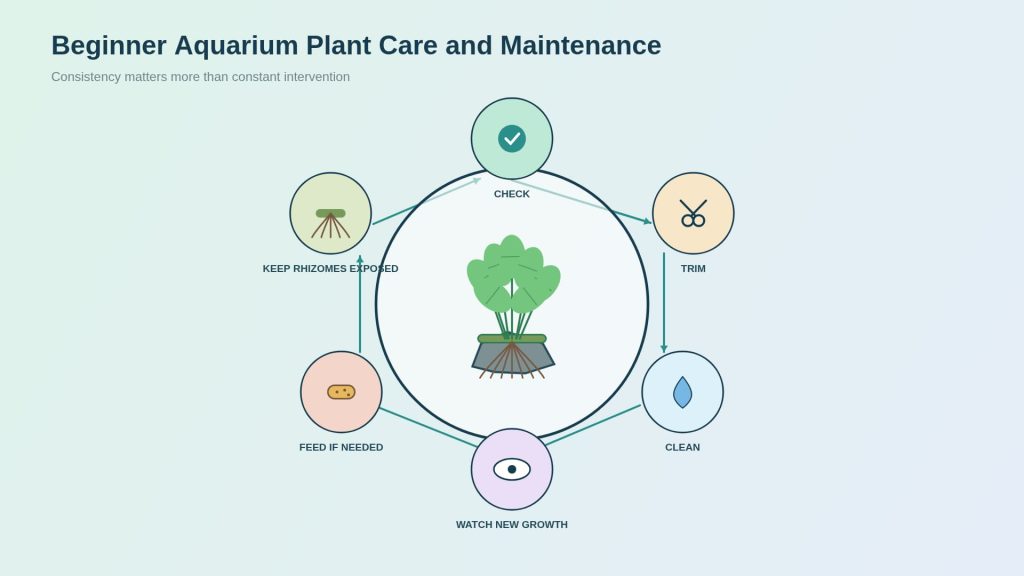
During regular maintenance of aquarium plants, remove leaves that appear to be completely dead, cut down plants that grow in too much shade, and remove any waste. It is also important to ensure that rhizomes are indeed above ground and that freshly planted leaves have not been repaired.
When it comes to plant care as aquarium plants grow, you should start focusing more on new leaves than on those that you have already taken care of. New leaves indicate the way the plant is dealing with the aquarium at present, while older leaves might still look bad even if the problem with the plant has already been resolved.
It is a known fact that fast-growing plants require a much more extensive pruning than slow ones. For example, water wisteria, hornwort, and Vallisneria will need frequent pruning once they become established.
Generally, plants such as Anubias and Java fern need fewer trims compared to others, although older leaves can still accumulate debris. Ensuring that the older leaves are clean helps the plants to reach optimal growth.
Proper care of the plants in the aquarium means that there are times to leave plants alone. If a plant has recently undergone a relocation or a trim, it is sometimes good to leave the plant alone and allow it to get used to the new circumstances.
In terms of aquatic planting, it is best to avoid simultaneous adjustments of different types. This is because when new changes in terms of light, fertilizer, and water conditions take place at the same time, it becomes impossible to find out which change works and which doesn’t.
Common Beginner Problems and Simple Fixes
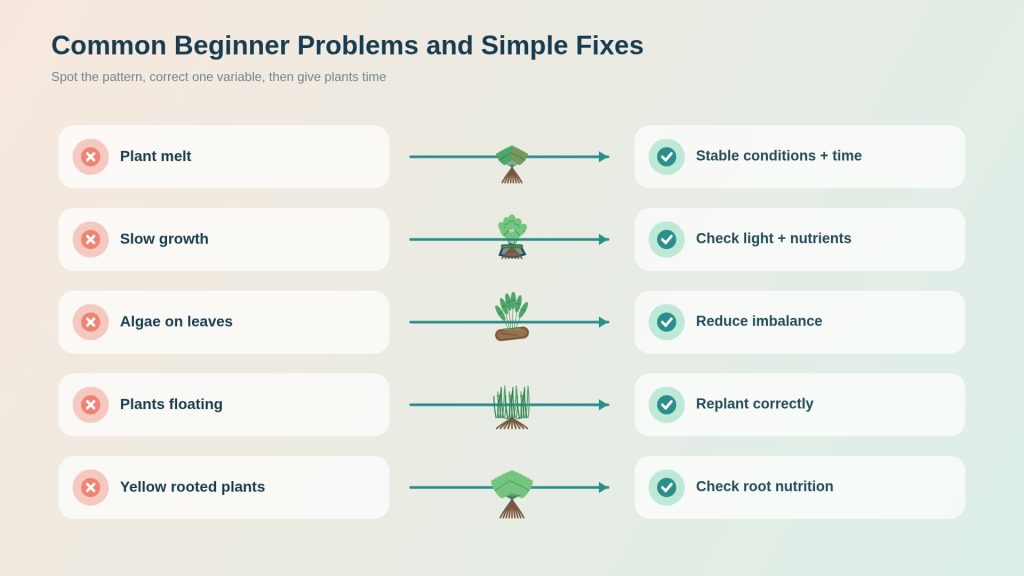
Plant Melt After Setup
Some living plants in the aquarium lose their older leaves when they are relocated to a new aquarium. This takes place if a plant has been grown above water in the nursery or if its environment changes drastically.
Both Cryptocoryne and Amazon sword plants have their periods of adjustment. Trim back dying leaves, but don’t determine the health of a plant based solely on its older leaves. Good roots and new growth underwater are better indicators of how the plant is adjusting.
Slow Growth
A slow growth rate doesn’t mean that the plant is doing bad. Anubias and many different species of Java ferns are naturally slow-growing plants. Thus, if the plant seems stable and produces new leaves every once in a while, it may actually be fine.
If a normally fast-growing plant stops growing, it is necessary to look into the basics. Check whether the conditions of light and supply of nutrients and the presence of higher plants affect the amount of light the plant receives.
Algae on Plant Leaves
It is not rare for algae to make an appearance on the leaves, which are growing at a slow pace. This happens especially when the ratio of plant growth, lighting, nutrients, and maintenance is wrong.
Try to get rid of the visible algae when it is possible, and prune the affected leaves. However, it is advisable to reconsider the amount of light in the aquarium before adding any fertilizers or increasing the lighting period.
It is not necessary to keep the aquarium completely free from algae: the main objective should be controlling the algae while keeping plants growing normally.
Plants Floating Out of the Substrate
Sometimes the roots of newly planted stems and plants in rosettes may loosen from the substrate before they have gotten firmly established.
You should take care in replanting them, but do not bury the crowns and rhizomes too deep just for the sake of having them in place. Group plants such as Anubias and Java fern that are fixed can be easier to care for if they keep getting disturbed by the fish.
Yellow or Weak Rooted Plants
Root-feeding plants growing in plain sand or gravel may require more nutrients around the roots after some time.
You can use root tabs if that is what is needed. Meanwhile, watch for heavy shading and make sure to determine whether the yellowing applies to only old leaves or recently developed leaves.
Beginner Plant Mixes by Tank Goal
If you need to keep maintenance to a minimum, you can use anubias, Java fern, Java moss, and cryptocoryne. These tough aquarium plants for beginners have steady growth and typically do not require regular trimming.
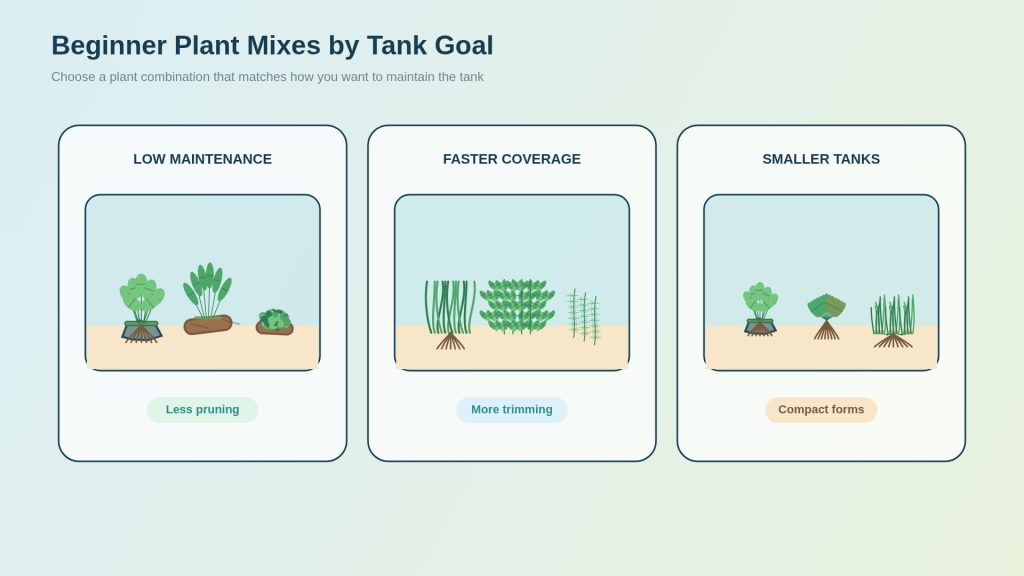
If the plant coverage needs to be quick, you can use Vallisneria, water wisteria, hornwort, and Bacopa. These fast-growing aquarium plants for beginners will allow you to fill a larger space much quicker, though they will need more regular pruning.
For smaller tanks, you might want to use Anubias nana or petite, java moss, small Cryptocoryne varieties, and dwarf Sagittaria. The mature size of the plant is much more important than its initial size, so always check on the potential size of the species before buying it.
In a newly planted betta tank, broad-leaved Anubias and Java fern will allow the fish to hide and provide cozy spots for resting. Long or floating plants may allow softening of bright light as well, but the tank has to have free access to the surface and the right plants for its temperature and environmental conditions.
Ending Note
The most suitable aquarium plants for novices are simply the plants that fit into an aquarium that can be properly cared for. It does not make sense to choose demanding types simply because of their look if the aquarium does not provide their growing conditions.
Anubias and Java fern are perfect for low-light aquascapes, while Cryptocoryne and dwarf sagittaria introduce rooted plants with no aesthetic demand for trimming. The Amazon sword serves as a good accent in big aquariums. Vallisneria, hornwort, and water wisteria are plants that develop fast, while Bacopa is a plant that gives beginners a simple chance to practice pruning.
One does not need sophisticated equipment for the formation of a proper planted aquarium. One can start simply with hardy plants for beginners, use lighting of normal intensity, ensure that the rooted plants get nutrients, and stick to a proper routine. Such an elementary thing will help a beginner make a planted tank.
Quick answers
Frequently asked questions
Which aquarium plants are suitable for novice aquarists?
Some plants that beginner aquarists can consider, because they are easy to maintain, are Anubias, Java fern, Java moss, Cryptocoryne wendtii, Amazon sword, Vallisneria, hornwort, water wisteria, Bacopa caroliniana, and dwarf sagittaria. Remember that choosing the right choice depends on the tank size, light intensity, quality of substrate, and necessary maintenance.
Which aquarium plants can be grown effectively and easily?
The plants such as Anubias and Java fern are easy to use, as they do not need high light intensity or injection of CO₂. They can also be attached to rocks or woody pieces of driftwood instead of using soil that is rich in nutrients.
Do beginner aquatic plants need to have CO₂?
Plants discussed in this article do not require CO₂ injection; therefore, there is no need to add CO₂ in order to have effective growing conditions for low-tech tanks.
What are some types of beginner aquarium plants that can grow in gravel?
Plants like Anubias and Java fern can grow in gravel, as they can be fixed onto stones or driftwood. It is also possible for plants like Cryptocoryne, Amazon sword, Vallisneria, Bacopa, water wisteria, and dwarf sagittaria to grow in gravel if the correct planting techniques and nutrients are used.
What beginner aquarium plants grow in sand?
The same plant species can grow well in aquarium sand. Aquarium plants that feed through their roots will do well with root tabs since sand is not capable of providing all of the required nutrition.
What are some aquarium plants that grow in low-light conditions?
Some good types of aquarium plants that can thrive in low-light conditions are Anubias, Java fern, Java moss, and Cryptocoryne wendtii. However, low light doesn’t mean that there is no light; such plants will thrive better under natural conditions.
What are the quickest-growing beginner aquarium plants?
Some of the fastest-growing plants included in this article are water wisteria, hornwort, and well-established Vallisneria plants. They are useful for quickly filling up the aquarium space but also imply regular maintenance.
Which aquarium plants are the smallest growing?
Species of Anubias, petite varieties of Cryptocoryne, Java moss, and dwarf sagittaria are some of the easiest plants that can be used in small aquariums. The size will vary depending on the species and the conditions in the tank.
Do aquarium plants need fertilizer if fish are present?
Fish waste gives certain nutrients, but it cannot provide them in a proper concentration. Even root-feeding plants can benefit from root tabs, while plants that take nutrients out of water can take advantage of nice liquid fertilizer.
How often to trim new aquarium plants?
Rather than following a schedule, trim based on each plant’s growth rate. Fast-growing plants will need to be trimmed frequently, but Anubias and Java fern generally require little more than taking off the occasional old or damaged leaf.
What does the melting of new aquarium plants mean?
Some species of plants can shed their old leaves while they adapt to submerged growth. Do not focus on old leaves, but look for healthy roots and new underwater growth instead.
How to set up a planted aquarium easily?
Use one of each of three different types of plants: one attached plant (e.g., Anubias), one planted plant (e.g., Cryptocoryne), and one plant that grows quickly (e.g., water wisteria). Maintain the same light, fertilize properly, and do not make too many radical changes at once.

About the author
Olivia Brooks
I am Olivia Brooks, an expert in freshwater aquariums. Being a fish enthusiast myself, I have learned a lot about how to keep aquariums healthy and very pleasant. At Stardexa, I offer clear and easy-to-read tips on many subjects related to freshwater fish and aquaristics in general. This is what helps fish keepers of all experience levels make better decisions.
Reader Fishkeeping Feedback
Comments, questions, and aquarium reviews
Share your aquarium experience, ask a fish care question, or write a helpful note about tank setup, water quality, filters, algae control, or maintenance for other readers.
No aquarium reviews yet. Be the first to share a helpful review on content or fishkeeping question, setup tip, or care experience.