About Me
I am Daniel Reed. For over seven years now, aquariums have become a serious subject of applied studies for me. I have learned that in most cases, in order to assess the condition of any fish, one has to look deeper than just the symptoms. For example, a fish may begin not to eat, to hide, to clamp its fins, to breathe differently, to develop spots on its body, to lose its color, or to get injured. However, I believe it should be looked at from the following perspective: What changed?
This principle helps me in writing fish health guides for Stardexa. I help aquarists to understand the problems of fish in context. Instead of looking at each behavioral change or each mark on the fish’s body as an isolated incident, I find it worth looking at the fish’s general condition, including the water conditions, stress factors, neighbors, recent changes in the aquarium, feeding techniques, keeping the aquarium, and the overall picture.
I aim to make the topics of fish disease symptoms, the behavior of sick fish, the quality of water in the aquarium, common diseases of aquarium fishes, and signs of fish stress much easier to understand for aquarists.
My Aquarium Experience
For over seven years, I have built up my aquarium knowledge when it comes to common problems dealing with the keeping of fish around the world. I pay attention to how fish appear, their swimming patterns, their breathing and eating habits, social interactions, and reactions to changes in their environment.
Water parameters are always extremely important in this process. When I do a search or provide an explanation regarding a fish health concern, I always remind people to measure some important parameters of aquariums such as temperature, pH, ammonia, nitrite, nitrate, filtration, oxygen levels, stocking rates, recent activities, and the introduction of new fish or plants.
That broader approach is very important since the different health problems might give the same signals. In addition, fish veterinary recommendations for fish health also prescribe stress, water quality, overcrowding, infectious agents, and quarantine as important factors in fish disease diagnosis.
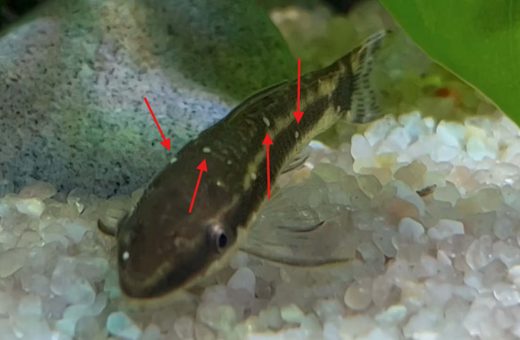
For example, if the aquarium owner notices white patches, it could compel the individual to look up ich or white spot disease. The discovery of ragged fins would raise the suspicion of fin rot. By seeing fish flashing, rubbing, excessive mucous, or strange breathing, an individual might explore issues of fish parasites. If some strange growth occurs, the presence of a fungal disease may be suspected. Hiding behavior, loss of appetite, weird swimming, and rapid breathing would call for an investigation of tank conditions and stress.
As a writer, I make it my duty to help readers make sense of these observations without exacerbating already stressful situations.
What I Write About
Most of my writing is devoted to fish problems and guiding aquarium hobbyists in terms of what to observe at that point.
Regularly, I deal with writing about ich and white spot disease, fin rot, fish parasites, fungal illnesses, fish stress, bad aquarium water, quarantine aquariums, sick fish, and other fish health issues.
While discussing issues, I answer the questions that tend to arise in the minds of aquarists as soon as they realize that there is something wrong.
What does the fish issue usually look like? Are there any other signs that may indicate a problem? Is it possible that the quality of the water in the aquarium is contributing to the situation? Should I consider keeping away the sick fish from the other inhabitants? Will my other fish be affected? What things do I need to check before thinking of treatment options? And at what point should professional help be sought?
I want people to get something useful out of each guide, not just the name of the sickness.
How I Approach Fish Health Information
I think that good fish disease information should be based on observation, not just action.
When a fish is suddenly spotted sick, it is tempting to turn to medicine immediately. I believe that it is better to consider the possible problem together with the aquarium conditions first. Therefore, I will constantly refer you back to water tests, recent changes, quarantine history, visible symptoms, and fish behavior.
Quarantining, in my opinion, is a very crucial topic. A quarantine aquarium is an aquarium that allows the keeping of fish that have recently been added to the collection for infections or illnesses for further observation. There is a common belief that quarantining helps in preventing the introduction of pathogens into the main aquarium, and thus, it is an important aspect of good fish care.
In my guides, I do share aquarium quarantine tank features, setup, and limitations as well as procedures for observing the new inhabitants of aquariums.
At the same time, I do not want to suggest that aquarium diagnosis is simple. Identical symptoms can indicate different health problems. In case of serious symptoms or troublesome cases, it is better to consult a specialist, fish veterinarian, or aquatic health professional.
Why I Write for Aquarium Keepers
Unlike most pets, fish do not communicate their health problems, which allows observation to become one of the most important and developed aquarium keeping skills.
An aquarium keeper who notices signs such as white spots on a fish’s body, lack of appetite, rubbing its body against objects, hiding more than usual, breathing in and out more often, and damage in fins can use my writing to learn more about treatment for fish that made him notice these symptoms.
I target sharing information about fish keeping with both beginner aquarists and hobbyists who are looking for a reliable source of information.
I want to explain complex issues regarding fish health in ways that are easy to understand without making them too simple. I do not use fear tactics or miracle cures, nor do I treat every aquarium problem as if there is a miracle cure that solves them all. I focus on the problems themselves (symptoms), the cause of those, different aquarium conditions, prevention, quarantine, and practical fish care.
At Stardexa, I continue my work on aquarium fish issues, their diseases, symptoms of ich, fin rot, parasites, fungal infections, stress, water quality, quarantine tanks, and treatment options.
Despite my 7 years’ worth of experience with aquariums, I still stick to my principle of keen observation of the fish’s bodies and aquarium in general. It makes my decision-making better.
An aquarium is only able to flourish well through regular maintenance, so I want my articles to help aquarists provide better care services.
Contact: [email protected]

No comments yet. After you submit a comment while logged in, it will appear here.