
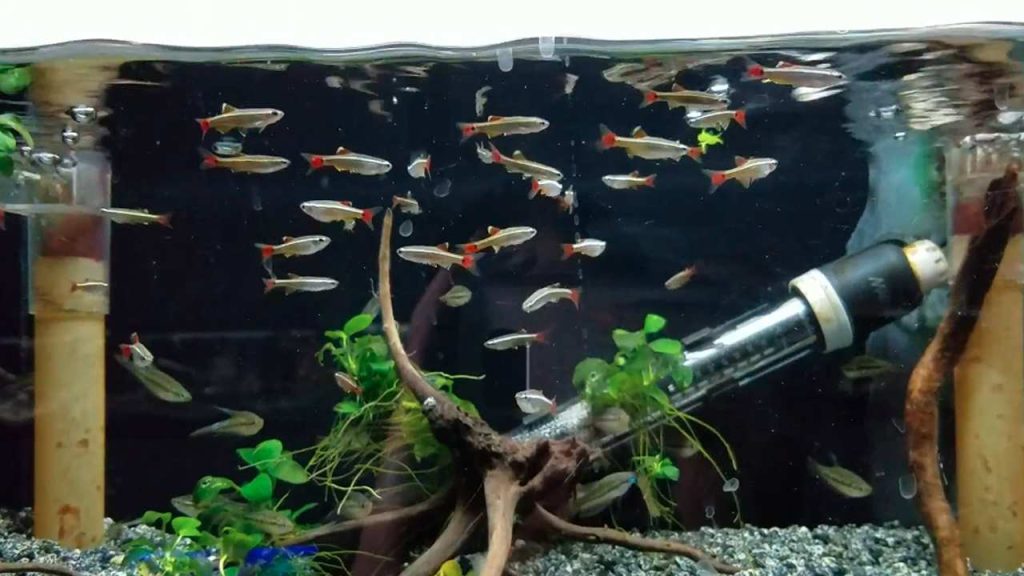
The best fish tank setup for beginners
The first aquarium for any beginning aquarist is preferably a 20-gallon freshwater aquarium. It allows better water conditions to develop in comparison with the tabletop tank but remains quite cheap, convenient, and manageable.
A reliable starting set must include a good aquarium stand, filter, thermometer, heater, cover, lighting, water treatment products, test kits, proper substrate, hiding spots, a gravel vacuum cleaner, and allow the developing of the biological cycle within the tank before stocking it with all planned inhabitants. A larger water volume means fewer fluctuations in water parameters that allow additional time for a novice fishkeeper to detect and resolve arising issues.
It is better to see the aquarium as a full-fledged life support system rather than as just a vessel with a lot of decorations. Every single thing in and around the aquarium must somehow help with water quality, temperature regulation, oxygenation, filtration, or fish behavior.
Planning the aquarium around the fish
Decide on the type of fish to keep before choosing the aquarium to ensure that you do not buy a tank that is too small for your fish in terms of its adult size, swimming needs, sociability, or filtration.
Find out these details about each species:
- Adult size
- Minimum group size
- Swimming height and activity
- Temperature requirements
- Temperament and compatibility
- Water hardness and pH preferences
- Filtering needs and water flow
- Need for plants, caves, or open spaces
The capacity of your aquarium cannot be calculated by using a single formula of inches per gallon. Adult size, body form, activity level, amount of waste produced, tendency to become aggressive, filtering power, and swimming space all go into determining the number of fish that should be kept.
Choosing the right aquarium size
The bigger the size of the aquarium, the higher the price you may have to pay initially, but a larger tank will generally provide a greater margin of error for beginners. The effect of slightly overfeeding your fish, forgetting a water change, or an error with the heater will be felt in a smaller tank quickly.
10-gallon fish tank setup
Ten-gallon fish tanks work well with one properly housed betta or with well-planned small fish groups. As the amount of water is small, the number of fish should not be too high, and water quality should be checked on a regular basis.
Small fish tanks do seem easy to take care of; however, this may not be so in most cases. Changes in temperature and other conditions of the water can occur much faster in a smaller tank.
20-gallon fish tank setup
A 20-gallon fish tank setup would be a wise option for many novice aquarists, as it provides ample space for plants and shelters along with a small school of compatible fish and provides better water stability in comparison with small aquarium kits.
While having the same volume of water in each tank, the aquarium, which is longer but not necessarily higher, will be more beneficial than the opposite variant because of the greater efficiency of gas exchange on the increased surface and additional space for swimming fish.
55-gallon fish tank setup
The 55-gallon fish tank setup looks stunning and allows a broader range of fish. At the same time, it means that you will need a solid and level stand, a considerable quantity of the substrate, large equipment, and additional expenses on its maintenance.
This aquarium must be chosen only after making sure that the floor will sustain it with water in it and there is enough space around for working with it. It also means taking into account the size of your future fish.
Essential equipment for a beginner aquarium
Fish tank setup kits will have an aquarium, lid, light, and filters included; however, not all kits will provide everything necessary for the complete setup of your aquarium. Be sure to read the package before buying any other items.
An aquarium fish tank setup requires the following:
Aquarium and stand: The stand should be level and able to hold a fully filled aquarium.
Filter: It needs to be chosen depending on the size of your aquarium. It should take care of the visible particles and provide adequate surface area for beneficial bacteria.
Heater and thermometer: Tropical fish need constant water temperature, so make sure to get the heater suitable for the aquarium size and type of fish you have.
Water conditioner: Tap water can contain chlorine and chloramine. These substances can be harmful for both fish and bacteria. So, the conditioner should treat them.
Kit for Water Tests: At the least, the kit must have means for testing the ammonia level, nitrites, nitrates, and pH. It is always necessary to maintain a separate thermometer despite the temperature dial of the heater.
Substratum: Depending on the types of fish, plants, and the general appearance, it could be gravel, sand, or even a planted substrate. Bottom-dwellers would feel comfortable in a substrate that does not damage their bodies.
Cover and lighting: The cover prevents evaporation and jumping of the fish, while the lighting would allow both viewing and growth of the plants without being on at all times.
Tools for maintenance: You need a separate aquarium bucket, gravel vacuum, algae cleaner, and fish net. None of those should be used for other purposes within the house.
In my opinion, it is more important to have proper filtering and water tests than various gadgets. A nice aquarium would never last without stable water chemistry.
Step-by-step freshwater fish tank setup
1. Prepare a safe location
Position the aquarium far from direct sunlight, heating devices, air conditioning, doors leading to outside, or other places where there are drastic changes in temperatures. Also, leave sufficient space around the aquarium for the filter, cords, hoses, and maintenance. The surface on which the aquarium will stand must be flat and capable of holding up the full weight of the aquarium.
Direct sunlight can lead to the growth of algae, and the sunlight will heat the water differently throughout the day. It is important that power outlets be near, but all power cords must go below the outlet before going up to the plug, creating a drip loop.
2. Inspect and rinse the tank
Look for any damages, cracks, missing parts, or any other problems. Wash your empty aquarium and plain aquarium gravel with water.
Do not use soap, household sprays, or any chemicals, as even the smallest amount will be detrimental to the fish. Performing a simple test for leaks will also be easier without decorations and any equipment.
3. Add substrate and hardscape
The substrate needs to be spread at the bottom of the tank with a bit thicker covering in the sections where the rooted plants will go. Rocks, caves, wood, and plants should be set up in the tank when it is either completely or partially dry.
Fish need many hideouts to take refuge in case they become stressed; however, the active fish need open spaces to swim in. The rocks and other decorations need to be stable, as the fish can easily dig and move them around.
4. Install the equipment
Install the filter, the heater, the thermometer, and the light according to the manual provided with each item separately. You should never turn the filter and the heater on until they have enough water inside them.
The thermometer needs to be placed in the position where you can see it easily each time you check on it. The heater needs to be positioned near some water movement.
5. Fill and condition the water
Place a clean plate or bowl above the substrate and pour the water into it carefully. In such a way, you will make the water less cloudy and avoid making it interfere with the structure you have already made.
Use the proper dosage of water conditioner depending on the volume of the whole aquarium. Leaving tap water to sit in an open container might get rid of some of the chlorine, but it is not guaranteed to eliminate chloramines.
6. Start the filter and heater
Once the tank has been filled, turn on your filter, heater, and other equipment used to circulate the water in the tank. Ensure the water is flowing in the right direction and gradually increasing the temperature in the tank.
Leave everything on for a while and check for any leaks, odd noises, insufficient flow of water or heating, or problems with the equipment. It will be easier to fix them when there are no fish in the tank yet.
Completing the nitrogen cycle
A new filter can be shiny and seem prepared for use, but it lacks beneficial bacteria required to break down fish waste. In addition, uneaten food, fish waste, and decomposing plant material may result in the presence of ammonia in the water.
In a nitrogen cycle, one kind of bacteria breaks ammonia down into nitrite, and another kind breaks nitrite down into nitrate. Ammonia and nitrite are extremely toxic for fish, while nitrate can be regulated by regular partial water changes, the usage of live plants, sensible fish feed, and good fish stocking practices.
Follow a good fishless cycling method that includes an exact ammonia source, adequate biological filter media, and a water test kit. Though bottled bacteria and mature filter media from an existing healthy aquarium can speed up the process, testing is needed.
Cycling may take four to six weeks; however, every aquarium works at its own pace. Do not depend on the time frame only. Your aquarium is cycled only after testing shows that your biological filter is capable of breaking ammonia down to the point where ammonia and nitrite become undetectable.
Matching the setup to different fish
Betta fish tank setup
The appropriate betta fish tank setup involves warm conditioned water, a mild filtration system, a lid, a thermometer, smooth decorations, and comfortable hideouts. Bettas can breathe from air above the water surface; however, they require a completely cycled and filtered tank. Powerful currents could tire them; therefore, it is possible to use an adjustable filter or even a flow baffle.
Perhaps the best betta fish tank setup idea would be a 5- or 10-gallon planted tank with wide resting places for the fish and a comfortable cave while allowing easy access to the surface of the water. Such a tank will give the fish enough comfort and places to move around.
Guppy fish tank setup
The right guppy fish tank setup requires stable tropical water, a filtration system, open swimming spaces, and plants. Guppies are very active and social fish; therefore, the aquarium needs to provide enough space not for one fish but for the whole colony of guppies.
Think carefully before adding males and females to the tank since guppies multiply quite rapidly. It means that without a careful plan of dealing with the young generation, the lightly stocked aquarium will become overcrowded in no time.
Saltwater and reef aquarium setup
A saltwater fish tank setup is similar to a freshwater fish tank setup, but in addition to marine salt and testing for salinity, a saltwater fish tank setup will require specific equipment and tools for measuring and testing water parameters for saltwater. Salt water tanks will also need evaporation control since water evaporates from the tank but not the salt.
In addition to corals and invertebrates, a reef fish tank setup will usually have specific requirements, such as special lighting and water testing.
Most beginners would start off with a freshwater aquarium due to its simplicity and affordability. Saltwater fish tank set-up will become easier once one learns how to perform proper filtration, biological cycles, testing, feedings, and water changes.
Adding fish without overloading the aquarium
After completing the cycle, it is important to introduce just a few fish initially into the system. Introducing all the fish in one day will create an influx of wastes, which the biological filter may not be able to manage.
Observe the recently introduced fish for any signs of change in eating habits, respiration, swimming ability, positioning of fins, coloration, and behavior around the other fish in the tank. It is recommended that you continue to check ammonia and nitrite levels for a few more weeks, as a newly set up aquarium may take some time to become stabilized.
Maintaining the tank after setup
Partial water change is recommended over complete water changes in aquariums. Changing about 10 to 25 percent of the water weekly is one method. The exact quantity will be determined based on your tests, stocking level, feeding schedule, and plant growth rate.
Use a gravel siphon to extract wastes from the substrate while removing the water. Add the replacement water after conditioning it and matching its temperature with that of the aquarium.
Not all the filter sponge or biological cartridges should be replaced during regular cleaning. There are beneficial bacteria in the filter media, and cleaning all of them will impair the process of the nitrogen cycle. Reusable filter media should only be rinsed with water taken out of the aquarium and not tap water.
The daily maintenance procedures should be short and easy. It includes watching the fish, making sure that the filter works, reading the temperature, taking out the uneaten food, and checking for any leakage or strange activities. Regularity is more efficient than occasional deep cleaning.
Common beginner setup mistakes
All major mistakes made by beginners are connected to either a lack of research or improper maintenance of the aquarium:
- Purchasing fish without knowing their demands in adulthood
- Introducing new fish until the nitrogen cycle is finished
- Choosing a tank that is too small for the desired fish
- Overloading the tank with fish within the first week
- Pouring unconditioned tap water into the tank
- Feeding the fish with an excess amount of food
- Cleaning all of the filter media at once
- Performing unnecessary water change
- Introducing fish that are not compatible
- Thinking that transparent water equals healthy water
Transparency is not enough to ensure that there is no ammonia, nitrites, or any other problems in the aquarium water. Testing gives you accurate data that would be impossible to get otherwise just by observing the aquarium.
Final beginner setup checklist
Make sure everything is prepared before buying any fish:
- Your aquarium tank is level and full of water without any leaks.
- The filter works constantly and creates constant water flow.
- The water temperature is stable.
- All the tap water was correctly conditioned.
- Your aquarium went through a complete nitrogen cycle.
- Ammonia and nitrites show a zero concentration.
- The chosen fish can coexist with each other.
- The tank will be able to accommodate them when fully grown.
- There is a realistic maintenance regime.
- The fish will be added gradually.
Patience is the most boring thing about setting up an aquarium, yet often it is the key factor. An aquarium that is cycled and not too heavily stocked is easy to take care of, safe for fish, and much more pleasurable than a hastily set up one.
Quick answers
Frequently asked questions
What is the ideal setup of a fish tank for beginners?
A freshwater tank of 20 gallons is a great option for many beginners. The tank must have an effective filter system, heater (if necessary), thermometer, water treatment chemicals, test kit, cover, and completion of fishless cycling.
How long should a new tank run before introducing fish?
New tanks will normally require 4-6 weeks for cycling, but not so much because of the days as because testing shows that there is no ammonia and nitrite in the water.
Is it possible to put the fish in a new tank on the first day?
It is not advised to do so. The new aquarium does not contain enough bacteria needed for breaking down the waste of the fish into less dangerous substances, which results in the accumulation of ammonia and nitrites.
Is a 10-gallon aquarium adequate for newbies?
It is possible to use a 10-gallon tank when stocking and testing are done appropriately. But the small amount of water in this tank is susceptible to changes that can arise from overfeeding, changes in temperature, and others.
Does every freshwater aquarium have a heater?
No, while tropical fish tanks usually need heaters, cold-water fish will not require any heater provided that the room's temperatures are favorable enough.
How often should the water in an aquarium be changed?
A weekly change of 10%-25% is recommended as a start. The actual schedule should depend on the tests conducted, number of fish, feeding frequency, and other factors.

About the author
Chloe Adams
I'm Chloe Adams, a beginner aquarium expert and writer for Stardexa with more than 11 years of experience in the field of fishkeeping. As many beginners find aquariums hard to comprehend, I've kept learning, practicing, and sharing all the basic information from choosing the right aquarium to cycling it, filtering it, feeding the fish, and taking care of water quality as well as maintaining it regularly. My aim is to ensure each novice fishkeeper knows how to turn his/her aquarium into a pleasant and healthy habitat for fish.
Reader Fishkeeping Feedback
Comments, questions, and aquarium reviews
Share your aquarium experience, ask a fish care question, or write a helpful note about tank setup, water quality, filters, algae control, or maintenance for other readers.
No aquarium reviews yet. Be the first to share a helpful review on content or fishkeeping question, setup tip, or care experience.