
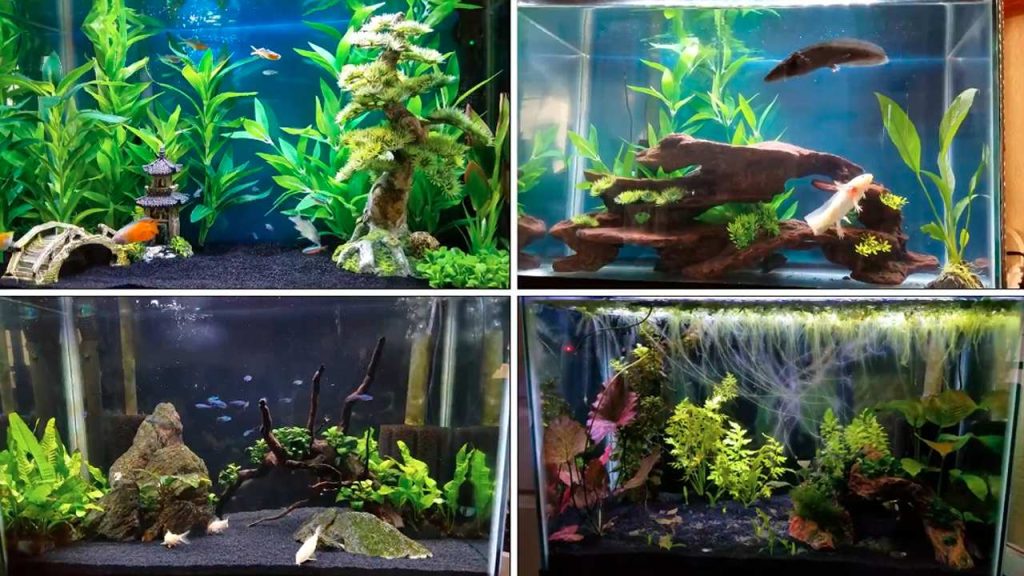
An aquarium’s success does not depend on the number of fish it can accommodate. Healthy aquariums are created with consideration of the shape of the tank, its filtration capabilities, water parameters, swimming room, and adult requirements of each particular species.
Why a 20-Gallon Fish Tank Works Well for Beginners
A twenty-gallon tank provides an effective compromise between stability and portability. It contains enough water to be stable as compared to a small aquarium for your desk, but it is not big enough that it cannot easily fit in your room.
The water quality in a small tank may deteriorate rather rapidly since the amount of water in such a tank is quite low. More volume of water in the twenty-gallon aquarium will give you additional time to recognize any signs of high levels of ammonia, unusual behavior of your fish, or temperature changes before the problem gets serious. A bigger area will provide your fish with more space for swimming and better gas exchange on the water surface.
However, you have some flexibility when choosing a design of the twenty-gallon aquarium since you can have a planted community, a single peaceful school of small fish, colorful shrimps, or even a one-species aquarium. But remember that your tank does not represent unlimited space since the substrate, decorations, equipment, and plants take a lot of space.
Understanding 20-Gallon Fish Tank Dimensions
The two most common models are the 20-gallon-long aquarium and the 20-gallon-high aquarium.
| Tank style | Approximate measurements | Best use |
| 20-gallon long | 30¼ × 12½ × 12¾ inches | Schooling fish, bottom dwellers, and planted layouts |
| 20-gallon high | 24¼ × 12½ × 16¾ inches | Tall plants, centerpiece displays, and limited floor space |
Depending on the brand of 20-gallon fish tank you choose, the exact dimensions may differ slightly from one another. Once the aquarium is filled up and arranged, the weight of the structure, including water, substrate, rocks, and other equipment, can exceed 225 pounds.
For community fish tanks with beginners, I recommend using the 20-gallon-long fish tank. The advantage of such an aquarium is that it offers more room for the horizontal swimming of active fish, as well as providing the extra floor area for bottom dwellers and easy arrangement of plants.
The high model of the aquarium is also good to use when there is not much place available on the floor of your house.
Beginner-Friendly 20-Gallon Fish Tank Ideas
Low-Tech Planted Community
An easy planted community tank is among the easiest 20 gallon fish tank ideas that should work well for those planning to establish their aquarium for the first time. Plants that are easy to grow include java fern, anubias, crypts, water sprite, and floating plants without the need for advanced technology or injections of CO2.
Choose one small school of fish in the middle section of the tank, but add any suitable bottom feeders only when you have enough room on the ground of the tank. By keeping some open spaces in the aquarium, you enable the fish to swim comfortably and avoid making it look congested.
Whenever I am designing an aquarium of this kind, I use plants and hardscape at the sides and back of the aquarium and leave an open space for the fish to swim in the middle section.
Male Guppy Display
Having only males in the tank will provide the beginner guppy tank with vivid colors and continuous movements without the population problems that tend to arise when both sexes of the guppies live in the same environment. Living plants, smooth rocks, and dark background may help highlight the colors even more.
As guppies are quite social and active fish, they need to be kept in the appropriate school and not alone. The stocking ratio for guppies depends on their future size and amount of waste produced and not on their apparent size at purchase time.
Though there is a great temptation to have all color varieties in one tank, the carefully chosen smaller number of guppies provides a better view. Moreover, a moderate stocking level will also make feeding and changing water easy to manage.
Betta-Centered Planted Aquarium
A planted 20-gallon tank would make an excellent home for a single betta fish. Wide-leafed vegetation, floating cover, shady spots to rest in, and minimal water flow contribute to creating a cozy environment for the fish where it could swim around without being pushed about by the water.
It is important that there is only a single male betta in the aquarium since the fish are quite territorial and would try to attack each other. Some bettas can live peacefully with other fish, and some cannot, so no assumption could ever be made.
In my opinion, one should start with the betta and see how it acts before thinking about anything else. Maybe a snail or another peacefully acting species would work.
Pygmy Cory Bottom-Focused Tank
A twenty-gallon-long aquarium will serve as a good substrate for housing the social community of pygmy coryns. The fine sand, smooth woods, shady spots, and dwarf plants will ensure that the small catfish have a chance to hunt for food and swim around.
The pygmy corys should not be housed singly, since they feel safer and exhibit natural behavior when living in a community. It would be reasonable to start with six individuals or even more for a more active life of the group in a sparsely populated aquarium.
The pygmy corys should not be considered as cleaners. They need their own balanced diet and cannot survive only on leftover food from other inhabitants.
Cool-Water White Cloud Aquarium
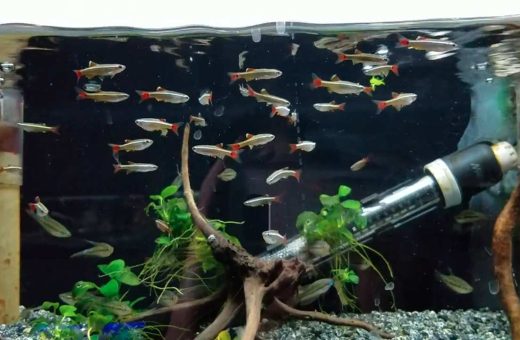
The white cloud mountain minnows put up a very dynamic show with a natural and realistic look compared to many tropical community tanks. An elongated tank with rounded rocks, swimming area, and plants on the back wall suits them perfectly.
These fish are social by nature, and as such, they need to be kept in a proper school. Their active behavior also makes an elongated tank more suitable than a narrow one with limited horizontal swimming area.
The water temperature should be slightly cooler than the optimum for many tropical fish. That is why it is important to combine them with fish that will do well under similar conditions.
Shrimp Garden
Even though the planted shrimp tank is going to be relatively small, it can stay dynamic and interesting all day. The presence of moss, plants with narrow leaves, caves, and leaf litter inside the tank creates grazing zones for the shrimp as well as gives the young shrimp hiding places.
The sponge filter is an excellent option for this tank, since it provides good water circulation without sucking little shrimp into its intake. I would let the tank develop before introducing the shrimp to it.
Blackwater-Inspired Display
The blackwater-style aquarium features dark substrate, wood from nature, dim lighting, and tannin-stained water. Dark aquarium-safe botanicals could be used along the sides and the rear of the tank while providing clear passage through the middle part of the tank.
Such an aquarium needs to be designed around fish species suitable for soft and acid water. Check the water parameters and then choose appropriate fish species without resorting to excessive use of chemicals for lowering water pH to desired values.
Minimalist Rock and Plant Layout
A minimalist aquarium does not involve using everything to fill all the empty spaces. Just a couple of firmly placed stones, plants of one or two kinds, and a simple background will give a better result than placing all kinds of ornaments haphazardly around the aquarium.
It is important to use smooth, aquarium-safe rocks, arrange them properly before adding any fish to the aquarium, and place heavy stones on a solid base, not on gravel which can shift under fish digging.
Such an aquarium suits colorful fish very well since their beautiful colors will be highlighted by the plain background.
Single-Species Schooling Tank
In a single-species aquarium, only one small schooling fish is included rather than a collection of a variety of unrelated fish species. Usually, a greater number of identical fish will make a more natural appearance than a number of smaller groups that compete for space.
It is important to keep the design consistent with the behavior of the selected fish. In general, shy fish will enjoy the presence of plantations at the edges and on the surface of water, while more energetic fish require an unobstructed route horizontally across the aquarium.
The maintenance of a single main species makes the process of feeding, choosing temperature, managing the parameters of the water, and compatibility much easier for beginners.
Simple Natural Aquascape
Natural aquascaping can be easily made using sand, one attractive piece of wood, some smooth stones, and a number of durable plants. The design is versatile, inexpensive, and easy to modify according to the development of the plants.
In my view, it is better to place the main piece of wood not in the center but a little off it. Such deviation adds dynamics to the design of the aquarium.
Choosing a 20-Gallon Fish Tank Stand
The ideal 20-gallon fish tank stand has to be able to bear the entire weight of the aquarium without any form of flexing or wobbling. The conventional furniture is sturdy but not necessarily made to bear more than 200 pounds on a particular area permanently.
The stand has to be flat and water-resistant and have enough space to provide the entire base of the aquarium, following the guidelines of the manufacturer. The tank has to rest completely on the stand without any overhang.
The 20-gallon long fish tank stand has to cater to an aquarium measuring 30 inches in width, while a stand for a high aquarium has to measure around 24 inches in width. It is thus more prudent to verify the actual measurements rather than just basing the choice on gallons.
Do not keep the aquarium where it can get direct sunshine, exterior doors, vents, speakers, and high foot movement. This will help in minimizing temperature fluctuations, unwanted growth of algae, and bumping of fish.
Selecting a Filter for a 20-Gallon Fish Tank
The right filter for 20-gallon fish tanks will be able to take away debris, have room for bacteria growth, and move water while not making more movement than is tolerable by the fish. The right filter is one which is suited for the livestock, not just the gallon rating found on its packaging.
A good start will be to select a filter that can move the total volume of the water four times within an hour. For a 20-gallon tank, this would mean a flow of 80 gallons per hour or more, although heavily populated tanks might need extra power while tanks with shrimp or bettas will need low flow.
Good options include:
- Hang-on-back filter for a regular community tank.
- Sponge filter for shrimp, baby fish, bettas, and other situations where you need low flow.
- Internal filter in case you do not have enough room behind your tank.
Never choose filters only because of their gallon ratings. Other important factors are media capacity, water flow, debris creation, maintenance requirements, and fish habits.
Using a 20-Gallon Fish Tank Kit
An aqua tank kit of 20 gallons can help when making the first purchase because it will include the tank, lid, lighting system, filter, and sometimes a heater. It could be more affordable to purchase all the components in one package than to buy each item individually.
Nevertheless, even a full package might miss some necessary components that will be required to make an ideal aquarium. Such components as a thermometer, water conditioner, liquid test kit, substrate, siphon, net for catching the fish, timer for lights, and appropriate heater should be purchased additionally.
One should pay attention to the filtering system, which is usually included in the package, since the basic filtering system may work great in a sparsely stocked tank but not in the tank with many fish.
A Reliable Setup Sequence
- Position the empty stand, make sure it is level, and then put the aquarium on top.
- Wash the substrate, rocks, and aquarium-safe decorations using fresh water without ever using soap.
- Put in the filter, heater, thermometer, lid, and lighting system.
- Put fresh, conditioned water in the aquarium and check for any leakage from the aquarium.
- Go through the fishless nitrogen cycle while testing for ammonia, nitrite, and nitrate.
- Start adding the livestock only when the filter bacteria have been well-established.
An active biological filter eliminates waste products in an aquarium using the nitrogen cycle process. In a balanced aquarium, the ammonia and nitrite levels will be zero while nitrate will be controlled by moderate stocking, good feeding, plant development, and partial water changing.
If you introduce all your fish at once, they will put too much pressure on your new filter. Slowly introducing the livestock allows the bacterial colony to develop according to the amount of waste produced in the aquarium.
A Manageable Maintenance Routine
Do a partial water change every week, changing approximately 10-25% of the water. Use a siphon to extract waste in open areas of the substrate. Increase the percentage of changed water if there is an increase in nitrate levels or heavy stocking in the aquarium.
Reusable filter media should be rinsed only when the water flow starts to become weak or the debris increases in quantity. Rinsing should be done using water taken out of the aquarium since untreated tap water might destroy the beneficial bacteria residing in the filter.
Feed moderately, take out dead leaves, and inspect the equipment and your fish daily. Breathing difficulties, closed fins, fast respiration rate, peculiar hiding spots, lack of eating, or strange behavior indicate water problems or fish stress.
Common Beginner Mistakes
Overstocking is still one of the biggest problems with beginner aquariums. The adult size, movement, sociability, territoriality, and the amount of waste produced have much more significance than how many juvenile fish you could actually fit into the aquarium.
Other common errors consist of adding fish to the tank before cycling the aquarium, replacing all filter media at once, overfeeding, keeping the lights on for too many hours, keeping incompatible fish species together, and putting the aquarium on inappropriate furniture.
Do not make more than one major change in your tank simultaneously. If you clean the substrate thoroughly, replace the filter media, move all elements of the aquascape, and change the majority of water on one day, your aquarium may become unstable after being fine before.
Final Note:
Successful 20-gallon fish tanks start with a well-thought-out and realistic plan. It consists of selecting the shape of the tank, deciding on the design of the tank, researching each species, and giving enough space to the fish to grow to their full size.
One of the most versatile aquariums is the planted 20-gallon long community aquarium, but the betta display aquarium, the shrimp garden, or the guppy aquarium can be equally interesting. Regular maintenance and stable water conditions will bring more benefits than expensive decoration.

About the author
Chloe Adams
I'm Chloe Adams, a beginner aquarium expert and writer for Stardexa with more than 11 years of experience in the field of fishkeeping. As many beginners find aquariums hard to comprehend, I've kept learning, practicing, and sharing all the basic information from choosing the right aquarium to cycling it, filtering it, feeding the fish, and taking care of water quality as well as maintaining it regularly. My aim is to ensure each novice fishkeeper knows how to turn his/her aquarium into a pleasant and healthy habitat for fish.
Reader Fishkeeping Feedback
Comments, questions, and aquarium reviews
Share your aquarium experience, ask a fish care question, or write a helpful note about tank setup, water quality, filters, algae control, or maintenance for other readers.
No aquarium reviews yet. Be the first to share a helpful review on content or fishkeeping question, setup tip, or care experience.