
How to Set Up a Freshwater Aquarium for Beginners
To start a freshwater aquarium for beginners, begin with selecting an appropriate tank size and then placing the aquarium on a sturdy flat surface. Add rinsed substrate, decor, filters, heater, thermometer, and water. Let the aquarium complete its fishless cycle before bringing fish into it.
What most beginners do wrong is adding the fish immediately after setting up their tanks. A new aquarium should be allowed time to grow its beneficial bacteria that will help eliminate the toxic fish waste. When the aquarium is tested and found to have zero levels of ammonia and nitrite in its water, it is relatively safe to start adding the fish.
A 20-gallon-long aquarium is ideal for beginners because it is easier to maintain stability compared to very small tanks and also allows the fish some room to swim around.
Why a Proper Freshwater Aquarium Setup Matters
The freshwater aquarium is far more than just an enclosure filled with water. It is a dynamic system that requires fish, plant life, bacteria, filtration, water temperature, food, and water conditions to interact successfully.
If a tank is assembled in a rush, fish can fall victim to water parameters, rapid temperature change, stress, overcrowding, or ammonia poisoning. Proper aquarium assembly will allow you to avoid any of these problems in advance.
There are several factors that ensure successful assembly of a beginner aquarium:
- Water temperature stability
- Clean, prepared water
- Reliable filtration
- Completed nitrogen cycle
- Gradual fish stocking
Once you accomplish these steps, you will find keeping your aquarium easy and enjoyable.
Best Aquarium Size for Beginners
Most individuals believe that a small aquarium will require less maintenance. But this may not be the case since water parameters will change quite quickly in smaller tanks.
A tank that is just a little bit bigger will provide more stability and give you more leeway to make adjustments.
| Aquarium Size | Best For | Beginner Friendliness |
| 5–10 gallons | One carefully chosen fish species or shrimp tank | Less forgiving and harder to stabilize |
| 15–20 gallons | Small freshwater community tank | Good option for beginners |
| 20-gallon long | Small community fish, plants, and easier upkeep | Excellent beginner choice |
| 29–40 gallons | Larger freshwater community aquarium | Great if you have enough room and budget |
The most recommended size is 20 gallons long since it will offer the fish more swimming space and will keep water parameters more stable than a tiny aquarium.
But when deciding on the size of the aquarium, one must remember that water is quite heavy. Thus, the table where you place the aquarium should be able to handle the weight.
Freshwater Aquarium Supplies Checklist
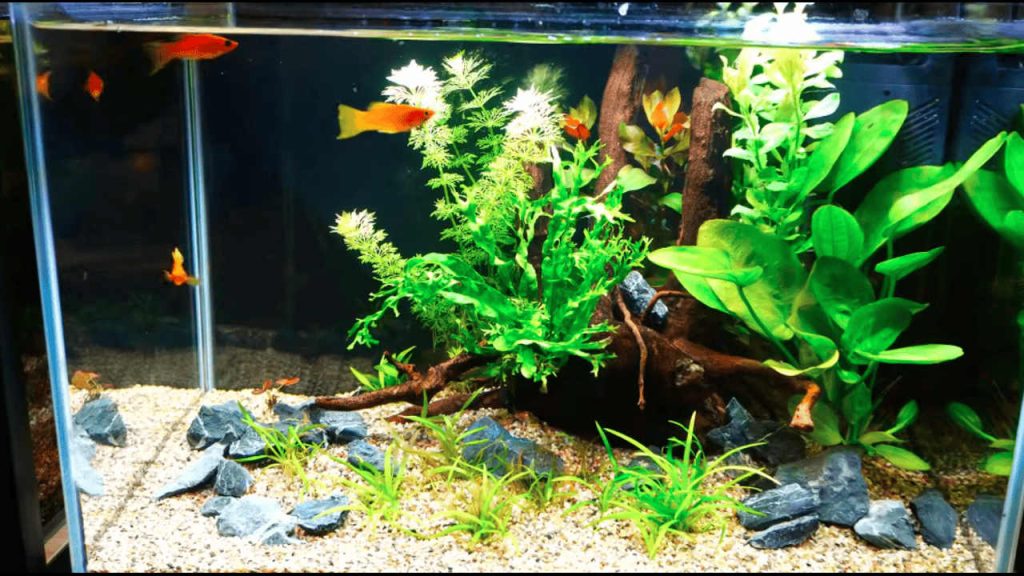
Prior to creating an aquarium setup, make sure you have all necessary items at hand. It will make the process easier and help prevent last-minute rushes.
Essential Freshwater Aquarium Equipment
- An aquarium and a sturdy aquarium stand
- Aquarium lid or hood
- Aquarium filter equipped with biological filtration media
- Aquarium heater adjustable for tropical fish
- Aquarium thermometer
- Aquarium light
- Gravel or sand for the bottom of the tank
- Aquarium water conditioner/dechlorinator
- Aquarium water test kit
- Gravel vacuum or siphon
- A bucket that will be used exclusively for aquarium water changes
- Fish net
- Proper fish food for your particular fish
- Fish-safe rocks, caves, driftwood, or ornaments
- Live or artificial aquatic plants
Helpful Optional Supplies
- Light timer
- An air pump and an air stone
- Algae scrubber
- Beneficial bacteria starter kit
- Aquarium background
- Plant fertilizer for planted aquariums.
- A small quarantine tank for new fish
Never clean your aquarium equipment with any type of dish soap, detergent, bathroom cleaner, or scented chemical substance. Even a tiny trace is toxic for fish.
Step-by-Step Freshwater Aquarium Setup for Beginners
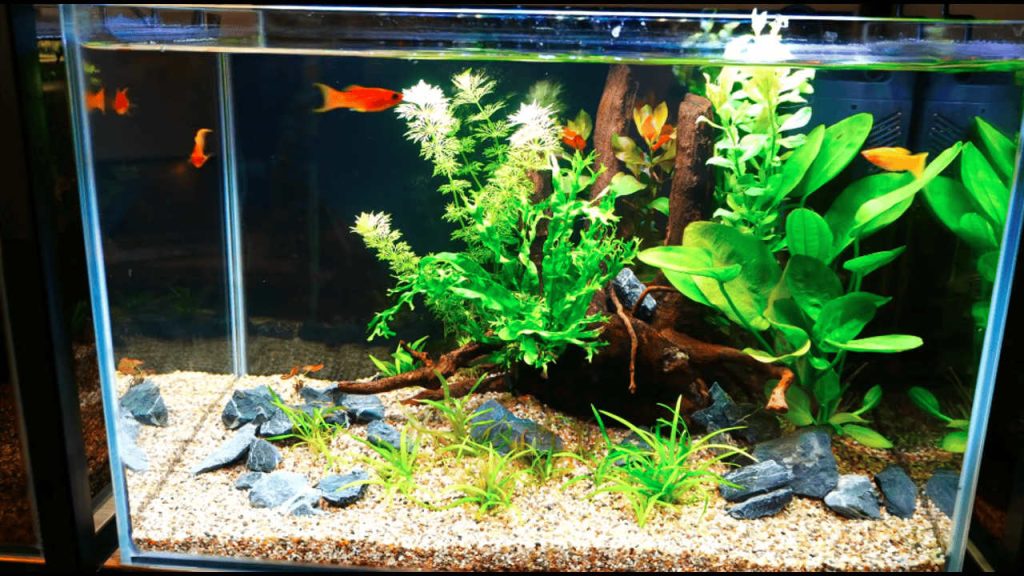
Step 1: Choose the Right Location
Select a spot for the aquarium prior to filling it with water. It will become very heavy once it is filled with water and must not be shifted then.
Your aquarium should be placed in a place that provides the following:
- A sturdy and flat surface
- Proximity to an electrical plug point
- Space behind the aquarium to accommodate cables and equipment
- No sunlight falling directly on it
- No strong winds coming from any source
- Low chances of collision
Do not set the aquarium near a window where sun rays can fall. It will encourage algae growth and increase the temperature of the water rapidly.
Step 2: Rinse the Tank and Check for Damage
Rinse the empty aquarium only with clear water. Soap, detergents, and any other types of house cleaning products should not be used.
At this stage, examine the aquarium thoroughly for any cracks, chipped glass, broken edges, and loose silicon seal. If you want to perform an extra test, you can fill the empty aquarium with water and let it stay there for a short period of time.
When you have made sure that the aquarium does not leak, drain the water out of it and go to the next step.
Step 3: Add and Rinse the Substrate
The substrate is material that lines the bottom of the aquarium and consists of rocks, sand, soil, or any other substance that is safe for fish.
For beginners, the best option for the substrate is aquarium gravel, as it is easy to wash and is suitable for many freshwater aquariums. The other good option is a sand substrate.
Wash the substrate thoroughly with clear tap water till it becomes almost dust-free. Avoid using soap or chemicals.
Approximately one to two inches of substrate should be added on the bottom of the tank. It is also possible to raise the level somewhat towards the back of the tank for a better arrangement.
Step 4: Add Decorations and Plants
While the aquarium is being filled with water, put your rocks, caves, driftwood, artificial plants, or living plants in the tank.
Besides creating a beautiful appearance, they provide shelters for the fish and places where the fish will be able to find cover, rest, hide and explore the tank.
Only those items which are created specifically for the aquarium should be used. Sharp or rough elements may damage fish’s fins and may trap them.
A basic set-up for beginners may consist of the following design elements:
- Taller decorations at the back
- Clear swimming space in the middle of the tank
- Shorter decorations at the front of the aquarium
- One or more hiding spaces for timid fish
Living plants add to the natural look of the aquarium and utilise the nutrients from the water. On the other hand, living plants require lighting and some care.
Step 5: Install the Filter, Heater, Thermometer, and Light
Now it is time to set up your aquarium equipment following the manufacturer’s instructions.
The filter must be working around the clock, as it will provide constant water circulation and give a chance to beneficial bacteria to thrive there. Consider choosing a filter appropriate for the size of your aquarium or a bit larger than it.
In case you have planned to keep tropical fish, buy an adjustable aquarium heater. Place the thermometer on the other side of the tank to check the evenness of water temperature in the aquarium.
Also set up the aquarium light. It is useful to use a timer since it will provide a regular day and night schedule to both fish and plants. The excessive lighting is a perfect environment for algae development, whereas the uneven one can harm fish and plants.
Important Electrical Safety Tip
Always create a drip loop with your aquarium cords. You should let the wire dangle under the electrical outlet before plugging it in. Thus, you prevent water from getting into the electrical outlet through the cord.
Moreover, remember not to switch on a heater unless it is totally submerged in water.
Step 6: Fill the Aquarium With Conditioned Water
Place a small bowl, plate, or a plastic bag above the gravel before adding water. Add the water very carefully to it, thus preventing the displacement of substrate.
With each use of tap water, use a water conditioner. Tap water may contain such chemicals as chlorine and chloramine, which may be dangerous for fish and beneficial bacteria.
Fill the tank almost to the top, leaving enough space for the lid and all other devices. When the tank is filled with water, turn on the filter, heater, thermometer, and light.
Let the water stand and stabilize its temperature, and then start the process of cycling.
Step 7: Cycle the Aquarium Before Adding Fish
Cycling is one of the most important steps in setting up a freshwater aquarium for beginners.
Beneficial bacteria are crucial for the proper operation of the aquarium. Fish waste and uneaten food form ammonia, which may turn out to be toxic. Beneficial bacteria convert ammonia to nitrite, while other bacteria convert nitrite to nitrate.
The Aquarium Cycle in Simple Terms
- Fish waste and uneaten food form ammonia
- Bacteria transform ammonia into nitrite
- Another set of bacteria convert nitrite into nitrate
- Water changes will control nitrate levels
The best way to start for beginners is to use the fishless cycling method. In this case, you will develop beneficial bacteria before introducing fish into the tank.
How to Know When Your Aquarium Is Cycled
Your aquarium is usually ready for fish when:
- The ammonia level is 0 ppm
- The nitrite level is 0 ppm
- The nitrate level is low but present
- The temperature of the water is constant
- The pH level is stable and appropriate for your fish
Cycling typically takes a few weeks. Do not base your assumptions only on the number of days that passed. Test your water and determine when your aquarium is ready.
Step 8: Choose Compatible Beginner Fish
When you know your tank has successfully completed its cycling process, then start to select fish that will thrive in your tank environment.
Never select fish simply because of how good they look in the aquarium shop. Most fish will turn out to be a lot larger than you expect. Others will need to stay in shoals. Some fish will have unique water requirements; some fish can get very territorial against other fish in your tank.
When selecting fish, first do research on:
- Adult size
- Minimum tank size
- Water temperature preferences
- pH and water hardness requirements
- Behavioral characteristics
- Compatibility with other fish
- Schooling/shoaling fish or not
- Diet and lifespan
Never rely on the outdated one-inch-of-fish-per-gallon principle of fish selection.
Step 9: Add Fish Slowly
Even if the cycling process is completed, do not overcrowd the tank with fish. Too many new fish will generate more waste products than your biological filter can process.
Choose just several fish that can live together. Observe the readings of the water test kit and the fish feeding and behavior for some time before adding any more fish.
After buying fish from a pet shop:
- Switch off the lights on your tank
- Float the closed bag of fish for about 20-30 minutes
- Gently use the net to put the fish in the aquarium
- Do not pour water from the pet store into your aquarium
- Reduce the lighting in the aquarium for the rest of the day
This gives the fish a calmer transition into their new home.
Step 10: Follow a Simple Aquarium Maintenance Routine
Care for a freshwater aquarium is necessary, but that does not mean it has to be hard. Smaller, more frequent jobs are always easier than cleaning or fixing problems after they happen.
Weekly Aquarium Care Routine
- Ensure your fish are alive, healthy, and feeding
- Check the water temperature
- Check the water quality if necessary
- Scoop up any uneaten food
- Wipe off algae from the sides of the aquarium
- Change about 10% to 25% of the water
- Treat the new water
- Use a gravel vacuum to clear away dirt slowly
Monthly Aquarium Care Routine
- Check filter flow
- Clean the filter intake if necessary
- Check the heater and thermometer
- Prune dead leaves of plants
- Check the growth of fish to see if they need more room
- Inspect for old equipment, leaks, and broken connections
Never change all filter media in the aquarium at once unless you have good reason for doing so. Bacteria are found within the filter itself, as well as the substrate and the rest of the aquarium. Changing too much may disrupt the aquarium.
Common Freshwater Aquarium Setup Mistakes to Avoid
Adding Fish on the First Day
For the new aquarium, time is required for the growth of bacteria, which are helpful for the survival of fish. Adding fish too early may harm the fish because of ammonia and nitrite present in the water.
Use of the tank, which is too small
It appears to be easy to use a small tank; however, it is not. This is because the water temperature may change quickly. A moderate-sized tank is recommended for beginners.
Skipping the Water Test Kit
Water that seems clean may have problems like ammonia, nitrite, nitrate, and pH problems. To avoid serious problems, a water testing kit should be used.
Overfeeding Fish
Overfeeding is one of the common causes of poor water conditions. The extra feed decomposes and generates waste material in the water.
Only give fish as much food as they consume within minutes. All uneaten food should be removed from the aquarium.
Overstocking the Aquarium
Having too many fish makes it difficult for the filter and helpful bacteria to handle all the wastes. Fish should be added slowly with consideration of their future size.
Cleaning the Entire Tank at Once
Do not take out all the water, change all filter media, and clean all surfaces at once because this practice will kill too much good bacteria and destabilize the entire aquarium system.
Ignoring Temperature Requirements
All fish do not require the same temperature settings. Study the particular species of fish and set the temperature accordingly.
Placing the Aquarium in Direct Sunlight
Too much light in terms of the sun will lead to increased algae development and raise the water temperature too high. Place the aquarium where there is plenty of light but no direct sunlight.
Beginner Freshwater Aquarium Setup Timeline
Day 1
- Select the placement of the aquarium
- Add substrate and other decorations
- Mount the filter, heater, thermometer, and lighting
- Add conditioned water to the aquarium
- Activate all devices
Week 1 and Beyond
- Start the Fish-less Cycling Process
- Check the levels of ammonia, nitrites, and nitrates
- Pay attention to the temperature of water
- Make adjustments where necessary
When the Tank Is Cycled
- Check for zero levels of both ammonia and nitrite
- Select fish that are suitable for your aquarium
- Introduce the fish gradually
- Keep checking the water each time you add new fish
Ongoing Care
- Perform small water changes
- Feed the fish moderately
- Observe any strange behavior from the fish
- Maintain the filter continuously
Important Note:
The optimal method of creating an aquarium for novices would be creating stability before adding the fish to it.
It means choosing a good aquarium, installing appropriate equipment, conditioning the water, cycling without fish, testing the water, and slowly introducing the fish. A thoughtful approach will help avoid many common mistakes.
Quick answers
Frequently asked questions
How can I set up my first freshwater aquarium?
First, place the aquarium on a stable and leveled surface. Place gravel or sand, decorations, a filter, a heater, a thermometer, and conditioned water. Allow the aquarium to finish the cycle without fish, test water parameters, and add fish when ammonia and nitrite levels equal zero.
Should I immediately introduce fish into a newly purchased aquarium?
No, the newly purchased aquarium needs to cycle first. Early introduction of fish might cause exposure to high ammonia and nitrite levels.
How much time will the cycling process of my freshwater aquarium take?
The cycling process usually takes several weeks. The exact time depends on a number of factors, such as the size of an aquarium, its temperature, filtration, cycling technique, and bacteria reproduction. Water testing will provide better results than a certain number of days.
Which aquarium size will be the best choice for a beginner?
One of the best choices for beginners is a 20-gallon long aquarium. The aquarium will give fish enough space to swim and offer more stable water conditions than a very small aquarium.
Does freshwater fish need a heater?
It is true that tropical fish require a heater, as the water temperature is very crucial for their survival. However, there are coldwater fish that have different requirements. It is advisable to read about your planned fishes before buying a heater for them.
How frequently should the aquarium water be changed?
Changing about 10%-25% of the aquarium water weekly will work great for most beginners' freshwater aquariums. The amount depends upon the aquarium size, the number of fish, feeding frequency, and other factors.
Why Is My New Aquarium Water Cloudy?
The reasons for cloudiness could be any of these: presence of gravel dust, bacterial bloom, extra food in the aquarium water, or an incomplete cycle. Let the filter run continuously, don't overfeed your fish, do a water test, and don't make any changes immediately without understanding the reason behind it.
Do I Need Live Plants in My Aquarium?
Live plants are not compulsory for any aquarium; however, live plants are good for aesthetics and may use up some nutrients in the water. These need basic care and proper lighting. You may even use artificial plants in your aquarium.

About the author
Olivia Brooks
I am Olivia Brooks, an expert in freshwater aquariums. Being a fish enthusiast myself, I have learned a lot about how to keep aquariums healthy and very pleasant. At Stardexa, I offer clear and easy-to-read tips on many subjects related to freshwater fish and aquaristics in general. This is what helps fish keepers of all experience levels make better decisions.
Reader Fishkeeping Feedback
Comments, questions, and aquarium reviews
Share your aquarium experience, ask a fish care question, or write a helpful note about tank setup, water quality, filters, algae control, or maintenance for other readers.
No aquarium reviews yet. Be the first to share a helpful review on content or fishkeeping question, setup tip, or care experience.