
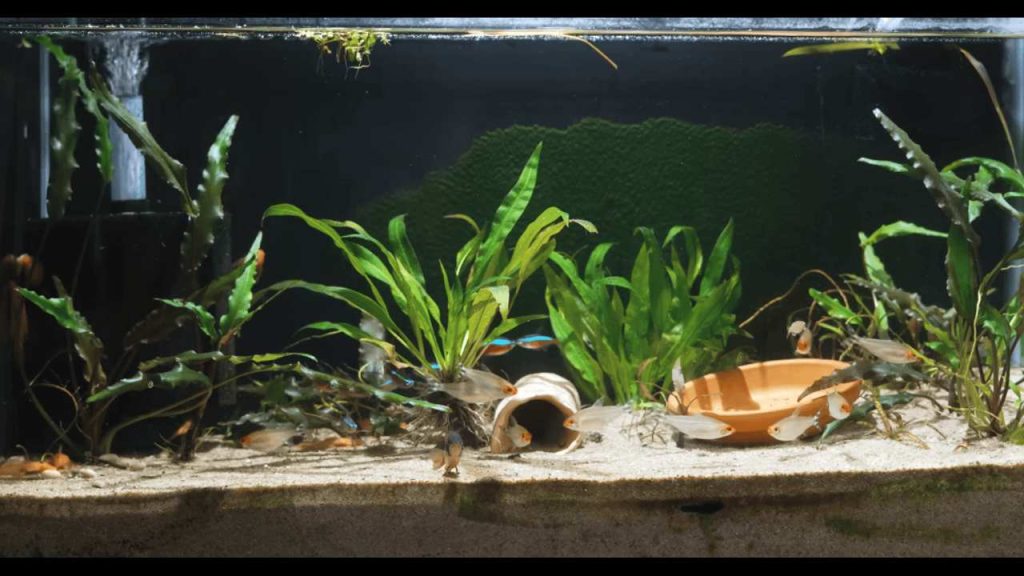
Healthy aquarium plants require five basic elements: proper choice of plants, adequate lighting, proper planting procedure, sufficient fertilization, and proper water conditions.
Beginners will never need strong lighting, special equipment, and a pressurized CO2 system in order to make their aquarium healthy and full of plants. Instead, the best way to proceed with planting is starting from easy types of plants like anubias, Java fern, cryptocoryne, bacopa, vallisneria, and water sprite.
These types of plants are usually easier to maintain than the carpeting or red plants. They can grow successfully in a simple freshwater aquarium provided that you will plant them and take care of them properly.
The example of the good beginner plant setup would be this:
- Select plants that fit into the temperature, hardness of the water, and light in the tank.
- Start with moderate light for six hours a day.
- Plant each type of the plant the way it would grow in nature.
- Feed the plants only if necessary with the use of liquid fertilizers and root tabs.
- Do not redesign the entire setup at once; make small changes instead.
Such an approach simplifies plant care and helps to learn how to take care of plants properly.
The Practical Value of Real Aquarium Plants
Real plants do not only improve the aesthetic view of an aquarium but also create a feeling of its naturalness by giving useful areas for fish, shrimps, snails, and other little inhabitants of the tank.
The plants can give:
- Hiding places for timid fish
- resting places for shrimps and fry
- visual barriers for territorial fish
- places for growing biofilm and microorganisms
- shade for fish who love soft light
- natural balanced design
As the plants grow, they also receive nutrients from the water, some of which come from fish excrement, leftovers of food, and other organic substances present in the aquarium.
Nevertheless, living plants cannot become an alternative to the filter, regular changing of water, cycling the tank, and responsible fish stocking. They provide the balance of the aquarium but should be regarded as its components rather than the whole system itself.
During the process of photosynthesis, the plants transform light and carbon dioxide into energy, and they might release oxygen into the water as well. Sometimes, when certain conditions are met, oxygen can appear as tiny bubbles on the plant’s leaves.
The ideal combination of plants and fishes in one aquarium presupposes the following:
- Cycling biological filter
- Appropriate water flow
- Reasonable fish stocking
- Maintaining the aquarium
- Compatible plants and fishes
When all the elements mentioned above function in harmony, the aquarium will become easier to take care of.
Aquarium Plant ID by Growth Type
It is very crucial for correct identification of aquarium plants since every type needs its own method of planting.
Some types of plants reproduce by rhizomes, while others grow using crowns or runners. An all-in-one approach in planting plants can result in injury of roots, their inability to develop, or even the plant’s rotting altogether.
| Plant type | Identification features | Correct placement | Common examples |
| Rhizome plant | Horizontal stem thickened with roots underneath | Attach on wood or rock without burying the rhizome | Anubias, Java fern, Bolbitis |
| Rosette plant | Leaves grow from one central area | Bury the roots but keep the crown above the substrate | Cryptocoryne, Amazon Sword |
| Stem plant | Leaves grow in a row along an upright stem | Keep some distance between the stems while planting | Bacopa, Ludwigia, Rotala |
| Bulb or lily plant | A new growth starts from a bulb or tuber | Partially bury in nutrient substrate | Tiger Lotus, Dwarf Aquarium Lily |
| Runner plant | New plants grow from runners in a sideward direction | Plant in the substrate while keeping some distance | Vallisneria, Lilaeopsis, Dwarf HairgrassTH |
| Epiphyte or moss | Grows on hard substrates and not in the substrate itself | Tie to rock, wood or aquarium decor | Java moss, Christmas moss |
| Floating plant | Grows floating in the water, with roots dangling in the water | Leave them floating at the surface level | Frogbit, Water Sprite, Dwarf Water Lettuce |
Plants with rhizomes are often injured by novices who tend to bury their thick stems. The roots can stay near or even under the substrate, but the rhizomes themselves need to remain out.
Roost plants have to be planted in such a way that their roots stay under the substrate while crowns remain above it. Otherwise the plant will suffer and can start to rot.
Plants growing from stems are supposed to be separated before being planted. Putting all stems in one place is not a good idea since it reduces light and water circulation around the bottom stems.
Best Aquarium Plants for Beginners
Ideal beginner plants are supposed to be sturdy, adaptable, and easy-to-maintain. They should be able to grow without complicated carbon dioxide or powerful illumination equipment.
| Plant | Best position | Typical light demand | Important care point |
| Anubias | Foreground or midground | Low | Place it on rock or wood and don’t cover its rhizome |
| Java fern | Midground or background | Low | Attach its rhizome to some hard surface |
| Cryptocoryne wendtii | Foreground or midground | Low to moderate | Make sure that its crown is above substrate |
| Bacopa caroliniana | Background | Low to moderate | Pinch out healthy upper shoots and re-plant them |
| Vallisneria | Background | Low to moderate | Leave enough room for its runners |
| Water sprite | Midground, background, or float plant | Moderate | Prune it when it grows too much |
| Amazon sword | Midground or background | Moderate | Nutrition for roots and plenty of room |
| Dwarf aquarium lily | Midground feature plant | Moderate | Give roots nutrition and control of floating leaves |
| Lilaeopsis brasiliensis | Foreground | Low to moderate | Divide it into small pieces before planting |
| Dwarf hairgrass | Foreground | Moderate | Don’t plant it in one large bunch |
Anubias and Java fern are ideal selections for aquariums that have less lighting. Anubias and Java fern also fit perfectly into tanks that have fish disturbing the substrate since they are easily anchored onto wood or rocks.
Cryptocoryne wendtii is a very suitable choice for beginners. Cryptocoryne wendtii is a plant that emerges from the substrate and is versatile in various circumstances, although it loses some leaves when transferred to another place.
Bacopa, vallisneria, and water sprite are the ideal plants to give height to your tank. These plants can also be used to fill gaps in your midsection and background. In place of getting many different copies of an unknown plant, go for some variety of small plants to test the compatibility of the plants with your aquarium conditions.
Aquarium Grass Plant Selection
The name “aquarium grass plant” does not refer to a specific plant species. Aquatic plants having thin and tall grass-like leaves are known as aquarium grass plants.
Some common aquarium grass plants are as follows:
- Dwarf hairgrass: This plant is a short Eleocharis type and is used to make a grass carpet in the foreground.
- Lilaeopsis brasiliensis: A slow-growing plant having narrow leaves is suitable for the foreground area.
- Dwarf sagittaria: This plant produces runners and can make a grassy area.
- Vallisneria: This plant is tall and makes a flowing, grass-like background.
The appropriate aquarium grass plant varies depending upon the position at which it is planted.
The dwarf hairgrass and Lilaeopsis are suitable for the foreground because the Vallisneria plant is much taller and usually used for the background position.
Aquarium grass plants need to be cut into several small pieces before planting. These pieces must be kept some distance apart in order to provide them enough light and water movement. The whole pot is planted at once; then, problems might arise. The internal leaves cannot receive enough light, and the bottom leaves become weak and decaying.
The complete planting of an aquarium floor also requires time. Although lighting and carbon dioxide can help accelerate the process, they will lead to the increased presence of algae and maintenance efforts if the other conditions in the aquarium do not coincide with that.
In the case of a simple aquarium for beginners, a slowly growing grass plant can be easier to manage than carpet grass plants like dwarf baby’s tears.
Aquarium Lily Plant Care
An aquarium lily is one of the plants that can become an interesting addition to any aquarium. Its broad leaves provide an excellent contrast with narrow grass plants, mosses, and tall stem plants. One of the most common aquarium lilies is called a tiger lotus (nymphaea lotus). The leaves of this plant may vary in color and may be green, red, brown, or even spotted.
Aquarium lily plants tend to become large. They may even produce leaves that float on the water surface.
For better growth and control:
- Put the bulb partially into the substrate.
- Do not bury the whole bulb deep into the substrate.
- Use a root tab or nutrient tablet in the vicinity.
- Leave sufficient room for the plant.
- Trim some of the longer leaves before they cover the substrate surface.
- Keep bigger leaves from covering other plants from light.
The aquarium lily plant generally reacts positively to fertilizers placed near the roots. A fertile substrate or root fertilizer is recommended to stimulate healthy growth. To keep your plant compact, you have to cut off the leaves that start reaching the water surface. You should cut the whole stem of the leaf right at the bottom of the plant.
Cold Water Plants for Aquarium Setups
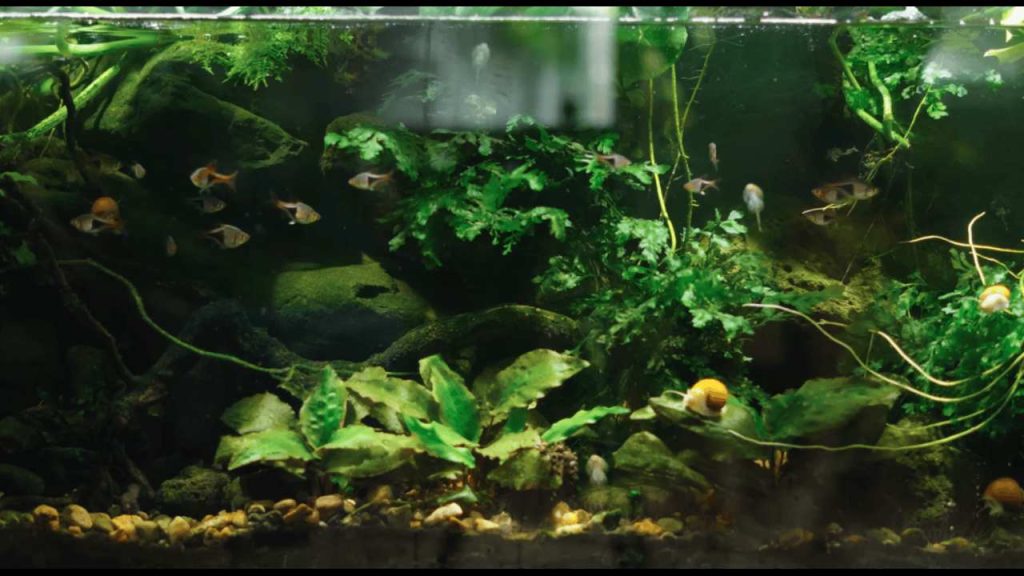
The cold-water aquarium plants refer to the plants that can develop in a cold freshwater environment. Such aquariums are either unheated or kept colder compared to tropical ones.
Some possibilities may include:
- Anubias
- Java fern
- Bolbitis fern
- Crinum
- Vallisneria
- Hornwort
- Certain aquarium mosses
Anubias and Java ferns are sometimes chosen in cooler aquariums due to their durability and suitability for attachment to rocks and/or wood.
Vallisneria and hornwort may also be good choices, although their growth will depend upon exact temperature and water parameters.
“Cold water” is a bit of a misnomer, since all cold-water tanks do not have the same temperature. It’s always advisable to verify the exact plant’s temperature requirements.
It is possible that a plant will tolerate colder temperatures but grow slowly. Also, there might be instances where the plants will cease growing leaves below their optimal temperature.
Behavior of the fish is another important factor to consider. Fish such as goldfish that prefer cool water might pull some plants out of the substrate or eat some softer leaves of some.
In such cases, plants with heavy roots, attachment capabilities, durable leaves, and so on need to be considered.
Aquarium Plants in Hard Water
The hardness of the aquarium water results from the presence of different minerals. These minerals are mostly calcium and magnesium. However, it should be mentioned that the hardness and pH are not the same concepts because hard water may be connected with increased pH.
It is still possible to grow aquarium plants in the water with high hardness. The biggest problem is related to the choice of suitable plants able to grow in the presence of minerals. Such plants are called hardy aquatic species. Among the most popular types of plants in hard-water tanks is vallisneria, which tends to grow easily in alkaline environments and spread thanks to the runners.
Some other hardy plants that can be successfully grown in hard water include the following:
- Anubias
- Java fern
- Bacopa
- Cryptocoryne
- Water sprite
- Guppy grass
- Certain sword plants
However, even if a certain type of aquarium plant is hardy, it does not mean that it can survive in any hard-water tank. Too many minerals, insufficient lighting, poor circulation of water, lack of nutrients, or instability can become obstacles.
Some plant types require softer water and might develop poorly when there are too many minerals in the water. That is why it is recommended to take into consideration the individual needs of plants and not follow the general guide.
The proper hard water strategy should include:
- Testing general hardness, carbonate hardness, and pH.
- Choosing the plants that can survive in such an environment.
- Not making drastic changes to the water conditions.
- Using a few plants at first and not filling the tank entirely.
- Evaluating their progress through the growth of new plants, and not older leaves.
Properly conditioned stable water suitable for your plants is preferred to constant change of the pH and hardness of the water in order to obtain the optimal results.
Best Aquarium Plants Lighting, Substrate, and Nutrients
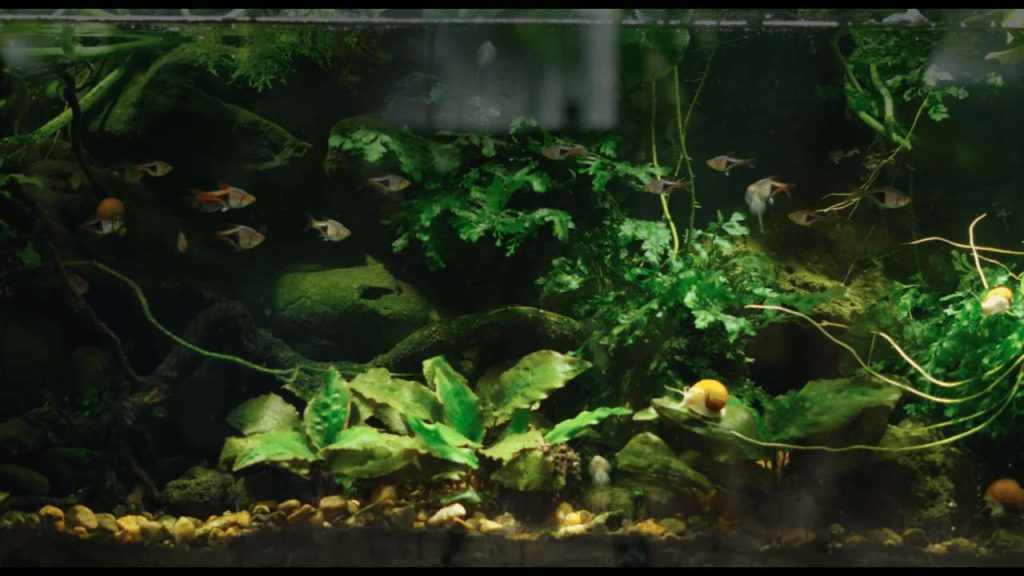
Good development of the plants requires a good combination of lighting, substrate, nutrient content, carbon dioxide, and maintenance. An increase in any of these components will not necessarily mean good development.
Aquarium Lighting
Plants receive energy from the light for their development; however, not every additional light makes the life of plants easier. Excessive light increases the consumption of carbon dioxide and nutrition and may cause algae because of the unused excessive energy from the plants.
Lack of light can result in such problems as the following:
- Slow growth
- Long and thin stems
- Pale leaves
- Insufficient growth
- The death of lower leaves
- Plants’ inclination to light
When starting the planting of a new aquarium, it is recommended to provide about six hours of light per day during the first two-three weeks. Then you can gradually increase the light exposure time if needed. Don’t make any big changes.
The timer can be considered the easiest device for a planted aquarium. It helps to maintain the stability of the light regime regardless of any changes in your schedule. Do not put your aquarium near direct sunlight because it is hard to control.
Aquarium Substrate
Choosing the best substrate for an aquarium will depend on the types of plants you intend to grow. Inert gravel and sand may help keep the roots in place but will have few nutrients to promote plant growth. Rooted plants may require root tabs.
Aquarium soil or planted substrate will have nutrients that may help sustain the rooted plants. Suitable for sword plants, Cryptocoryne, lilies, and carpet plants. Decorative gravel with attached plants may do fine with Anubias, Java ferns, mosses, and similar-growing plants.
The substrate depth will allow rooted plants to thrive, although crowns and rhizomes should not be covered by the substrate. Substrate that is too thin may not be able to sustain larger plants. Substrate that is too thick may trap waste material if not cleaned regularly.
Carbon Dioxide
Carbon dioxide is used by all the plants in their process of photosynthesis, but not all the aquariums require pressurized carbon dioxide systems. Easier plants might grow without the help of carbon dioxide, which occurs naturally in the aquarium.
A pressurized carbon dioxide system will be helpful in growing demanding plants, but on the other hand, it becomes more challenging to use it. Stability of the system is very important and should be taken care of.
Pressurized carbon dioxide can help in:
- Plant carpeting
- Highlight aquascaping
- Demanding red plants
- Plant growth
- Shape formation
But it should not be used as a solution for improper plant placement, unstable light conditions, improper maintenance, and inappropriate choice of plants. An easier low-light aquarium can succeed without injected carbon dioxide.
Aquarium Plant Supplements
There are basically two types of aquarium plant supplements in the form of liquid fertilizer and root fertilizer.
Liquid fertilizers are added directly to the water. They can be used for:
- Plants that float
- Mosses
- Stem plants
- Anubias
- Java Fern
- Other plants that feed from leaves and water
Root tablets or nutrient capsules can be added into the substrate. They can be particularly helpful for:
- Amazon Swords
- Cryptocoryne
- Aquarium Lilies
- Grasses
- Carpet plants
Aquarium plants require macronutrients and micronutrients. But then again, the amount needed is based on the following:
- Amount of plants
- Fish waste
- Lighting intensity
- Substrate used
- Hardness of the water
- Levels of carbon dioxide
- Frequent water change
For beginner aquarists, having one aquarium plant fertilizer should be easier to manage than multiple fertilizers.
Exercise caution while applying fertilizer to aquarium plants:
- Study the instructions on the label carefully.
- Determine the amount of the supplement based on the real water volume in the tank.
- Make sure that the fertilizer does not harm fish, shrimp, or snails.
- Do not use various fertilizers that contain similar substances.
- Do not make more than one change to the regimen at once.
- Be patient; let the plants adjust to the new conditions.
It is normal for the plants to be unaffected within days or even weeks; it will take them some time to react to your efforts to improve their condition.
Step-by-Step Planting and Aquascaping Process
The work on a planted aquarium is greatly facilitated when it is designed beforehand. Here are some tips on designing an aquarium that looks natural and provides sufficient space for each plant to grow.
Step 1: Plan the Planting Zones
Create three sections in your aquarium.
- Foreground – Low plants, carpet plants, moss, and smaller Anubias plants
- Midground – Medium-sized rosettes, rocks, driftwood, and decorative plants
- Background – Vallisneria, tall-stemmed plants, swords, and water sprite
Not every inch of the substrate should be covered by plants.
Free spaces will help your aquarium balance and give space to swim freely for the fish. You will find it easier to clean and trim your plants. Think about the mature size of each plant. For example, the small sword plant will grow up to take the whole aquarium.
Step 2: Position the Hardscape
Rocks and aquarium-safe wood need to be placed before fragile plants. The heavy objects must be stable and must not shift due to fish activity.
The hardscape will allow you to create the following:
- Focal point
- Different levels
- Swimming areas
- Covering places
- Natural borders
- Hiding places for rhizome plants and mosses
Don’t place any heavy rock on top of loose substrate unless you are sure about its stability.
Step 3: Prepare the Plants
Plastic containers, baskets, metal weights, and all possible growing wool should be removed. Carefully rinse each plant and examine it before planting it in the aquarium.
Look for:
- Damaged leaves
- Rotten roots
- Algae
- Snails
- Snail eggs
- Broken stems
- Soft bulbs
- Unhealthy tissue
Plants in pots can usually be split into several smaller plants.
Tissue culture plants should be carefully rinsed and cut into small pieces prior to planting. Dead or severely damaged leaves should be removed. Roots of healthy plants may be slightly trimmed where necessary.
Step 4: Plant by Growth Type
Differing plants need to be planted differently.
- Rhizome plants have to be attached to the wood or rocks.
- Stem plants should be split and planted with some space between them.
- Rosette roots should be buried with the crown remaining above the substrate.
- Aquarium grass plants have to be divided into small pieces.
- Lily bulbs should be partially buried in the substrate.
- Moss should be spread on wood or rocks in a thin layer.
- Floating plants should be left floating on the surface.
It is sometimes easier to plant the plants while there is not much water in the tank. It will help the plants stay in place and give you more control. Aquascaping tweezers can be used for planting small stems and grass plants.
Step 5: Fill the Aquarium Slowly
Make sure to fill the tank slowly enough so that water will not stir up the substrate.
Water should be poured on:
- Plate
- Small dish
- Plastic foil
- Clean the bag and put it over the substrate.
Such an approach will make the water flow gentle and will not tear out the plants. Use conditioned water of the proper temperature. Very cold or very hot refilled water can harm the plants and creatures in the tank.
Step 6: Establish the Initial Routine
First weeks will be critical in terms of adaptation.
At this stage:
- Maintain proper duration of lighting.
- Take out fully decomposed leaves.
- Do proper water replacement.
- Replant any stems, which are not stable.
- Make sure crowns and rhizomes are still visible.
- Do not feed the fish too much.
- Add fertilizers only if there is a need.
- Observe the development of new leaves, roots, runners, and buds.
Some old leaves may melt after planting. However, this is not necessarily a sign of a dying plant. Pay attention to the condition of new shoots. The appearance of healthy leaves with appropriate shape and color is a more important factor.
Step 7: Introduce Fish Responsibly
The presence of living plants will not make cycling the aquarium unnecessary. Test the water and wait until biological filtration occurs before putting in too many fish.
Introduce livestock gradually. Overstocking with livestock at once will lead to an excess of waste materials compared to what is possible to filter out. Select fish that fit the planted arrangement. Do not put species that will damage fragile plants unless the aquarium has been created according to their habits.
Plant and Fish Aquarium Compatibility
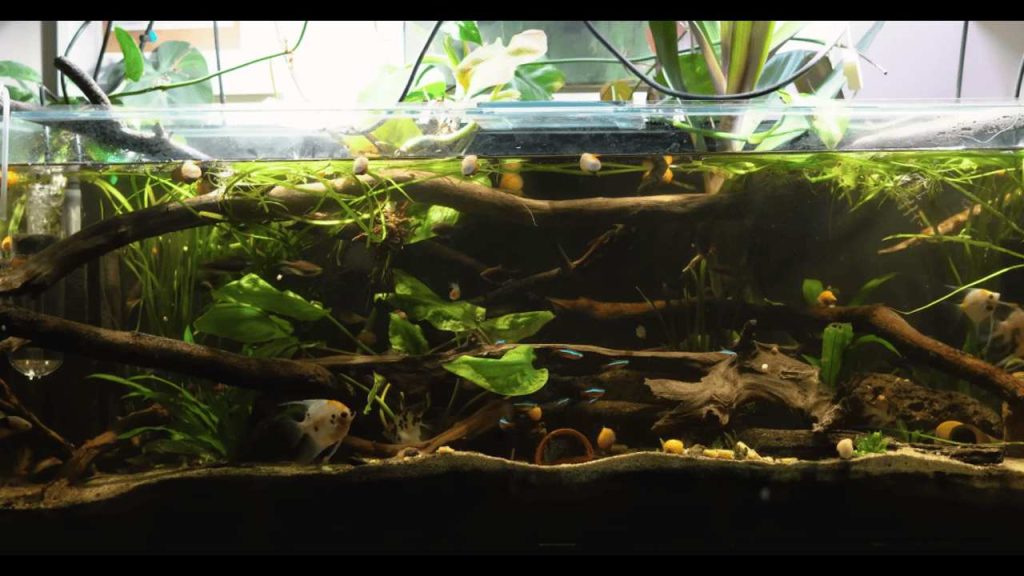
An aquarium with fish and plants has to be designed based on the needs of fish and plants.
When selecting plants, take into account:
- If the fish dig up the substrate
- If the fish eat the leaves
- If the fish need powerful water currents
- If the fish need open spaces for swimming
- If the fish like shadows
- If the water is cold or warm for the fish
- If the water is hard or soft for the fish
Big fish may displace the small plants just from swimming near them. Herbivorous fish may eat leaves. Bottom dwellers may destroy young roots or pull up carpet plants.
When working with tanks where there are aggressive or destructive fish, use:
- Plants on heavy rocks
- Plants tied to wood
- Large rooted plants sheltered by rocks
- Sturdy rhizome plants
- Floating plants
- Empty spaces without delicate carpets
In any case, it will always be better to find suitable plants beforehand rather than replace dead ones afterwards.
Growth Problems and First Corrective Actions
Problems with aquarium plants can be due to more than one reason.
Yellowing of the leaves does not necessarily indicate the lack of nutrients. Holes in the leaves can be caused by phishes, snails, mechanical damage or the lack of nutrients. Melting can occur due to stress, bad planting or the transition from the emersed to the submersed stage.
Always keep in mind the overall picture instead of looking at one damaged leaf only.
| Symptom | Common possibilities | Best first action |
| Newly bought leaves start being transparent or rotting | Change into submersible plants, transplant shock, or damage during planting | Prune all rotting leaves and observe new leaves forming |
| New leaves develop as pale | Unlikely micronutrient deficiency, inappropriate water, or poor growing conditions | Conduct analysis of fertilizer, water, and lights |
| Yellowing of old leaves first | Natural aging or deficiency of mobile nutrients | Conduct feed analysis and prune dead leaves |
| Holes develop in old leaves | Damaged physically, eaten, or nutrient-imbalanced | Check livestock and analyze the whole care regime |
| Stems grow tall with large space between leaves | Low available light or too much shading | First adjust placement, then increase light intensity |
| Algae develops on the leaves | Slow growth rate of plants, long periods of lights, or unbalanced care regime | Prune the leaves and fix the imbalance |
| The carpet plant grows vertically rather than spreading | Hidden lack of light, overcrowding, or unsuitable type of plants | Prune the plants and check whether the type is appropriate |
| The rhizome of the plant turns mushy or black | Buried or damaged rhizome | Uncover the rhizome and cut away any rotting parts |
| Lilies cover the surface of the water | Long leaves have not been pruned | Remove some leaves near the bottom |
| Plants stop growing after multiple adjustments | Multiple changes done at once | Stabilize the tank and change one parameter at a time |
Young leaves contain the most valuable information.
Damaged leaves will still be present on the plants after the initial cause has been fixed. Do not draw conclusions until new leaves appear.
Algae Control Without Damaging Plants
Some algae in the aquarium is usual. Overgrowth with algae occurs as a result of an imbalance between light, nutrients, plant growth, waste products, and aquarium maintenance.
The following measures are to be applied initially:
- Pluck off leaves with a lot of algae.
- Manually clean glass, wood, stones, and equipment.
- If there is an excess of lighting time, then reduce the time of illumination.
- Remove decaying vegetation.
- Change the schedule of water changes.
- Monitor water circulation near thickly planted areas.
- Check the fertilizer application.
- Plant appropriate rapid-growing plants if the aquarium contains no or very little plant mass.
It is necessary not to change everything simultaneously.
Simultaneous changing of lighting, fertilizers, CO₂, filtration flow, feeding, and water parameters does not allow revealing the true reason.
Algae-eating fish, shrimp, and snails can help; however, one should not rely on them completely. Each algae-eating animal has its own needs. Some algae eaters grow big, others need additional feed, and others do not feed on algae that occurs in an aquarium.
Thus, the solution to the problem should be found in improving the balance of the aquarium rather than in using animals and chemicals.
Aquarium Plants Pearling
Pearling in aquarium plants occurs due to the appearance of bubbles on plant leaves. They usually consist of oxygen and arise due to the process of photosynthesis. Bubbles can be situated either on the surface of the leaves or move up through the water.
Pearling becomes more noticeable:
- after the lighting of the aquarium turns on
- during intense photosynthesis
- when the water is rich in gases
- after the water change
- when the leaf or stem was injured
The flow of bubbles from one damaged spot may only be the result of gas coming out of the plant.
Pearling can be considered a good symptom; however, the presence of bubbles does not necessarily mean that all the plants in the aquarium are healthy. Sometimes healthy plants do not show any bubbles on their leaves, especially those growing in a dimly lit aquarium without any additional CO₂ supply.
More reliable symptoms of good health include:
- growth of new leaves
- healthy roots
- growth of runners
- unchanged colour
- strong stems
- species-specific development
- recovery after trimming
- absence of any decay
The growth is much more important than bubbles.
Correct Trimming Techniques
Trimming will help maintain the health of the plant, control its size, and prevent it from covering other parts like sunlight and water supply. This will depend on the type of plant.
Stem Plants
Take a healthy stem at the point above a lower leaf node. The upper portion can then be planted to form another plant, while the lower part will produce side shoots, hence becoming bushier. Cut down those lower stems that appear to be unhealthy.
Rosette Plants
Remove old leaves of the plant close to its base. It is important to note that one does not cut down the center of the healthy leaves directly unless it is clear that the plant will be able to tolerate that method of trimming.
Rhizome Plants
Remove old leaves at the junction with the rhizome. An adult rhizome can now be divided into small parts provided the part has healthy leaves and roots. The new rhizomes must never be buried.
Carpeting Plants
It is important to trim the upper layer gently in order to keep it more compact. Do not leave any floating cuttings since they may drift all over the tank and clog the filter or even start decomposing. Sometimes it will be necessary to thin out thick carpets. The upper layer should not become too thick; otherwise, the bottom plants may lack light and will die.
Vallisneria and Similar Strap-Leaved Plants
All extra leaves should be trimmed near the crown if possible. Cutting all leaves in half will result in the appearance of some dead-looking tips. In case of excessive density, you should trim whole old leaves or runners.
Aquarium Lilies
Long leaves should be trimmed down at their base. It will help to control the surface growth and prevent larger leaves from overshadowing the other part of the aquarium. Small and frequent trims are always better than trimming a lot of plant matter in one go.
Simple Weekly Maintenance Routine
Keeping a very basic schedule each week will help prevent small problems from escalating into bigger issues.
Weekly tasks should include:
- Inspecting both old and new growth.
- Removing all dead/decaying material.
- Cleaning the front glass.
- Pruning plants that obstruct the light/water flow.
- Checking the flow of the filter.
- Completing a proper partial water change.
- Feeding the appropriate dose of fertilizer per directions.
- Replanting any loose stems.
- Making sure that crowns/rhizomes are not buried.
- Noting any important changes.
A simple record for an aquarium would include the following:
- Time of lighting daily
- Amount of fertilizer fed
- Amount of water changed
- Plants pruned
- Water tests done
- New fish/inverts added
- Plant symptoms observed
This helps keep track of what has changed before the problem has occurred.
This way, one does not have to make repeat changes based on assumptions.
Common Beginner Mistakes
The majority of plant issues arise from minor errors in setting up. Knowing about those errors early will help you to avoid wasting money, time, and healthy plants.
Choosing Plants by Appearance Alone
A pretty red plant or a dense carpet may be impressive in photos, but it requires good lighting, carbon dioxide, fertilizing, and constant trimming. Pick the plants depending on your aquarium setup, not only because of their color or form.
Using Excessive Light
Extra lighting doesn’t necessarily lead to quick plant growth. Algae will enjoy the extra light if plants can’t use it. Start with short and constant lighting and extend it if needed.
Burying Rhizomes
Anubias and Java fern tend to rot when their rhizome is buried under the gravel or the substrate. Roots should be buried into the substrate; the thick rhizome should stay above.
Feeding Every Plant the Same Way
Most floating plants derive all of their nutrition from the water. Anubias and java fern are the same. Larger swords, lilies, and crypts usually appreciate additional feeding near their roots. Use the right feeding method for each plant.
Adding Too Many Supplements
The combination of iron, potassium, trace elements, full fertilizer, root tabs, and liquid carbon makes the routine complicated. There are cases when some products have the same nutrients. Use one balanced fertilizer first and add other fertilizers only if you have a clear reason for that.
Expecting Instant Growth
It is necessary to give plants enough time to acclimate. Some will have to grow new roots while others will be able to grow their new leaves, adjusted to the underwater environment. Assess the plant according to its new growth.
Treating All Melt as Plant Death
The plant may lose its old leaves when it is placed in the aquarium. It happens most often in cases when the plant has been growing above water before its sale. If the roots, crown, rhizome, and bulb are still healthy, the plant may revive.
Buying Non-Aquatic Plants
There are many plants that grow above water near aquarium accessories, but they are not real underwater plants. Such plants can live for a certain time under water but sooner or later will weaken and start rotting. Always find out the scientific name of the plant.
Quick answers
Frequently asked questions
What should beginners keep in mind while dealing with aquarium plants?
First, beginners should choose the hardy species and understand how each of them grows before putting it into their tanks. The light must be constant, the crown and rhizome shouldn't be buried, and the fertilizer should correspond to the way of feeding this plant. Consistency is more important than fast growth. Fresh leaves, healthy roots, and continuous growth are the best evidence of proper functioning rather than pearling and quick spreading.
What are the easiest aquarium plants for maintenance?
Anubias, Java fern, Cryptocoryne wendtii, Bacopa, Vallisneria, and water sprite are usually recommended for beginners as the easiest plants to maintain. They are relatively undemanding but, nevertheless, need proper planting, suitable water, acceptable lighting, and good care.
What should beginners remember when it comes to an aquarium grass plant?
The beginners should choose the aquarium grass plant depending on the mature height and specific growing features of the plant. Generally, dwarf hairgrass and Lilaeopsis are planted in the foreground. However, Vallisneria should be put in the background because the leaves of this grass can be higher.
Do aquarium grass plants require carbon dioxide?
No, not all aquatic grass plants require CO₂ injections. There are such species as lilaeopsis, dwarf sagittaria, Vallisneria, and some types of hairgrass that don't require carbon dioxide, but their growth will be slow and less compact. Carpet-demanding plants react positively to stable carbon dioxide levels and strong lighting.
What things should a beginner know about an aquarium lily plant?
The aquarium lily requires a lot of space, root fertilizers, and pruning. The bulb or tuber of this plant shouldn't be planted too deep. Too-long leaves reaching the surface can be cut off when they start shading other plants. A root tab or fertilized substrate may help with growing an aquarium lily.
Are aquarium plant supplements always needed?
Plants will always need nutrients, but there is no need for special aquarium plant supplements in each case. Aquarium plants can get their nutrients from fish food, fish poop, tap water, and rich substrate. Fertilizers become required when there is a visible lack of nutrients or lots of plant life in the setup.
Are root tabs superior to liquid fertilizer?
None of them is better always. Root tabs are used for the cultivation of plants that consume food through roots mainly, if they are grown in sand or gravel. Liquid fertilizer provides nutrition to stem plants, floaters, mosses, and those plants that attach themselves to woods and rocks. Most of the planted aquariums include both techniques in limited quantities.
Can aquarium plants live in hard water?
Yes, most of the aquarium plants can grow in hard water. The most commonly used plants are vallisneria, but anubias, java fern, bacopa, cryptocoryne, and certain types of swords can also be used. It all depends upon the hardness, pH level, light availability, nutrition, and stability of water.
Which cold-water plants are best suited for aquariums for beginners?
The best aquarium plants that will thrive in colder temperatures could be anubias, java fern, bolbitis, vallisneria, hornwort, certain crinum varieties, and mosses. Check the temperature requirements of the specific variety as well as the behavior of fish, which may nibble soft plants.
Is pearling an indication of healthy aquarium plants?
It usually happens when the plants produce oxygen as a result of the photosynthesis process. However, bubbles may appear due to a water change or because of some damage to the leaves. Therefore, although pearling may go together with good growth, it is not an indicator of a healthy state of the plant.
How long does it take for aquarium plants to settle?
It depends on the kind of plant, its condition, light, temperature, substrate, nutrition, and presence of carbon dioxide. Fast-growing stem plants will show results faster. Slow-growing plants like Anubias and most species of Cryptocoryne may need several weeks for new growth to appear.
Do live plants clean the aquarium water?
Although live plants will absorb nutrients from the water and may help to create a balance in the aquarium water, they cannot replace filtration, water changes, feeding, and water testing. Dead leaves should be removed to avoid the accumulation of waste materials in the aquarium water.

About the author
Sofia Khan
I am Sofia Khan, an aquarium lover and author with over 11 years of experience in the field of aquariums and aquascaping. I have a particular interest in creating aquascapes that look natural while requiring little attention. My blog, Stardexa, discusses the importance of fishes and all other relevant topics for aquarists, including all types of aquarium plants, aquascapes, CO₂, light, fertilizer, substrate, and algae.
Reader Fishkeeping Feedback
Comments, questions, and aquarium reviews
Share your aquarium experience, ask a fish care question, or write a helpful note about tank setup, water quality, filters, algae control, or maintenance for other readers.
No aquarium reviews yet. Be the first to share a helpful review on content or fishkeeping question, setup tip, or care experience.